
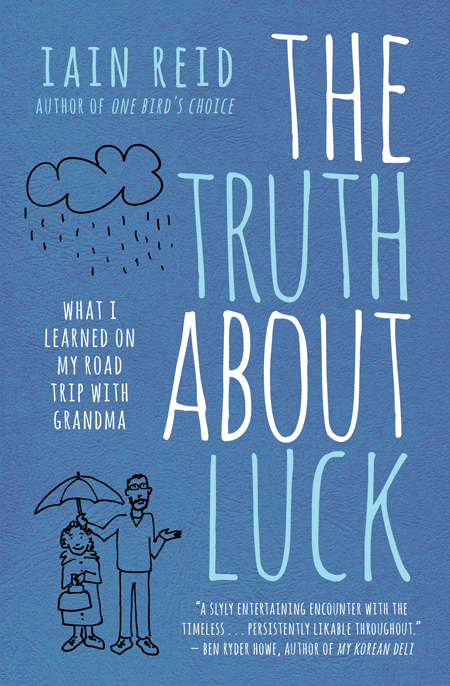
Review | The Truth About Luck, Iain Reid

978-1-77089-241-5_lIain Reid has a gift for getting right into his readers’ hearts. In One Bird’s Choice, he made us fall in love with his quirky, hilarious parents, as well as with a certain bird named Lucius. These characters make an appearance The Truth About Luck as well, but Reid’s second memoir shifts the author’s focus to his adorable, utterly loveable 92-year-old grandmother.

The premise of the book is practically guaranteed to make anyone with a grandmother go “Awww…” When Reid’s brother reneges for the first time on a joint birthday gift for Grandma, Reid decides to take his grandmother on a week-long road trip, gifting her with something far sweeter than a quirky portrait: his time. Unfortunately, for reasons that are unclear to me (finances? lack of planning?), the much-anticipated road trip turns instead into a staycation in Kingston. I do wish I understood better why Reid opted for a staycation instead, especially since the original plan had allowed for the possibility of the grandmother paying for the trip. As it is, I felt bad for Grandma, who’d looked forward to a road trip for months, and had possibly even brought her swimsuit. Worse, Reid admits he had no idea how to entertain his grandmother for a week — a cringe-worthy admission, though admittedly, we’ve all been there.

Reid is endearingly self-aware, unflinching in his portrayal of himself and unafraid to make fun of his own quirks. At times, he tries a bit too hard at self-deprecation — people likely aren’t paying as much attention to his treatment of Grandma as he imagines — but this as well is rather sweet, a heightened concern for his grandmother’s well-being. A wonderfully wry passage near the beginning of the book sums up Reid’s self-deprecating humour pretty well:

I called a friend to see if he had any ideas for me, tips on how to inject some carefree mirth into the trip. He reminded me that I wasn’t really the fun or adventurous one in our group. […] When pushed for which one in the group I was, he used the word egghead and asked what the opposite of an adrenaline junkie was. I wonder if I can offer Grandma a sherry first thing tomorrow morning? [p. 60]

Fortunately for Reid, his grandmother is such a sweet, gracious woman that she genuinely seems as excited over a week in Kingston as she originally was over a road trip. Grandma is the heart of this book, and Reid’s prose is a lovely, loving tribute. The staycation offers him the chance to listen to his grandmother’s stories about her past, a rare opportunity with a woman more accustomed to asking about her grandchildren’s lives than speaking about herself. In a coffee shop, as his grandmother speaks about her life during World War II, Reid notices the other customers busy with their books, laptops and mobile phones, and feels the urge to command them all to listen. Grandma’s life is far too interesting to ignore.

My own 89-year-old grandmother, who has always been a feisty, chatty woman, has recently begun exhibiting signs of dementia. She has difficulty remembering events and recognizing people, and is most comfortable speaking in Chinese, her first language and, unfortunately, one I don’t speak myself. Reid’s book makes me think of all the stories I may now never have the chance to hear, and makes me wish I’d paid closer attention all those times my own grandmother spoke about her past. I remember our trip to China, and my grandmother’s attempts to teach me Chinese, and wish I could remember more of what she taught.

This book then, perhaps more than any road trip, may just be the best, most precious gift Reid could have given his grandmother. Not only will he forever be able to remind himself of her stories, but he has also immortalized her past for people who have never even met her. Time and again, his grandmother frets that she is boring him with her stories. Time and again, Reid assures her that he is fascinated. And thanks to Reid’s masterful prose, so are we.

+

Thank you to House of Anansi for a copy of this book in exchange for an honest review.
Review | A Girl Named Digit, Annabel Monaghan

9780547668529I loved the premise behind Annabel Monaghan’s A Girl Named Digit – seventeen year old Digit is a math genius whose ability to recognize numerical patterns leads her to uncover a terrorist plot and she is recruited by the FBI to track the bad guys down. Sure, the premise is far-fetched, but the story had the potential to be a fun, fast-paced thriller with lots of awesome math nerditude.

Instead, we get fluff. Digit’s ability to see mathematical patterns is certainly impressive, but we get perhaps only three instances where this helps the investigation. Most of the time, we get a Lizzie McGuire type character whose reactions to events are immature at best. It’s understandable that Digit wants to try to fit in at school by hiding her mathematical prowess and pretending to be a ditzy Party Girl, but even when on the run with the FBI and free to be 100% Digit, she seems more concerned about kissing the hot FBI agent than about escaping the bad guys. In a publishing industry with such kick ass heroines as Katniss Everdeen, or heck, even Kim Possible, Digit’s lack of common sense is just grating. I understand that not every girl is a Kim Possible, and that the book is meant to be a lighthearted beach read rather than a thought-provoking tome, but seriously: you’re on the run from bad guys known for torturing people, you know they’re planning something soon and they want to kill you before you can stop them, you’re in a cab with a tense FBI agent and a mysterious bag and all you can think of is whether or not the FBI agent will kiss you? Seriously? I don’t care how hot he is, there are somewhat more important matters at stake.

And what was the point of Digit making the stupid decision to keep her (easily trackable!) cell phone when all she did with it was read text messages from a friend about bikinis and the prom? I would understand if she wanted to keep the connection to her real life, and perhaps saw those text messages as comfort, but she just found them annoying. Digit’s ditziness is even more annoying because of her sense of superiority over her school friends — she views them as vapid and thinks she has to hide her own intelligence to fit in. This would be annoying enough if Digit actually showed her smarts, but instead, she just came off like a delusional Mean Girl.

The mystery/thriller part of the book gets woefully buried under piles of rom com, which frankly is more boring than it is witty. Digit’s math skills do come into play at the end, but for the most part, any Hillary Duff or Selena Gomez character could’ve been in Digit’s shoes and it wouldn’t have made much of a difference. The worst part is, the book started off really well. I love the description of how Digit feels compelled to hide her math smarts in order not to seem weird — she was a real, sympathetic character. Unfortunately, Monaghan falls into the Stephenie Meyer trap and sacrifices her intriguing premise to focus on the romance. The book is touted as Da Vinci Code meets Clueless but is more a Disney Channel TV show than anything.

Finally, as with Twilight, the idea that romance is far superior to anything else, including a career, bugs me. In A Girl Named Digit, the FBI agent, John, admits he wants to enter an elite program that will unfortunately prevent him from pursuing romantic relationships or having a family, but will for some reason be even more awesome than being a regular FBI agent. It’s a sacrifice John’s father refused to make so he could marry John’s mother, and good on him for being happy with that decision. My problem is that Digit expects John to give up this dream to be with her. She’s seventeen! And perhaps they really are the loves of each other’s lives, but a couple of weeks of romance is hardly enough for John to give up a lifelong dream. Digit’s heartbroken reaction to this may be understandable, but the shallowness of Monaghan’s writing just makes Digit seem bratty rather than sympathetic.

I love the premise of a young girl using her brains to stop bad guys — we need more brainy heroines, I think. Digit, despite her ability with numbers, just isn’t one of them.

+

Thank you to Thomas Allen Ltd for a copy of this book in exchange for an honest review.
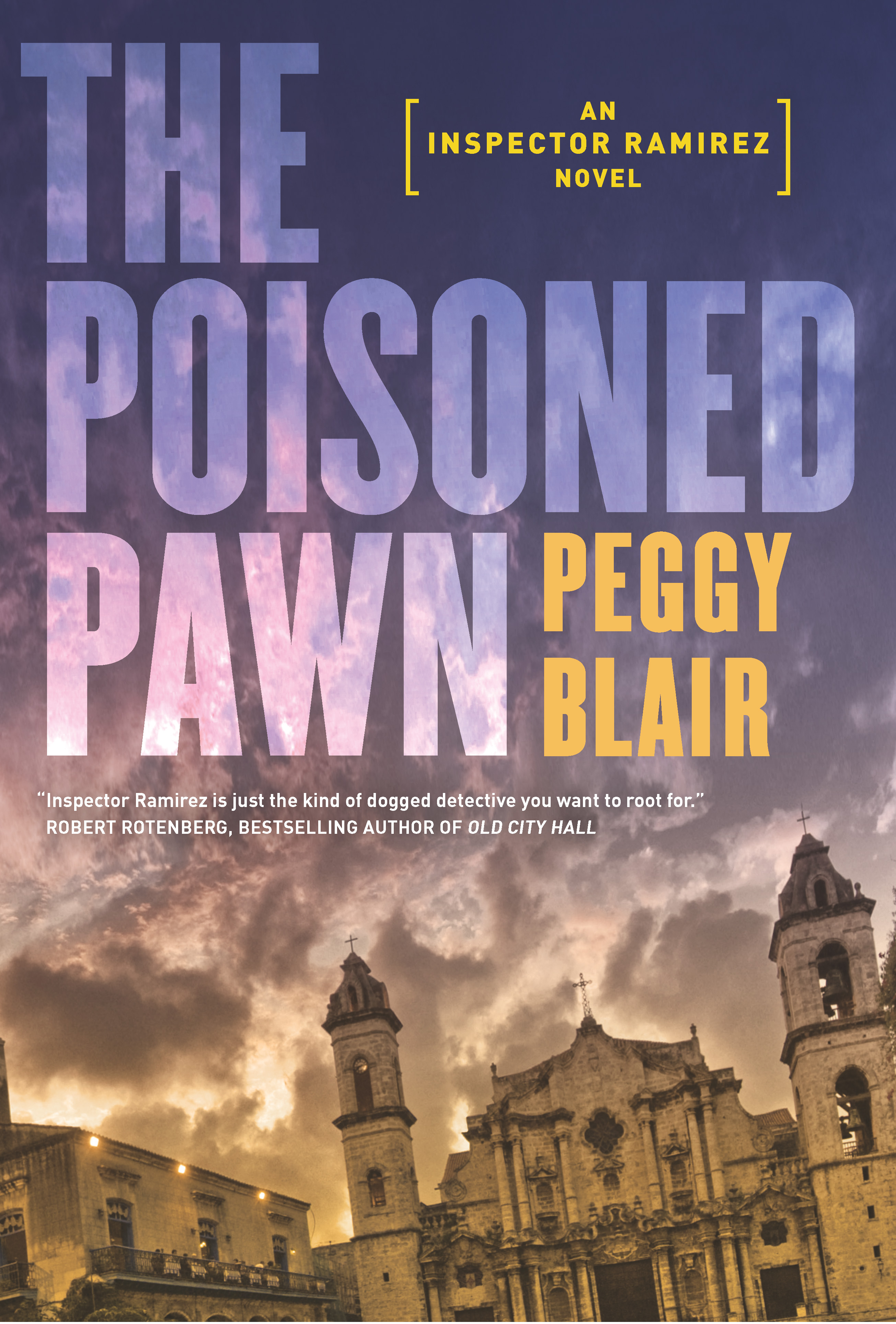
Blog Tour: Review | The Poisoned Pawn, Peggy Blair

blair_poisonedpawn_pbTalk about a timely book! In The Poisoned Pawn, second in Peggy Blair’s Inspector Ramirez series, the Cuban inspector deals with corruption in the Vatican and the injustices faced by aboriginals in Canadian residential schools. Inspector Ramirez is also concerned about his family, with women dying of mysterious causes in Cuba, and Ramirez’s friend and plastic surgeon turned forensic pathologist Hector Apiro restricted by lack of access to the first victim’s records.

Blair’s first book The Beggar’s Opera absolutely captivated me. Inspector Ramirez is a fascinating character — haunted (literally!) by the ghosts of the victims whose crimes he is tasked to solve, worried his sixth sense is a sign of impending death, and above all, an honest man (more or less) who must operate in a corrupt world. While Ramirez sees nothing wrong in lying to suspects during interrogation (“How else will you get them to talk?”), and while he quite openly takes liquor from the evidence room for his staff to enjoy, he also draws the line at taking the cash from the evidence room for himself. He works within the system, yet still maintains a level of idealism in his dogged determination to get to the bottom of the mystery.

I also loved Blair’s depiction of Cuba. Ian Rankin’s Edinburgh and Donna Leon’s Venice reveal the corruption their protagonists have to battle, but in some ways, Blair’s Cuba feels so much more immediate. Perhaps it’s because unlike Rebus, who drowns his sorrow in alcohol, and Brunetti, who is an absolutely upright man, Inspector Ramirez is compromised by and implicated in the corruption. This makes for an interesting dynamic — Ramirez is hardly an anti-hero, but he’s far from a traditional hero either. Rather, he’s all too real, all too human.

Poisoned Pawn takes Inspector Ramirez to Canada, where he must bring home a priest found in possession of pornography depicting Cuban children. Rather than a regular man-hunt, the “hunt” for the priest played out in back-room negotiations and political concessions. Even the more traditional mystery involving the deaths of women was discussed by characters primarily because of how it would affect the tourist trade in Cuba — a much more significant, much less callous concern than it sounds, considering Cubans like Ramirez consider pencils a luxury, and rely heavily on tourism to maintain even the limited rations they are permitted. Despite being set mostly in Canada, Poisoned Pawn delves even deeper into Cuban politics and corruption, and reveals how playing within the system rather than fighting it head-on can score a much bigger victory for the good guys.

The story lends itself well to exploring corruption — the Cuban government probably has nothing on the Vatican when it comes to cover ups and under the table deals. Poisoned Pawn draws parallels between the experiences of Cuban children in Catholic boarding schools and Canadian aboriginal children in residential schools — a well known piece of history made discomforting by the knowledge that still, restitution has not been made.

I didn’t enjoy Poisoned Pawn quite as much as Beggar’s Opera. That may be partly because I read them back to back — after the vibrant, colourful, utterly fascinating Cuba that Blair created in Beggar’s Opera, the no less vibrant but far more familiar Ottawa in Poisoned Pawn felt like a letdown. Beggar’s Opera subverted my expectations and surprised me at almost every turn; in contrast, Poisoned Pawn unfolded pretty much as I expected, at least until the very end. That’s not necessarily a bad thing — rather, a testament to how much Beggar’s Opera raises the bar.

Author Peggy Blair, photo by Alan Dean Photography

Author Peggy Blair, photo by Alan Dean Photography

On the other hand, I think Poisoned Pawn dealt with much more significant issues. It took the framework laid out by Beggar’s Opera and brought some important points to light. While each book can be enjoyed without the other, Poisoned Pawn feels not so much like a sequel, but rather like the second half of a book Beggar’s Opera started. The best part is, the connecting threads are based on larger contemporary issues rather than series-specific plot points.

I do have a couple of quibbles with the book. One is that a key piece of evidence involves a detail that I believe is scientifically inaccurate. I will keep this spoiler-free, so the only thing I’ll add is that it’s entirely possible that it’s a character’s understanding (or my own, to be fair) that is flawed rather than the detail being inaccurate.

[UPDATE – 6 MARCH 2013 – Peggy has kindly invited me to ask her about this in more detail over an email, and then explained that the character involved would have had no way of knowing the proper science behind the detail. True enough — what I had seen as a scientific inaccuracy instead is an unfortunate reality about a certain group of people’s lack of access to information. Thanks, Peggy, for clarifying!]

Another is that when a character, Jones, tells Ramirez about the police officer assigned to work with him in Canada, Jones says, “His name is Charlie Pike. He’s aboriginal.” Again, to be fair, it’s possible Jones (as opposed to the author) had a valid reason to mention that Pike is aboriginal, but it felt out of place to me. It’s a personal pet peeve when characters in books mention details apropos of nothing, just in order for the author to impose a deeper context upon the scene. From the conversation to that point, the detail seemed to come from nowhere, and I wondered — why would Jones even bring it up in the first place? I understand that Pike being aboriginal plays a significant part later on, but it seemed like the detail would’ve been more naturally introduced when he first appears in the story.

[UPDATE – 6 MARCH 2013 – Check out Peggy’s explanation for this in the comments.]

Overall, however, Poisoned Pawn is a really good book that tackles some very important issues. If you loved Beggar’s Opera, you’ll love seeing the story continue to unfold. If you haven’t read Beggar’s Opera yet, definitely check it out. Amazing book — it literally kept me up all night. Poisoned Pawn is paced a bit slower, yet offers more food for thought. Blair has taken Inspector Ramirez on a fascinating journey so far — I’d love to see what will happen next!

+

GIVEAWAY

Thanks to Penguin Canada, you can win a copy of both books in the Inspector Ramirez series! Click on the link below to enter on Rafflecopter:

Win a copy of The Poisoned Pawn, as well as a copy of Peggy Blair’s first book, The Beggar’s Opera! (Canada only)

+

Thanks to Penguin Canada for a copy of this book, as well as a copy of The Beggar’s Opera in exchange for an honest review.