
Review | The Testing, Joelle Charbonneau

Ever since The Hunger Games made it big, publishers have been churning out one dystopian YA trilogy after another. And not just any type of dystopian YA trilogy. Kick ass heroine? Check. Unjust government? Check. Love triangle? Check, unless the author decides she’s too cool for love triangles and fans proudly trumpet the absence of such. It’s almost as if authors and publishers want to cash in on a trend before badly written erotica takes over the market.

Often, the comparison of these trilogies to The Hunger Games is a disservice both to the new trilogy and to Suzanne Collins’ work. To compare any kick ass heroine to Katniss Everdeen discounts the depth of Katniss’s experiences, a level of emotional trauma, of raw, absolutely raw, honesty that I have yet to experience in any of these other dystopian YA trilogies. Similarly, to say a book is like The Hunger Games just because of certain elements is to discount the originality of these other writers and their influences.

9780547959108That being said, you get a book like Joelle Charbonneau’s The Testing and realize publishers and authors aren’t even trying to distinguish themselves from The Hunger Games anymore. I see how jacket artist Sammy Yuen used elements from the story to create the cover, but seriously, anyone else take a look at this and get a sense of deja vu?

Then you get the story: a group of teenagers fight to the death to get one of the twenty spots in University, where a degree will get them a good job and lift their families out of poverty. There’s even a love story, though thankfully no love triangle: during the Testing the protagonist Cia falls in love with Tomas, a handsome boy from her hometown, but can she trust him? A Goodreads review called this Hunger Games: School Edition, and I think that sums it up pretty well.

That being said, I actually really enjoyed this book. Charbonneau writes well, and I found myself almost unable to put it down. I especially love the academic twist on the story — many of post-Hunger Games dystopias have gone for the high action type of battle, likely because that’s a natural page turner. In contrast, The Testing stands out by positing an intellectual battle — in order to win, characters must remember their lessons in mathematics, history and science. And while later stages of the Testing process test the application of this knowledge, the initial stages of competition literally have the teenagers filling out test booklets with essay answers. Imagine if Tris from Divergent had chosen Erudite rather than Dauntless (personally, I’m Team Erudite all the way) — finally, finally, in Charbonneau’s book, nerds get their moment in the sun. It’s not easy to make a scene with teenagers taking tests exciting, but Charbonneau pulls it off. 

My eyes are sore and my body numb with fatigue when I finish and realize the clock is still ticking. Ten minutes remain in the testing period.

Panic floods me. Did I answer the questions too fast? Did my hurrying cause me to give incorrect or incomplete answers? My fingers itch to open the cover so I can fix the mistakes I must have made. And yet, I hear my parents’ voices inside my head. […] Never second-guess myself. Almost always my first instinct will be the correct one. [p. 88]

I have always been a complete nerd, so this scene definitely struck a chord in me. How often have I gone through this exact scene myself? Charbonneau has brought the YA dystopia home.

More significantly, The Testing is a fascinating critique of the academic system and the pressures children face to do well in school. On one hand, it doesn’t really make sense for a government to, as in The Testing, force the best and brightest in the land to undergo potentially lethal tests, possibly even kill each other. Wouldn’t it make more sense to utilize the brainpower of all the smartest people in the country, rather than whittle them down?

On the other hand, I remember well the intense pressure not just to do well in school, but to be one of the best. Real life, thankfully, doesn’t have such deadly consequences… Or does it? I recently read an article about a Chinese man who literally worked himself to death. I also remember hearing horrific stories when I was younger of Japanese students about my age who would literally kill themselves over failing marks. I don’t know how the situation is in North America, but growing up in Asia, the pressure to succeed academically was intense. In some cases, it wasn’t just the pressure to get straight A’s, but rather the pressure to be the top student in the class — academic excellence at the expense of your classmates.

In a chilling moment in the book, Cia’s father warns her that even if she gets to University, some of her classmates might poison her: “Not enough to kill. Just enough to make someone too sick to sit for a test.” [p. 42] I know Charbonneau’s world is fiction, but can I believe this possible? Can I believe as well in the possibility of a government, of institutions in power, actually prizing that degree of killer instinct? Take a look at what politicians are willing to do to win. In the Philippines where I grew up, that means bribery, cheating, sometimes even murder. So yes, I can believe it. And that is why Charbonneau’s book, despite its all too striking similarities to The Hunger Games, is so powerful.

The violence is quick, intense, more like Koushun Takami’s Battle Royale than The Hunger Games in Charbonneau’s almost casual attitude towards the scenes. For example, a mistake with an intellectual puzzle results in a student being impaled in the eye — the students lies on the ground bleeding out while others are forced to stay in their seats until their finish their own puzzles, lest they accidentally view the answers of the other students. Later on in the test, Cia is horrified at having to use a gun, but another student stalks competitors from the shadows with a crossbow, seeming more like a comic book supervillain than even a Hunger Games Career tribute who at least were somewhat humanized by their alliance with other careers. Charbonneau’s humour is almost as dark and horrific as Takami’s, and the horror intensified by the fact that in The Testing, technically, students aren’t required to kill in order to win.

It’s unfortunate that The Testing so clearly owes its genesis to The Hunger Games — the similarities are much too striking to ignore. Because it is a good book, with a much overdue spotlight on intellectual rather than physical battles. It’s an entertaining read, and more importantly, a provocative exploration of academic pressure — how far will you go to succeed?

+

Thank you to Thomas Allen Ltd for a copy of this book in exchange for an honest review.


Review | Dear Life, You Suck, Scott Blagden

9780547904313Scott Blagden takes Holden Caulfield into a 21st century Catholic orphanage in his book Dear Life, You SuckCricket Chirpen’s life sucks. Not only does he have to deal with a name like Cricket Chirpen (when introduced to his girlfriend’s parents, the stepmom thinks she’s being punk’d), he also has a horrible past and zero prospects for the future. He is constantly getting suspended at school for fighting, and despite the efforts of some of the adults in his life, he believes his best prospect after school is to become a drug dealer.

Despite Cricket’s propensity for getting into trouble, he is clearly a good kid at heart. He cares for the Little Ones, younger kids at his orphanage who look up to him, and despite grumbling about it, enjoys entertaining them with wild stories. His crush on Wynona Bidaban is described with hilarious bluntness — Blagden doesn’t shy away from describing Cricket’s poorly timed erections — and his disbelief at her niceness to him is endearing. I love the “Dear Life” letters; they revealed much more about Cricket than he intended, and as such struck me as the most honest sections in the book. So there’s a lot to like in this novel. As well, in a YA book market saturated with dystopian trilogies, it’s almost refreshing to see someone writing contemporary stories with realistic characters.

That being said, there’s also nothing new about this novel. J.D. Salinger said it before, and quite frankly, said it better. Blagden creates a distinct narrative voice for Cricket, one that presumably is meant to be snappy and witty and to convey just how pissed off he is at life. Take the opening paragraphs for example:

The shrinkadinks think I have a screw loose. Ain’t playing with a full deck. Whacked-out wiring. Missing marbles.


Oh wait, I live in the north of Maine now with the moosikins and lahbstahs.


The shrinkadinks think I have a bent prop. Knows in the net. Sap in the chain. Am thin in the chowda.

Blagden certainly maintains the consistency in his narrative voice. The thing is, he falls a bit too much in love with it. Take the opening paragraphs for example. Even from the first paragraph, we get the gist, but then Blagden keeps going. He doesn’t present new information so much as show off his narrative chops. Unfortunately, Blagden doesn’t quite have the skill to get away with it. Unlike the seductiveness of repetition in A Clockwork Orange, which ensnares you so that you barely notice the same phrases are being repeated over and over again, Cricket’s repetitiveness just becomes wearying.

Even the way Cricket refers to people becomes tiresome — he gives so many multiple variations on their nicknames that it’s more him showing off how clever he is at coming up with names than any form of characterization. Poor Mother Mary for example, head of the Naskeag Home for Boys where Cricket lives, is referred to as Mother Mary Mammoth, Mother Mary Monument, Mother Mary Mad-as-Hell, Mother Mary Mockery, Mother Mary Mushroom Cloud, Mother Mary Mafia, and so on… and this is all within a single scene. We get it, Mr. Blagden, Cricket is clever. Now enough.

The other problem is despite Cricket considering a career in dealing drugs, he’s never really believable as a potential drug dealer. Blagden does such a good job depicting Cricket’s vulnerability that he never really comes off as being capable of selling drugs to children. Wisecracks, name calling, even the occasional fight aren’t quite enough, particularly when it’s made so clear that the fight was triggered by a need to protect a younger, weaker boy. Certainly, Cricket has his dark side — he continues the fight past the point of self-defence because of some deep seated anger we don’t fully understand till the end — but overall, his image is that of a troubled teen looking for help. And perhaps because of the strength of his support system — Mother Mary, the Caretaker, his English teacher Moxie, even the Little Ones who look up to him — Cricket’s story lacks the sense of desperation that would have made his story urgent.

Instead, we have a boy that tries too hard to be bad ass, and a novel that tries too hard to stand out. Dear Life, You Suck is actually a pretty good read. Because of the language, it’s a bit hard to get through, but still worth the effort. The moments of tenderness stand out, and the insights revealed by Cricket’s “Dear Life” letters are right on the mark. It’s Catcher in the Rye redux, and while the original is vastly superior, in my opinion, Dear Life, You Suck is a sharp, funny argument that life, in fact, does not quite suck after all.

+

Thank you to Thomas Allen Ltd for a copy of this book in exchange for an honest review.
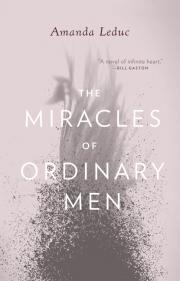


Review | Miracles of Ordinary Men, Amanda Leduc

9781770411111_0Amanda Leduc’s Miracles of Ordinary Men is a lovely, deeply spiritual novel. What can an English professor who doesn’t believe in God do when he wakes up one morning with angel wings? What else, but ask the Catholic priest from his childhood for guidance, a priest who cooks a mean dish of scrambled eggs but is forced to admit that God’s will is as mysterious to him as it is to the professor, Sam. Along with Sam’s story is that of Lilah, a young woman whose brother wanders the streets of Vancouver and who assuages her guilt by allowing herself to be physically and sexually dominated by her boss. Miracles of Ordinary Men begins with a miracle — Sam brings his cat Chickenhead back to life — and turns into an exploration of belief, guilt and the ambiguity of human potential.

I’m not a religious, or even particularly spiritual, person, so it was a surprise to find myself getting really drawn into this book. I credit Leduc’s writing — her language is beautiful, I would even say spell-binding. In describing an experience of physical pain for example, Leduc writes, “She dreams of light that isn’t warm.” I love, absolutely love, that line.

A lot may also have to do with my own Catholic upbringing. Leduc’s story took me back to a time when I believed priests and nuns had a direct line to God and could give me the answers I sought. The story also reminded me of the moment when I realized they didn’t know everything, that spiritual searching, the big question about one’s purpose, or God’s plan, is inevitably a lifelong quest, and may never be answered. Even Sam’s angel wings, which propels the story, isn’t an incontrovertible fact — most people can’t see the wings; they only see rips in Sam’s shirt. Yet for this reader at least, the existence of the wings was never in question; much like Catholicism itself, Leduc’s story demands a degree of faith from the reader. Whether the wings exist or not matter less than whether or not you are open to the possibility that they do. Leduc situates her story firmly in this ambiguity, definitive answers always just a bit out of reach, and because of that, achieves a heightened sense of realism, even within a story about angel wings and demons in human form.

Despite the presence of angel wings, God’s presence in this story is conspicuously characterized by his absence. Leduc makes the wise choice not to let her characters get too embroiled in discussions about whether there is even a God in the first place. Even the atheist Sam is less concerned about finding a scientific explanation for his angel wings than he is about finding a spiritual one. As a result, the question “Does God exist?” is rarely uttered out loud. Rather, it simmers below the surface — every time Sam asks why he has wings, every time the priest admits he knows even less than Sam does — always, always is the unspoken question, the one the characters, and indeed many believers in real life, may be afraid to even dare contemplate.

In contrast, the devil is very much present, commandingly so. In the form of Israel, Lilah’s cruel, domineering boss and lover, evil is as certain and as present in this novel as God is left unclear. Lilah’s sexual relationship with Israel is a metaphor for her own need for penance, and a discomfiting reference to the mostly outdated Catholic practice of penitence through physical mortification. In the Philippines, some people still seek penance through self-flagellation, others through the less extreme measure of walking from one church to another on one’s knees. There’s something liberating in pain, and within the context of assuaging guilt, pain can become almost comforting.

Miracles of Ordinary Men is a novel powerful in its uncertainty, realism within the framework of fantasy. It offers no easy answers, nor does it even establish what the questions are. Rather, the story exists in ambiguity, drawing the reader in and asking, if not for belief, than at least for a mind open to possibilities.

+

I purchased this book at the launch in Ben McNally Books, May 2013. Thank you to the author and the publisher for an invitation to the launch.