
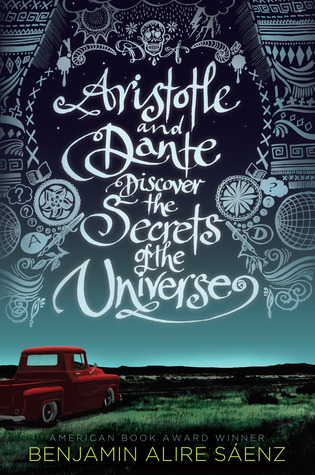
Review | Aristotle and Dante Discover the Secrets of the Universe, Benjamin Alire Saenz

12000020This is by far one of the best books I’ve read all year. It’s a story about friendship and family and all the things people don’t say. It’s about silence, and the consequences of that silence, and it’s told in lovely, heartfelt prose. Saenz’s gift is subtlety — beneath a story ostensibly about a friendship between two Mexican American boys is so, so much more. The prose invites the reader to reach deeper, to attempt to grasp what lies between the lines, and yet the story works because there is so much more than what is within our grasp. Like Aristotle and Dante, we sense the depth of secrets the universe has to offer, and as they eventually realize, we find the answers much closer than we might expect.

One late afternoon, Dante came over to my house and introduced himself to my parents. Who did stuff like that?

“I’m Dante Quintana,” he said.

“He taught me how to swim,” I said. [p. 32]

Ari is a bit of a misfit. He has no friends, literally, and always feels out of place when talking to boys his age. His older brother is in jail, for a crime Ari has never been told; his parents never want to speak of the brother, and his father, a stoic, distant man, is struggling with PTSD from the Vietnam War. So when Ari meets Dante, a friendly, open book of a boy who is casually affectionate with his parents, it almost makes no sense for them to get along, and yet they click immediately.

In both family and friendship, while the connections that form may be easy, the relationships are never quite that simple. The contrast between the boys’ families is sharp, and Ari understandably finds it difficult to trust that Dante’s family’s warmth toward him is genuine. Then an accident alters Ari and Dante’s friendship, and forces both to face things they may have been much more comfortable keeping hidden.

And yet there are consequences to keeping silent, and the characters understand that all too well. The refusal of Ari’s parents to talk about his brother causes Ari to have nightmares, all these memories struggling to surface and yet being held back. Similarly, when Dante gives Ari his sketchbook, which he has never shown anyone else, and Ari refuses to look at it, it’s because of what Ari fears — and knows — he’ll find inside. Each time, not talking about something is the easy choice, and each time, it also turns out to be the more problematic one.

I discovered Aristotle and Dante Discover the Secrets of the Universe at Glad Day Bookshop. I asked the bookseller for the best novel he’d read recently. Without hesitation, he handed me this book. Turns out I’d bought the last copy he had in stock, and I discovered on Twitter the next day that there was someone after me who also wanted to buy it. I read it, absolutely loved it, and recommended it to my sister. Upon reading it, she marked it as a favourite in Goodreads and did a Google search for other books by this author. That’s just the kind of book this is. So read it. I hope you like it, and if you do, pass it on.

Review | Beautiful Day, Elin Hilderbrand

4984cdf8952a88d0371a815d73eca7eeElin Hilderbrand’s Beautiful Day is a fun, soap opera-like beach read. Jenna Carmichael and Stuart Graham are getting married on a beautiful Nantucket beach… What could go wrong? For one thing, it turns out that the bride’s sister is bitter about marriage in general and about her role as the responsible mother figure. She also happens to be having a fling with a much older man. The groom’s parents have divorced over an affair, and subsequently remarried, and the woman who caused the divorce in the first place will be at the wedding with her son (the aforementioned cause of the divorce). Bridesmaids and groomsmen are in and out of each other’s beds, and soon various skeletons in various closets are brought to light. What can I say? Beautiful Day is a fun, absolutely fluffy, ride of a book. Take it with you to the beach and enjoy!

Even better, amidst the fluff and melodrama are some real tender moments. Central to the wedding is a notebook left behind by Jenna’s mother before she passed away. In it, Jenna’s mother writes down her hopes and dreams for her daughter’s wedding — a sweet way for her to be involved even though she is no longer physically around. I admit, my own mother has passed away, and the realization that she won’t be around to see it if I ever do get married is almost too painful for me to contemplate. My mom was a major romantic, much more so than I am, and to be honest, she’d probably have enjoyed the ceremony of my wedding much more than I would have. So Jenna’s mother not being around and instead leaving a notebook for Jenna to refer to did make me somewhat teary-eyed.

I can also see how the notebook, while a sweet gesture, puts far too much pressure on the family. As Jenna’s stepmother points out, Jenna has had hardly a say in her own wedding — everything had already been detailed by her mother. The notebook also, understandably, puts a strain on Jenna’s father’s current marriage — his previous wife is a much more dominant presence than even the bride herself.

There are also moments of sharp social insight. The Best Man’s boyfriend Jethro for example is hyper aware not just of being one of the only two openly gay men on that Nantucket beach, but also being the only black man at the wedding apart from a server and the bandleader. His tongue-in-cheek commentary is funny, and the way some other characters comment on his adding a welcome touch of “diversity” to the wedding is a hilarious bit of satire about the white bread nature of that predominantly upper class resort.

Beautiful Day is just a fun page-turner for the summer. Take it with you to the porch, or to the beach if you’re lucky, and lose yourself in the delightful soap opera of the Carmichael and Graham families.

Review | When We Were Good, Suzanne Sutherland

17076485Remember being a teenager? Remember that all too dismissive word “angst” and the feeling that all these things you’re going through are much bigger and much more significant than adults give you credit for? Suzanne Sutherland’s debut YA novel When We Were Good plunges the reader right into that angst. I don’t know how I would have reacted to the book as a teenager, but as an adult, it did bring back memories of how it is to view the world as a teen. And in a literary landscape where teenage characters are either Joss Whedon sophisticated wits (think of John Green’s teens) or forced by dystopian societies to grow up too soon (Katniss Everdeen and her many succeeding iterations), there’s something refreshing about an author who decides to show teenage angst straight up. Protagonist Katherine Boatman is flawed, horribly confused, and desperate to “be good” without fully understanding what that means.

It takes a lot of skill to pull such a character off without letting her mess of emotions turn the story itself into an emotional mess, and unfortunately first time novelist Suzanne Sutherland hasn’t mastered it quite yet. There’s a lot going on in the novel, and a lot more that the author tries to do, and the result isn’t as tight as it could have been. That being said, Sutherland’s sense of characterization is strong — Katherine comes off troubled and sympathetic rather than melodramatic, and straight edge loud mouth Marie, who admittedly does get annoying at times, actually does sound real rather than a caricature.

This strength is sometimes overshadowed by an overabundance of detail and attempt at verisimilitude. In a scene for example where Katherine cries while grocery shopping, one can almost hear the creative writing professor advise to “show, not tell.” Yet after a couple pages of the physical symptoms leading up to the actual act of crying, I would have preferred the single line: The avocados reminded Katherine of her grandmother and made her cry.

Similarly, many conversations between characters consist of information unnecessary to the plot, and awkward in a way that feels real, but adds nothing to character development. Again, there is the basic creative writing tenet to capture “real” conversation — to be fair, the dialogue does mimic conversations we hear on between teenagers on the bus. However, for conversations on a page, I would have preferred more polish.

Toronto is very much a character in this story. Katherine’s exploration of the indie music scene takes her around the city, and Sutherland takes the reader with her, naming real Toronto streets and landmarks. The Bloor Viaduct, in particular the “Luminous Veil” suicide barrier becomes a potent metaphor for Katherine’s grief. The author hammers home the point a bit too much for the image to keep its resonance, but again, one remembers the overpowering emotion of teenage life, and certainly my teenage self probably would have latched on to that symbol as much as Katherine did.

LGBTQ stories in YA are becoming more mainstream, though still fairly rare. Even rarer, at least from my own personal reading experience, is having a straight edge character — one who stays away from alcohol and drugs and genuinely believes that’s the cool way to live. (or as kids today are more likely to say: that’s the sick way to live) In Marie, Sutherland creates an unapologetically lesbian straight edge love interest. I wish Marie had been given more nuance, and that the development of her relationship with the (sexually confused for most of the novel) Katherine was less abrupt. Still, Sutherland does make a statement by glamourizing the straight edge lifestyle, and one that invites discussion.

When We Were Good is Sutherland’s first novel, and while this does show in her writing, the novel also touches on some really important issues. What does it mean to “be good”? How can a fifty dollar bill be enough to honour a beloved grandmother’s life? How can a teenage girl deal with so many things going on, without allowing herself to be pulled under? Sutherland’s novel explores the overwhelmingly emotional nature of the teen years, as well as its amazing potential to discover new interests and new ways of viewing the world.

+

Thank you to the author for a copy of this book in exchange for an honest review.