Review | The Decision, Penny Vincenzi

What a treat it is to read a Penny Vincenzi novel! The blurb from Daily Express likens The Decision to a “glass of Champagne: bubbly, moreish and you don’t want it to end.” I’ve never read Vincenzi before, but I was in the mood for a Champagne-type novel. True enough, The Decision was like a bubble bath of a book — luxurious, frothy and oh so indulgent.

To be clear, the book tackled a lot of very serious issues as well, particularly women’s rights and the role of a mother. It had its emotional moments, and at times, I was literally outraged at how Matt (the hero) treated Eliza (the protagonist). However, all these were framed within the story of a delightful Mad Men world of fashion, travel and romance. Escapist fiction with big ideas — love it!

To tell you more about The Decision, here’s a video I found on Vincenzi’s website, where Vincenzi herself tells us about the book and reads some excerpts:

Penny Vincenzi – The Decision from BeyondTheBlurb on Vimeo.

(source: http://www.pennyvincenzi.com/thedecision.html)

From the prologue and the back cover, we already know what’s going to happen to Matt and Eliza’s relationship — it won’t work out, and they’ll have a messy custody battle over their daughter Emmie. To my surprise, Matt and Eliza get married almost halfway through my 758-page ARC. Forget any concern about spoilers — the custody battle alluded to in the prologue only about 3/4 through the book, so you’re reading hundreds of pages about Matt and Eliza’s romance, with the full knowledge that it won’t last.

To my even greater surprise, it didn’t matter at all that I knew how it was going to turn out — I still had a great time watching it unfold. A lot of that is because of the world Vincenzi created, filled with fascinating characters you can’t help but root for. Take Eliza, for example. Raised in a wealthy family that just wants her to marry rich and have babies, Eliza prefers to be a successful career woman in the fashion industry. She has a natural instinct for fashion, and I loved watching her organize fashion shoots and come up with ideas for magazine features. It’s a glamourous world, and Vincenzi’s writing just wraps us up in it.

I especially love that despite her ambition, Eliza agrees to give up her career to raise a family with Matt. I didn’t agree with her decision, and in fact Eliza’s reluctance to do so was very evident. However, I love the complexity it added to her character. She wasn’t even a starry-eyed Bella Swan type; rather, she was a mature yet vulnerable young woman, like Julia Stiles’ character in Mona Lisa Smile, who wanted to make her marriage work. I didn’t agree with her decision, and given how unhappy it made her, I couldn’t really respect it, but I did sympathize with it, and with her. I especially, especially love that, even after having made the decision to give up her career, Eliza clearly struggles with it every day. I can imagine how many women in the 60s did face that dilemma, and I love how textured and complex Eliza’s character was.

Then there’s Matt. Ambitious, handsome, with a huge chip on his shoulder about his working class background, he was appealing as he fought to make his way in real estate, and he got annoying when he married Eliza. Team Eliza all the way! That, of course, is me reacting as a woman. Matt’s old-fashioned attitudes about gender roles were very apt for the time period, and I cheered every time Eliza or another woman (usually his sister Scarlett or his business partner Louise) stood up to him.

Beyond the romance, however, the female characters really shone in this book. Louise is an even stronger, more ambitious, woman than Eliza, and her tough negotiation tactics with Matt and other male colleagues made me cheer. You go, girl! Reading about Scarlett’s love life felt like watching a soap opera, and I love the man she eventually ended up with.

The pace slowed down somewhat once we got to the custody case. From a fun, lighthearted read, the book switches over to a more sombre, emotional tone. I was still definitely Team Eliza in the case, and I felt her horror as she looked back at various incidents in her past that seemed innocuous then but that could now lead to her losing her child. I also realized, as she did, the financial impact giving up her career had on her ability to fight her husband in a legal battle. It was horrible seeing the confident, successful woman at the beginning of the novel turn so vulnerable, even broken, in court, and I wished, absolutely wished, that she would be granted custody. I love how Vincenzi pulled together so many minor plot threads from the rest of the book, and made them all relevant to the climactic court case.

The Decision is an absolute treat of a book. It’s a long novel, but the 700 pages zip by really quickly. Vincenzi whisks you away to another world — more exciting and glamourous, and yet more difficult for women — and it’s so much fun just to sit back and let yourself be entertained. I love how engaged I was in the lives of these characters, and how much I either cheered for them or wanted them to go down. The book also made me very, very grateful for all the feminists of the era, who fought hard so that I, and other women, can enjoy all these little freedoms we take for granted.
 

On Finally Reading War and Peace by Leo Tolstoy

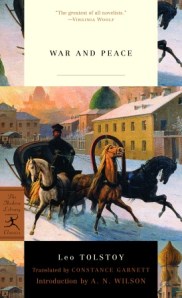
Well, I’ve done it. A couple of years of failed attempts and a couple of weeks of dogged determination, and I’ve done it: I finished War and Peace. How was it? Easier than I expected. Tolstoy’s a master storyteller, and Anna Karenina is probably one of my favourite all-time classics. War and Peace was difficult to get into at first — it felt like dozens of characters were introduced in the first few chapters, and when my sister asked me what it was about so far, I mentioned at least four different story lines before her eyes glazed over and I realized I was narrating the entire book so far instead of summarizing. That’s because I had no clue at that point what the book was about yet; I was too busy juggling all these different characters. My edition (pictured above) didn’t have a family tree or character list in the beginning, so I took out a pen and started marking away. To whomever picks up my copy at a used booksale, I hope my minor notations help somewhat.

After reading the book, can I give a summary? War and Peace is about several Russian families during the Napoleonic War. That really only begins to get into what the book is about, but it’s a start.

Good news — shortly after the war scenes got into full swing, the characters became more fully fleshed out, and much easier to distinguish. To my surprise (given how frustrated I felt at the beginning of the book in keeping the characters straight), I started to feel strongly about these characters. I expected to be captivated by the war scenes, and definitely the stories of friendships among the soldiers were striking. But it was really the drawing room scenes that fascinated me — the romantic entanglements among the main characters could rival The Bachelor in melodrama. An example: Nikolay and Sonya were childhood sweethearts, but Nikolay’s mother wants him to marry a rich heiress instead to help the family’s financial situation. Nikolay thinks marrying for money is reprehensible, yet, to my horror, at one point encourages Sonya to accept another man’s marriage proposal. “WTF!” I wrote on the margin. (To whomever gets my copy of this book, I apologize. I couldn’t help myself.) Don’t worry about having been given a spoiler — with over 1400 pages of storytelling, so much more happens to that particular plot thread.

Sonya’s love life is one of my personal favourite plot threads in War and Peace, but Tolstoy has certainly created a lot of interesting characters. The vivacious Natasha is usually called the heroine, but I’m more intrigued by Princess Marya Bolkonsky, a woman with “a plain, sickly face,” but with beautiful eyes — “large, deep and luminous (rays of warm light seemed at times to radiate in streams from them) […] her eyes were more attractive than beauty.” I love that phrase: “more attractive than beauty.” Oh wow, Mr. Tolstoy. Princess Marya however knows she is plain, and so believes she is destined to take care of her aging father rather than find romance. Fascinating, sympathetic character.

There’s also a touching scene where a married couple throws a dinner party and invite VIPs in order to increase their own social standing. They consider their party a success because it was just like everyone else’s. This couple is probably not meant to be very sympathetic — the woman was shown being cruel as a child — but there was something really pathetic, and sympathetic, about their desire to be like everyone else.

I was somewhat disappointed by Natasha’s attitude after marriage. Spoiler free excerpt:

Every minute of [her husband’s] life belonged to her and their home. [He] was so far under petticoat government that he did not dare to be attentive, or even to speak with a smile, to any other woman; did not dare go to dine at the club, without good reason, simply for entertainment […] To make up for all this [he] had complete power in his own house […] In their own home Natasha made herself a slave to her husband; and the whole household had to go on tiptoe if the master were busy reading or writing in his study. (Epilogue Part 1, Chapter X)

Seriously? From both perspectives, doesn’t that seem a bit stifling? That was also shortly after Tolstoy wrote that the primary significance of marriage was the family: “Natasha needed a husband. A husband was given her; and the husband gave her a family. And she saw no need of another better husband.” Interesting switch on the idea of women as baby machines (in Natasha’s case, her husband appears to be the baby machine), but not very romantic.

Even in the war scenes, I was most fascinated by the characters whose families I’ve read about in the domestic scenes. For example, in one scene, Tolstoy writes that Andrey wasn’t happy about running into someone from his past because of all the memories of his most recent visit home. Details like this make the soldiers real to me, and intrigue me much more than the passages when leaders meet to discuss war strategy or when Tolstoy pontificates about Napoleon and history and the role of chance. Tolstoy does talk quite a bit about his ideas on history, and I can certainly imagine long academic discussions about these passages. However, it was the characters that kept War and Peace real for me.

That being said, a couple of lines from Tolstoy’s essay-like passages struck me as being especially profound:

To the flunkey no man can be great, because the flunkey has his own flunkey conception of greatness. (Part 15, Chapter V)

Why does a war or a revolution come to pass? We do not know. We only know that to bring either result to pass, men form themselves into a certain combination in which we all take part; and we say that this is so because it is unthinkable otherwise; because it is a law. (Epilogue Part 2, VII)

True dat, Mr. Tolstoy.

Review | A Monster Calls, Patrick Ness

I read A Monster Calls by Patrick Ness because of this blog review. I enjoyed Ness’s Knife of Never Letting Go, but as I wrote in my comment to that post, I thought of Monster as just a children’s horror story. The jacket cover just said the monster “wanted the truth,” which I thought could mean practically anything. So, while I admired the art, I had no interest in reading it.

Then I find out it’s about a boy  whose mom is dying of cancer and whose dad has another family in a different country. Far from being a simple haunted house (monster-infested house?) story, Monster is about a monster who forces the boy to face the truth of his situation. What is that truth? You’ll have to read the book to find out. But it’s a truth that definitely, painfully, hit home for me.

I was an emotional mess reading Monster, and I mean that in a good way. It was cathartic, and in a way, I almost wished I’d had a monster like Conor’s, who told me such stories. A bit of personal background: my mother died of cancer last year. Conor’s pain, his anger, his denial — his experiences just felt very immediate. To be honest, I don’t know how this book will affect you. I won’t say anything as pat as that we’ve all experience loss in some form or other, because if there’s one thing I’ve learned this year, the experience of loss is never generic. The book jacket calls the story “darkly mischievous and painfully funny.” I didn’t see the humour, but perhaps, in a few years, I will. My point isn’t that the book isn’t funny, but that it’s so intensely personal that I think it will touch each of us differently. That’s not something I can say for many books.

I was immediately struck by Conor’s first encounter with the monster:

Then the monster paused again.

You really aren’t afraid, are you?

“No,” Conor said. “Not of you, anyway.”

Of course not. Conor has something much more horrible to fear, something much more difficult to fight. There’s a focus that comes with tragedy, a loss of anxiety that isn’t so much courage as it is the realization that, when all is said and done, some monsters are really very minor.

The monster says that he will tell Conor three stories, after which Conor must tell him a fourth: the truth about the nightmare that has haunted Conor for months and that scares him much more than this monster could. I loved the monster’s stories. They had a fairy tale quality, but they also touched on specific aspects of Conor’s life. Like Conor, I wanted to control the way the stories went, and like Conor, I was shocked or thrilled or dismayed at the twists. I’m over twice Conor’s age, yet I had very similar reactions to the monster’s tales. Some situations are just too big, too frightening to handle, and the reality that, even in fantasy, we don’t always get what we want, is painful regardless of age.

Monster goes far beyond the monster’s tales. The scenes of Conor’s real life are even more powerful. As he faces bullies, as he shuts himself away from a former friend, as he repeatedly insists his mom will be cured by her treatments — everything is just raw and immediate and all too relatable. Even Conor’s fear of talking about his nightmare struck home. How often do we cling to denial because admitting something might make it true? The scene where the monster, gently yet insistently, forces him to acknowledge the truth… Amazing.

Monster is gut-wrenching, emotional, even painful. It’s also beautiful, tender, and moving. I don’t mean to make it sound like a heavy, depressing book. Nor do I want to sound cheesy, but it is uplifting. Ness never gets maudlin. The writing is masterfully subtle, and therefore connects even more deeply. Whatever your experience with loss, this book will connect with that part of you.

After one of the monster’s stories, Conor demands to know what he was supposed to learn from it.

You think I tell you stories to teach you lessons? the monster said. You think I have come walking out of time and earth itself to teach you a lesson in niceness?

It laughed louder and louder again, until the ground was shaking and it felt like the sky itself might tumble down…

“I don’t understand. Who’s the good guy here?”

There is not always a good guy. Nor is there always a bad one. Most people are somewhere in between.

Conor shook his head. “That’s a terrible story. And a cheat.”

It is a true story, the monster said. Many things that are true feel like a cheat.

Indeed.