Review | Dr. Brinkley’s Tower, Robert Hough

Dr. Brinkley’s Tower is a lush, beautiful novel about Mexico in the 1930s. The tiny town of Corazon de la Fuente has just survived a long, bloody revolution, the scars of which are beautifully illustrated in the condition of a mirror in the opening scene. A century of the Ramirez family’s use has created “undulations” in the glass and “a spidery hairline crack near the bottom,” but the “real dissolution” is the faint, sour smell that still lingered from the time Francisco Ramirez’s father hid the mirror under fermenting wheat to keep it away from government soldiers during the revolution.

It is easy to lose oneself in Corazon de la Fuente. Hough’s writing portrays the flavour of the small town beautifully. We are overwhelmed with the sights and sounds of the town coming together for a lucha wrestling match, our ear quickly becomes attuned to a natural blend of Spanish and English, and we are absolutely captivated by the fragility of this town’s innocence. At times, Hough gets heavy-handed with his symbolism. For example, a character describes tequila as “the taste of Mexico, captured in a glass.” What an apt, beautiful and evocative metaphor! Unfortunately, I found its impact diminished by the almost overbearing two pages of description that preceded it. That being said, I enjoyed the language overall. The publisher’s description compares Brinkley to Gabriel Garcia Marquez, and while the novel isn’t magical realism at all, there is a strong sense of nostalgia, and the potential for magic, throughout.

Central to the story is the romance between Francisco Ramirez and Violeta Cruz. I love, absolutely love, this love story. Francisco’s Quixotic devotion to Violeta is simply endearing, and I hated Dr. Brinkley before he even appeared, simply because I knew from the publisher description that Dr. Brinkley will catch Violeta’s eye. Violeta is torn between the wild animal passion she feels for Francisco, and the escape from Mexico offered by a relationship with Dr. Brinkley, so while I was rooting for Francisco all the way, I did understand her dilemma. Hough does a fantastic job portraying the town in its socio-economic context. Because Corazon de la Fuente is poor, and poorer still for the effects of the revolution, Dr. Brinkley’s radio tower does appear as a god-send, providing jobs and enticing foreigners with deep pockets to spend money in the town.

I grew up in the Philippines, where many live below the poverty line and, unlike in Canada, there is no social safety net to ensure everyone has food, housing and education. I was struck by how relevant this tale of 1930s Mexico can still be relevant today. After an incident where a contest literally leads to a riot over gumballs, Violeta realizes how much she longs “to live in a place where a simple contest didn’t turn into a showcase for violent degeneracy.” It’s a sad state, yet I remember an incident years ago where people were trampled while trying to enter a contest for money. Poverty leads to desperation.

Also striking is a scene where the Corazon de la Fuente mayor encounters racism in his own town:

– No speeky the Spanish, said a large gringo at the front of the line. – Go back to Mexico…

– I am in Mexico, said the mayor in English. – And you’re in my country, pendejo.

My ARC has that passage underlined and, in the margin, a scribbled “Yay mayor!” It’s an odd form of racism, yet it’s all too prevalent. Growing up in the Philippines, I remember how many skin whitening products are advertised, and also how much more intimidating it is to be berated in English rather than the local Tagalog, simply because the use of the English language is viewed as intellectually superior. I remember a story my aunt once told me, about a sales clerk who signalled for a tourist to jump the queue simply because he was Caucasian. The tourist was embarrassed and refused to do it, but it bothers me that it was the Filipino sales clerk who slighted other Filipinos in the first place. So when I see the mayor of this tiny (albeit fictional) town stand up for himself, I raise my glass to him. One of my favourite passages in the book.

The radio tower Dr Brinkley introduces to Corazon de la Fuente brings progress and prosperity, but it also creates problems. Other than the racism and the increase in homelessness, the radio waves also cause sound to come from metallic objects. It’s the classic debate between progress and purity — does the town sell its soul for a few pesos? — and Hough’s prose has a wonderful, nostalgic, rather regretful tone that makes his stance clear. The cast of characters is colourful. I already mentioned how much I love the mayor and the young couple in love. Also memorable is the cantina owner who goes for Dr. Brinkley’s infertility treatment (extracted from goats!) so he can make love to his wife again — such a charming man! Finally, there is the aging molinero and Laura Velasquez, a plain woman who nevertheless is the heart of the town:

In the workings of a small town, the satisfaction of a person like Laura Velasquez functioned as a sort of inspiration for those who were far luckier but who nevertheless considered themselves to be having a bad day. Her inner peacefulness… functioned as a source of illumination, particularly in difficult times…

I love that a plain woman has such a vital role in the town, and precisely because of her plainness! I also love that the molinero, a Don Juan all his life, sees her beauty, and falls in love with her. It’s a beautiful romance, and one that made me cheer.

Hough makes you cheer for the characters, and for their town, as they struggle against the compromises imposed by “progress.” I especially love how relevant this story feels, even as I felt transported into the past. Above all, I fell in love with Corazon de la Fuente and with Francisco, Violeta, the mayor, at all their neighbours.

AUTHOR Q&A

Stay tuned to my blog tomorrow for a Q&A with author Robert Hough!

WIN A COPY OF DR. BRINKLEY’S TOWER!

Would you like to be transported to 1930s Mexico? Win a copy of Dr. Brinkley’s Tower, courtesy of House of Anansi!

To win, simply comment on this post, and answer this question:

If you could re-visit any place from your past,
where would you go and why?

Contest ends March 22, 2012. (Canada only)

Review | The Infernal Republic, Marshall Moore

Marshall Moore’s short story collection The Infernal Republic is darkly comic, at times downright disturbing, yet in some ways also strangely endearing. Moore’s stories feature characters who, for some reason or other, are alienated from their community, and therefore voice desires that we may censor ourselves from even contemplating. Yet at the root of even the most twisted desires is usually the almost desperate need to connect. Moore’s stories are intense and, when he resists the urge to throw in a surprise twist at the end and just allows the situation to play itself out, his stories are powerful.

Take for example “The Infinite Monkey Theorem,” which attracted me to this collection in the first place. Yahweh and Lucifer have placed bets on the idea that ten thousand monkeys with typewriters will, given an infinite amount of time, be able to re-create the complete works of Shakespeare. The story’s protagonist is Beëlphazoar, a demon tasked with supervising the monkeys and the team of demon guards. I love the concept — it’s absolutely ludicrous! — and Moore amps up the absurdity throughout. For the few thousand years, Beëlphazoar is so bored by his job that he teaches himself Mandarin, then Cantonese and other Chinese dialects. The demons get so desperate they beg Beëlphazoar to count “Some1” and “saxifrage” as words. “This isn’t Scrabble,” Beëlphazoar argues, but even he is soon desperate enough to consider cheating. As his fellow demon Nabob points out, “Boredom is death when you can’t die.”

The story itself kept me laughing throughout, but beneath the humour is the utter despair of all these demons stuck with a thankless, ultimately pointless job for all eternity. If you’re fortunate enough to have never felt that way about your job, watch Office Space. Beyond that is the relationship between Yahweh and Lucifer. Beëlphazoar describes the rift between Yahweh and Lucifer as a “vicious divorce,” and I was struck at the depth of emotion suggested by that term — one deity the spurned party, longing to rekindle the relationship, and the other unwilling to take him back. So when one party looks “crestfallen” at the outcome of the bet and Beëlphazoar suddenly understands what was at stake, I just love all the emotion seething just beneath the lines.

Much darker and angrier than “Infinite Monkey” is “Town of Thorns,” possibly my favourite in the collection. The story is almost painful to read — Michael was the victim of a hate crime and deals with the experience by getting tattoos, which alienates his partner Wade. “The heartbreaks, like the gods, are in the details,” Wade thinks. Michael has changed so much of his physical appearance that the only thing that remains unchanged are his sexual organs. “Why are you looking at my dick like that?” Michael asks, and Wade thinks but is unable to say aloud, “Because I miss the guy it’s attached to.” Just as Michael is having difficulty dealing with the violence to which he’d been subjected (which the cops claim is a matter of bad luck rather than gay-bashing), so is Wade unable to break through the barriers Michael has put up. Michael’s hate, fuelled by pain, is almost palpable, as is Wade’s love, both his desire and his inability to help Michael move on from the experience. We want Wade and Michael to re-connect, to be as happy as they were before the crime, yet we also feel Wade’s helplessness, that maybe things have just changed too much or, worse, maybe Wade had never really known Michael at all. I love the push and pull within this story, the pushing away and the clutching on. This is probably Moore’s most serious story in the collection and, for me, the most powerful.

I also liked the story “Flesh, Blood and Some of the Parts,” about a suicidal teen in a world where children were literally indestructible. How can one kill himself if doctors can easily remove one’s arms? It’s a twisted concept, yet also thought-provoking: how far would you go to prevent someone from taking his own life? Another story has a couple of strangers bonding over a man about to jump off a ledge, while still another has the narrator running over the man he loves and wanting to make love to his injured victim. Both stories very much twisted, and the narrator of the latter story actually psychotic. Yet Moore’s writing is compelling, and while I may not sympathize with the characters, I certainly perceive their obsessive need to connect. I also loved “Still Life with Pterodactyls,” about a man who has the power to make people disappear, but is unable to control it. He is doomed to loneliness, and I love how this is downplayed by Moore’s matter-of-fact recitation of disappearances.

Some of Moore’s shorter stories — about a condo literally ejected from its building or a woman who recruits beautiful young women for supernatural beings — just fell flat for me. They felt gimmicky, and I was left at the end wondering, so what? “The Physical Impossibility of Death in the Mind of Someone Living,” inspired by the Damien Hirst piece of the same name had potential, but also left me with the “so what?” feeling at the end.  “215,” about a house that has become self-aware and whose owners want to convert it to an apartment complex, had an interesting horror-story approach but was a bit heavy-handed with the existentialism.

Infernal Republic is an intense short story collection. Some of the works try a bit too hard to be funny or to have a surprise twist, but many others delve deep into the darkness of human desire. The stories I enjoyed in the collection are disturbing and, more importantly, compelling. The experience of reading this collection is much like the cover image suggests — it’s a wild, unpredictable ride, and like Moore’s characters, you dive deep, looking for something to break your fall.

The Infernal Republic isn’t available on Indigo, but can be purchased on Kindle and Amazon.ca.

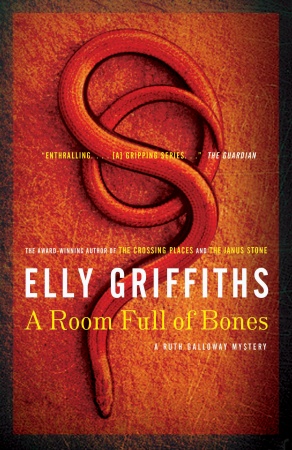
Review | A Room Full of Bones, Elly Griffiths

I’m always up for discovering a new mystery series, so when I heard of Elly Griffiths’ A Room Full of Bones, which features Ruth Galloway, a forensic archaeologist who solves mysteries, I was definitely interested. In Bones, a museum curator is found dead beside a coffin thought to contain the bones of medieval Bishop Augustine. I work in an art gallery, and I’ve always been fascinated by museums and artifacts, so I was excited to see how a forensic archaeologist would use her expertise to solve this mystery.

Unfortunately, I didn’t really see much mystery-solving from Ruth Galloway in this book. Bones is the first Galloway I’ve read but the fourth book in the series, and from this Eurocrime review, I see that Galloway is usually more involved in the actual case. However, I agree with the Eurocrime reviewer that the Galloway storyline in this book focused way too much on her personal life. It’s certainly realistic — as a single mother of a one year old, I can imagine that’ll take up most of her time. As well, I bet long-time fans of the series would be pleased to see so much character development. We learn not just about Galloway as a mother, but also about her complicated relationship with the baby’s father, D.I. Harry Nelson. To be honest, I really felt for Nelson’s wife Michele, and I did enjoy the scenes where she and Nelson struggle to make their relationship work. I also liked that, while Galloway clearly loves Nelson as the father of her baby, she doesn’t seem to be in love with him. I found that an interesting twist to the usual love triangle.

Despite the focus on Galloway’s personal life, there is a pretty interesting mystery in Bones. Galloway does discover a shocking fact about the bishop from the bones, and her expertise is eventually key to solving the curator’s death. I was disappointed that these pivotal elements appeared mostly in passing and I was somewhat disappointed at the way that mystery was resolved.

That being said, there are a couple of other mysteries in Bones — another character’s death and Nelson himself contracting a mysterious disease. These are both interesting puzzles, and I love the cast of secondary characters that we get to meet. The Smith family members are particularly quirky, and I like how the they reminded me a bit of Agatha Christie’s mysteries. We have all these complex characters, each potentially with his or her own motivations to commit a crime.

A blurb at the back of the novel calls Griffiths’ books “atmospheric,” and definitely, Bones contains an element of the gothic. I like that Griffiths never really confirms whether an incident is supernatural or whether it can be explained by science. For one plot twist in particular, Galloway’s friend Cathbad, a Druid, offers a supernatural explanation and drug-induced hallucinogenic solution, yet later on, someone else gives a more prosaic, perfectly rational explanation. This ambiguity adds to the atmosphere. While I found the potentially supernatural elements odd, I never really was sucked deep enough into the story to find them genuinely creepy. Even when someone received a snake that Cathbad says was a curse, I really just thought of it as a snake, despite Griffiths’ ambiguous treatment. That being said, I did have a horrible nightmare the first night I read this book. Perhaps my subconscious was more afraid than I realized.

A Room Full of Bones is a pretty good mystery. I was expecting a bit more of the historical mystery and I would have liked to see a bit more of the forensic archaeologist side of Ruth Galloway, but her personal life does make for an interesting story. I liked learning about the relationships between the characters, and I like how Griffiths made them seem real.