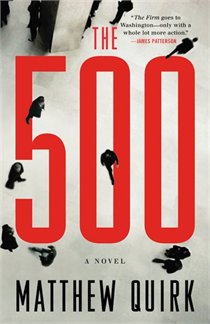
James Patterson compares Matthew Quirk’s The 500 to John Grisham’s The Firm and it’s easy to see why. Just like Grisham’s protagonist, Mike Ford is a fresh-faced hot talent who gets in way over his head in a high-powered career. Quirk takes the premise to Washington — “The 500” refers to the 500 most powerful people in Washington, usually those pulling the strings from the sidelines. Mike Ford has been hired straight out of Harvard Law School to join the Davies Group, Washington’s most powerful consulting firm. The Davies Group mandate is to make things happen for their clients, and that usually entails convincing one or more of the 500 to agree to something. As an ambitious young man raised in poverty and with a con man for a father, Mike’s street smarts provide fresh perspective for the Davies Group, otherwise staffed with privileged intellectuals.
The 500 is more action-packed than I remember The Firm to be. While The Firm, from what I remember, dealt a lot with the protagonist’s loss of innocence and the development of his relationship with his wife, The 500 focuses on the mystery — what are Mike’s bosses hiding? What do they want with an alleged war criminal? Why are they shutting Mike out and can Mike trust them? Unlike Grisham’s protagonist, Mike begins this story no longer an innocent. He has been trained by his father to be a con man, and has since struggled to live on the right side of the law. Unfortunately, his employment at the Davies Group forces him to use his long-suppressed con man skills, first to succeed, then later on, to survive.
Davies Group founder Henry Davies has built his empire on the tenet that everyone is corruptible. There’s an interesting reversal here — the law-abiding “good guys” manipulate people into corruption, and Mike’s old law-breaking “bad guy” acquaintances may be the only ones he can trust. It’s an old notion, and one that I think Quirk hammered home far too much. At one point near the end, just in case we hadn’t gotten the point yet, the narrator makes just that observation. It turns an otherwise fascinating story into a morality tale, and I wish it had been handled more subtly.
I do love the relationship between Mike and his father. Mike has tried his whole life not to become like his father, yet we see early on how much his father has influenced his life. I love the way Mike’s understanding of his father develops — it felt more genuine than Mike’s romance with a co-worker, and added a nice touch of emotion to this thriller. The romantic subplot was okay. At times the love interest felt more like a kick-ass Angelina Jolie fantasy figure — the perfect partner for a con man, who may or may not be trustworthy — than an actual woman.
Overall, the best part of The 500 is the mystery. I love that I couldn’t figure out what the Davies Group was up to, nor could I tell who Mike could trust. More than the Davies Group tenet that everyone’s corruptible, the House M.D. idea that everyone lies holds true in this book. The mystery was fast-paced and exciting, with unexpected twists. A lot of the action scenes and coincidental twists were a bit far-fetched, and would probably work out better on a TV or movie screen than a book. As well, despite the Washington D.C. setting, I would not consider The 500 to be a political thriller — I know there are major political consequences to the actions of the Davies Group, but the narrative was too focused on Mike’s experiences within the company to explore the bigger political picture. That being said, The 500 is a fun read and hard to put down.
+
Thank you to Hachette Book Group Canada for a finished copy of this book in exchange for an honest review.
I can’t say I wasn’t warned. My sister told me about this awesome tumblr where someone live blogs her reading of the Fifty Shades of Grey trilogy. Spoilers abound and yes, her reactions are pretty much spot on. Fifty Shades is as bad as people say, though the good news is, it’s often funny bad rather than boring bad. It’s best read out loud — gather a group of your best girlfriends, track down an available copy at the library (seriously, not worth spending good money on, unless perhaps there are a dozen of you and each only has to contribute a dollar or so), and make a drinking game out of it. Every time Ana bites her lip, every time Christian mutters darkly for no good reason, every time Ana’s subconscious primly purses her lips, every time Ana calls Christian “my Fifty Shades” — drink! You’ll be drunk within two chapters.
Reading Fifty Shades was, in turns, confusing, hilarious, infuriating, and most unfortunately, boring. Rather than write a long, well-thought-out review, I figure it most effective to just talk about plot points and passages that inspired a sticky note-level reaction from me. Fair warning: this post may contain spoilers and explicit material. Caveat: there isn’t much of a story arc to spoil, and there are more explicit scenes in Harlequin novels.
The first chapter (Ana interviews Christian for a school paper) confused the hell out of me. I could not understand Ana’s reactions at all.
[Christian says] “The harder I work the more luck I seem to have. It really is all about having the right people on your team and directing their energies accordingly.”
[Ana replies] “You sound like a control freak.” [page 10]
Huh? How is attributing your success to the people who work for you a sign of being a control freak? I see no reason for Ana’s reaction rather than to give Christian the opportunity to give the double entendre “I exercise control in all things, Miss Steele.”
In that same interview, Ana asks why Christian invests in farming technologies. He replies that it’s to feed those without enough to eat:
“It’s shrewd business,” he murmurs, though I think he’s being disingenuous. It doesn’t make sense–feeding the world’s poor? I can’t see the financial benefit of this, only the virtue of the ideal. [page 12]
Ana, you idiot. Yes, Christian may have a philanthropic side, but to seriously think there can be no monetary benefit to investing in farming technologies?
“Until we meet again, Miss Steel.” And it sounds like a challenge or a threat, I’m not sure which. I frown. When will we ever meet again? [page 15]
If anyone says that to me in a challenging or threatening tone, I won’t bother wondering when we’ll meet again. I’d be making sure we didn’t.
They do meet again, and Christian takes Ana to his home.
My mouth drops open. Fuck hard! Holy shit, that sounds so… hot. But why are we looking at a playroom? I am mystified. “You want to play on your Xbox?” I ask. [page 96]
This is a 22 year old college graduate. She may be a virgin, but she wasn’t raised in a glass bubble.
He steps out of his Converse shoes and reaches down and takes his socks off individually. [page 112]
Show of hands: has anyone ever tried taking their socks off any other way? I know this scene is supposed to be hot, but I kept imagining a male stripper whipping both socks off at the same time like some circus trick. Wheee!
So they have sex, and it actually is getting pretty good. Like Harlequin good. Then this passage:
Suddenly, he sits up and tugs my panties off and throws them on the floor. Pulling off his boxer briefs, his erection springs free. Holy cow… [page 116]
I couldn’t help it: I laughed. All I could think of was, ride ’em, cowboy! Then it gets worse when he puts a condom on:
Oh no… Will it? How? “Don’t worry,” he breathes, his eyes on mine. “You expand too.” [page 116]
I have to admit, it was a fun scene to read. So they continue to have sex, and it starts getting pretty hot again. Then:
“You. Are. So. Sweet,” he murmurs between each thrust. “I. Want. You. So. Much.” [page 121]
Seriously, imagine this scene for a moment. Never mind how sore Ana must be at this point, how sexy is this staccato speech?
Other things that drove me mad:
Ana’s constant lip-biting. Every other page, literally, she was either biting her lip or Christian was telling her to stop biting her lip. At one point, she smiles at another character and realizes she’d been biting her lip without noticing it. Here’s a fun exercise: stand in front of a mirror, bite your lower lip, then smile widely. You sexy thing. (I think I look like a deranged clown doing that, but apparently it turns Christian on.) By the third time or so that Christian “mutters darkly” that he wanted to bite her lip for her, I wished he would just chomp her lips off altogether and be done with it.
Christian’s obsession with food.
“I’m really not hungry, Christian…”
His expression hardens. “Eat,” he says quietly, too quietly.
I stare at him… his tone is so threatening. [page 155]
James eventually explains (kind of, like in one sentence) why Christian has such an issue about finishing food. But at this point, I was hoping for a plot twist where it turns out Christian was the witch from Hansel and Gretel. That would at least explain why he feels the need to threaten Ana to eat.
Ana whispers, bleats, murmurs, squeaks and, my personal favourite, mewls. Does anyone actually mewl in real life? How high-pitched is this girl’s voice? Worse, when she speaks, it’s always with a breathless, “oh my” quality that makes me think: wide eyed little girl. And yes, I meant girl — women, I believe, can speak up a bit more than Ana ever does. In contrast, Christian orders, mutters darkly and smirks. I’m imagining the Phantom of the Opera, except without the sexy singing voice. At one point, Ana wears pigtails, hoping that the girly look will keep Christian from being rough with her. All I could think was, dressing up younger to keep predators away? You can’t be that naive! Honestly, the way that infantilizing her turns him on, I’m thinking this book could’ve taken a much darker turn than James intended.
Ana and Christian’s flirtation over email is actually pretty good. Christian complains that Ana isn’t as forthright in person as she is over email, and I have to agree. Playful e-mail Ana is much easier to take than in-person Ana whose subconscious and inner goddess form a Greek chorus behind her.
I actually felt sorry for Christian. Little as I understand about the BDSM lifestyle, it works for some people, and clearly, for Christian as well. I don’t understand why he would try to fit Ana into that lifestyle when she’s so judgmental, calling him sick and wanting to bring him into the light. Why Ana would stick it out when she so clearly doesn’t enjoy the things that turn Christian on, and why Christian insists on being with her when she keeps making him feel like a total freak, make zero sense to me.
Finally, just for fun, Ana’s friend Jose apparently has a “dazzling toothy all-Hispanic-American smile.” It’s like E.L. James wanted to put the boy-next-door quality of “all-American,” then remembered Jose was Hispanic.
Seriously, if this book were meant as a parody of bad romance novels, parts of it would be downright clever. Instead, Fifty Shades is a parody of itself. I can’t imagine being able to parody a book that seems itself to be a parody, so I was curious how Andrew Shaffer did it with his upcoming Fifty Shades parody Fifty Shames of Earl Grey. His response:
@jacqua83 Inorite? I went in a different direction for the parody, parodying other things as well as that book…
Back to Fifty Shades: it’s not my thing. Granted, I haven’t read erotica before, nor have I read BDSM romance novels. I do read romance novels, and personally think Nora Roberts, Jayne Ann Krentz and Judith McNaught write better romances. For steamy romance, I’ve read better sex scenes in Harlequin Blaze.
Worst part about Fifty Shades is that, despite all the laugh out loud moments, the book becomes boring. The conversations, the flirtations, the sex scenes most of all, become redundant. Ana bites lip, Christian mutters darkly, Ana’s subconscious purses her lips, Ana and Christian have sex, Ana says “oh my,” Ana’s inner goddess dances the merengue or the salsa or the macarena, Christian wants to spank, Ana says “oh my,” Ana’s inner goddess hides behind a sofa. Rinse. Repeat. Over and over and over again. Funny bad tapers off into boring bad, and that’s the worst thing that can happen.
I am glad that I read Fifty Shades. It was mostly entertaining, and while I often wished I had a drink with me, there were enough funny parts to keep me turning the page. Erotic? In over 500 pages, maybe a scene or two. The BDSM scenes were especially un-erotic, partly perhaps because it’s not really my thing, but mostly, I think, because Ana so completely hates it (yet allows it to happen) that these scenes felt more uncomfortable than anything. Romantic? The email exchanges were fun and flirty, but overall, not very. Will I ever read Fifty Shades Darker and Fifty Shades Freed? Out loud, with a group of friends, a library copy and a lot of booze — then yes, possibly.
Personally, though, this may be a much more interesting read.
Or, check out Selena Gomez’s spot-on parody at Funny or Die. Not only did she mimic Ana Steele perfectly, but this video is much more entertaining than the book:
Okay, this book is just awesome. I started reading John Scalzi’s Redshirts before work one day, and almost instantly regretted my decision. Tip: Start it on a weekend, or after work, whenever you have a few free hours, because you will not want to put it down. That evening, watching me walk around with my nose stuck in this book, my sister observed that I was going through it pretty quickly. Yes I was, and it’s because, in my sister’s words, Redshirts hit all my geekspots.
I am a huge geek. I fangirl over Leonard Nimoy (Mr. Spock from Star Trek, for those who don’t know). When I saw this book in the Raincoast Books catalogue, even before reading the description, I immediately thought of Star Trek redshirts and was momentarily embarrassed that I may have confused a serious thriller with a Star Trek parody when I realized I right. Now, if like me, you know why you should never wear a red shirt on an alien planet, stop reading this review right now and find yourself a copy of this book.
Redshirts, as any self-respecting Trekkie knows, are the characters killed off before the first commercial break in the 1960s Star Trek series. Deaths usually occur when the crew beams down onto an alien planet, and they are usually pointless, put in only for some dramatic tension right before the opening credits. But what if the remaining future redshirts realize that there’s something fishy going on? What if they band together and decide to do something about it? In Redshirts, when Ensign Andrew Dahl joins the crew of the Intrepid, he finds out that a low-ranking crew member dies in every Away Mission, and that his more senior co-workers go into hiding every time a high ranking officer enters the room.
The first part of the book is a total send-up of Star Trek, and I suppose, other cheesy 60s science fiction shows. Scalzi’s observations about logical inconsistencies in Star Trek are spot-on, and he mercilessly undercuts them with biting humour yet also with an insider’s wink at the reader that belies the affection of a die-hard fan. To clarify: Redshirts is not just a Star Trek parody, in that it’s not an episode rehash with different names and caricatured details. The book is very much aware of how ridiculous some of its situations are, but there is enough underlying menace that even as we laugh, we realize how serious the situation is for the poor redshirt in it, and we genuinely want him to survive.
On an Away Mission in the first scene, Science Officer Q’eeng reveals that pulse guns are ineffective against Borgovian Land Worms, that in fact, pulse guns send them into a killing frenzy. Ensign Davis, who had just fired a pulse gun at an attacking worm, wonders why Q’eeng didn’t just reveal that very important bit of information during the mission briefing. The scene is hilarious, and we can just see it happening in a Star Trek episode, but we also can’t help but wonder why, indeed, Ensign Davis wasn’t provided with information that could save his life. Along with the hilarity comes the sobering realization that characters you come to care about are indeed treated as alien fodder. Because the story is told from the perspective of these redshirts, they become real to us, and, even as we laugh, we are struck by the unfairness of their situation.
The story takes an unexpected turn when Ensign Dahl and his friends discover the reason behind the redshirt phenomenon and make it their mission to change things. It’ll be difficult to discuss my reaction to the rest of the story without giving away any spoilers, so please excuse my vagueness. (Or, conversely, if what I write makes you guess something spoiler-y, I’m sorry — I definitely don’t want to give anything away.) Personally, with all the mystery and menace built up in the first part of the book, part of me wishes Scalzi had taken it in a different direction, a more straight up, mystery/thriller angle. That being said, I see how his choice actually makes even more sense for this story. While still keeping us on a crazy, hilarious ride, Scalzi’s twist introduces a philosophical angle, and offers us a new train of thought to ponder. I enjoyed the rest of the book — I laughed perhaps a bit less, but the plot remained compelling, and it was an interesting shift in reading experience. As with the first part, however, what kept me reading were the characters — I’d come to care for Ensign Dahl and his friends, and I wanted them to have much more of a life than redshirts usually do.
Minor quibble: You know how jokes have a point where, if you push it just that teensy bit over, it stops being funny? I personally thought Scalzi crossed that point in the last couple of chapters. He was coy enough about it, and smart enough not to belabour the point, so that it wasn’t annoying. As well, in fairness to him, it did fit with the rest of the story. Still, part of me went “meh” at that bit of development.
The novel ends with three codas. I hated the first one, mostly because if the last couple of chapters toyed with pushing the joke a bit too far, the first coda takes the joke all too seriously. I found it tiresome and just tad too self-aggrandizingly clever, and at that point, I wished the book had ended with just the novel. The next two codas, however, are brilliant. The second coda took the novel’s philosophical themes and expanded them by offering a different perspective. The “moral lesson” near the end was a bit too pat, a bit too neatly tied up, for me. It involved a message being delivered, and I wish the contents of the message were just less obvious. Still, other than that “moral lesson”, I loved the perspective provided by the second coda, and the new questions it raised.
The third and final coda, however, totally made the book for me. It took a funny, sometimes philosophical, other times exciting, novel and made it real. The characters felt real enough to care for — as I’ve said, I really wanted Ensign Dahl to change the redshirts’ fate — but the third coda took it to another level entirely. It gave a fully fleshed out story to a minor character, and in doing so, added texture and depth to the story of another secondary character in the novel proper. Definitely one of the best parts of the book.
Redshirts is as hilarious and thrilling as you would expect, but it works because Scalzi takes it far beyond that. Trekkies and fans of cheesy science fiction shows in general will find much to recognize and laugh at in this novel. Non-fans may not have as many knee-jerk laugh out loud moments, but I’d say it’s worth flipping through anyway, just to see if it’s for you. I had such a blast reading this book, and highly recommend it to fellow geeks everywhere. Trust me: it’ll hit all your geekspots.
+
Thank you to Raincoast Books for an ARC of this book in exchange for an honest review.

 James Patterson compares Matthew Quirk’s The 500 to John Grisham’s The Firm and it’s easy to see why. Just like Grisham’s protagonist, Mike Ford is a fresh-faced hot talent who gets in way over his head in a high-powered career. Quirk takes the premise to Washington — “The 500” refers to the 500 most powerful people in Washington, usually those pulling the strings from the sidelines. Mike Ford has been hired straight out of Harvard Law School to join the Davies Group, Washington’s most powerful consulting firm. The Davies Group mandate is to make things happen for their clients, and that usually entails convincing one or more of the 500 to agree to something. As an ambitious young man raised in poverty and with a con man for a father, Mike’s street smarts provide fresh perspective for the Davies Group, otherwise staffed with privileged intellectuals.

 Literary Treats