
Review | Tigers in Red Weather, Liza Klaussmann

I’m not quite sure what I feel about Liza Klaussmann’s Tigers in Red Weather. The book jacket compares it to the work of F. Scott Fitzgerald (“tempestuous elegance”) and Patricia Highsmith (“dark suspense”), and those are pretty big shoes for any book to fill. Yet when I started the book, I agreed absolutely, at least with the Fitzgerald comparison. The first few chapters of Tigers, told from Nick’s point of view, are indeed as lushly evocative as The Great Gatsby. Set in the 1940s, these chapters utterly transported me to a different world, a different era, where women wore gloves and drank martinis in lounge cars. In one of my favourite passages, Nick and her husband Hughes treat themselves to dinner in a restaurant far above their means. Because the food is so expensive, Hughes says they can only afford “two martinis and a bowl of olives and celery.” The “urbane 21 Club” boasted among its clientele Humphrey Bogart and Lauren Bacall, and Nick and Hughes happened to be seated at the table where Bogart and Bacall had their first date.

“Oh, Dick, let’s given them the table.” The woman was laughing again. “Are you two lovers?”

“Yes,” said Nick, feeling bold, sophisticated. “But we’re also married.”

“That’s a rarity.” The man chuckled.

“Yes, indeed, it is,” the woman said. “And that deserves Bogart and Bacall’s table. [p. 9]

Swept up in the experience, Nick later exclaims:

“Hughes. This may be the best supper I’ve ever had. From now on, I only want martinis, olives and celery.” [p. 10]

It’s a glorious experience, even just reading about it, and along with the Fitzgerald similarities, I found myself also being reminded of Hemingway. Klaussman’s dialogue is sharp, succinct and wonderfully multi-layered.

If the rest of the book were like that, I would be completely in love with this novel, probably would have gushed about it as one of my favourite books of the year. Unfortunately, the rest of my reading experience was uneven. There were moments when I’d be struck by a certain passage, or when I’d get excited about a particular bit of writing. Then there were others when I’d find myself skimming the text, wondering where the magic went. It may be that my reading experience was more affected than usual by my mood (I don’t usually have such fluctuating reactions over a single novel) or perhaps my expectations after the first section were incredibly high. I just know that when Nick and Hughes’ daughter Daisy came into the picture, the story turned ordinary.

Tigers is the story of Nick and her cousin Helena, their husbands Hughes and Avery, and their children Daisy and Ed. The story begins just after World War II and, after the first section narrated by Nick that I loved so much, revolves around the time Daisy and Ed discover a dead body. This is where the Highsmith comparison comes in. I normally love mysteries, but I couldn’t get into this one, and I think it’s because the focus wasn’t really on the whodunnit angle. Rather, the story, narrated by Daisy at this point, seemed more focused on a boy she liked than on the mysterious death.

Later, we hear about the incident from Hughes’ point of view, and that’s when we get a chilling revelation that suddenly grabs my interest again. Unfortunately, again the focus shifts away from the death to Hughes’ relationship with Nick, and far from the dramatic tension in the first section, this narrative felt more detached, which just made me not care.

I think a major part of the problem is that the characters are vastly uneven as well. Nick and Hughes are fascinating, but their daughter Daisy, though she has some moments to shine, just didn’t grab me. Helena and Avery had the potential to be interesting — Avery has an unhealthy obsession and Helena is in denial. Unfortunately, Helena just struck me as utterly colourless, and Avery was never really explored. Their son Ed has a dark side that could have made him the most interesting character in the book, but again, we barely touch the surface with him.

The book itself is beautiful — just look at that cover art! I’m also really partial to this audiobook cover art by Hachette (left). Unfortunately, the book was just too patchy for me to really love it. Some parts did completely blow me away, but others just made me want to skim. I also hated the ending. In the middle of the last chapter, I actually commented on Goodreads “WTF?!” It just felt like it came from out of nowhere, and various conclusions and generalizations were made about characters that made me just scratch my head.  Overall, however, still a good book, and certainly worth checking out for moments of brilliance.

+

Thank you to Random House Canada for a finished copy of this book in exchange for an honest review.



Review | The Redheaded Stepchild, Kelly I. Hitchcock

Kelly Hitchcock’s The Redheaded Stepchild is an impressive collection of short stories that moves back and forth in time to chronicle the strained relationship between Cady and her stepmother Katrina. It’s difficult to categorize Stepchild as either a novel or a short story collection — while each story stands alone, all the stories combine to form a cohesive narrative thread. I love the dual meaning in the book’s title — Cady is certainly a redhead and a stepchild, but the title also clearly refers to the colloquial use of the phrase “redheaded stepchild,” meaning someone treated worse than both biological children and other stepchildren.

This is certainly the case for Cady. We are treated in the first story to Cady at twenty, home from college and dropping by Katrina’s hair salon. When Cady admits her father hasn’t confided in her about his problems, Katrina reacts with disdain, declaring that Cady should “learn to communicate better with him.” Considering that Katrina herself hadn’t spoken to Cady’s father in a while, Cady understandably gets her hackles up: “I was still his oldest child. […] To [Katrina] my father was nothing more than a worn-out lover.” Unfortunately, Cady is too meek to stand up to Katrina, and instead ends up flustered and intimidated.

This dynamic pretty much characterizes their decade-long relationship, as Hitchcock chronicles it. Hitchcock works well with dialogue, juxtaposing Cady’s awkward, hesitant phrases with Katrina’s biting jibes. We see Cady’s emotional outbursts beside Katrina’s coldness. This is especially evident in “Pageant,” where Cady has her heart set on singing an original composition for her final high school pageant, and Katrina tears her down, saying Cady should instead stick to her usual cover of “Concrete Angel.” I don’t mean to paint Cady as a total victim, because she’s not. The best part of Hitchcock’s stories is that the emotional core is actually rather subdued, so that we sympathize with Cady rather than pity her.

The book as a whole speaks about Cady’s struggle for confidence and independence, for freedom not just from her cold-hearted stepmother, but also from her small-town life. With this in mind, I think Hitchcock’s decision not to tell Cady’s story chronologically works really well. I admit being a bit confused at the beginning — Hitchcock only notes Cady’s age after each story, and I didn’t like not being told how old Cady was up front. That being said, once I got into the rhythm of the book, it became easier to tell, if not how old Cady was exactly, at least at what point in her life we’re seeing her. She does develop as a character, and it’s great to see the subtle shifts in her concerns and her confidence level as she does. The first and the last stories work particularly well in framing Cady’s tale — set just a year apart, we see a marked difference in tone, and we can appreciate this because of all the stories in between.

While much of the focus is on Cady and her stepmother, I also liked reading about Cady’s siblings — by this, I mean her biological ones, since she feels more of an older sister protectiveness towards them. In one of my favourite scenes, Cady comes across an old school paper by her younger sister Teresa from 1st/2nd grade. Filled with spelling errors and an endearing backwards “e”, Teresa writes about how “Cafrin” is her hero. That story ends with Cady telling her father she goes by Catherine from now on, and that just about broke my heart. I love how strong the bond between the sisters is, and I love how Hitchcock used small details (the backwards e, a forgotten apostrophe) to evoke so much.

The Redheaded Stepchild is a touching, sweet book. It’s the small details that get you, and while Hitchcock sometimes has a tendency to go overboard with the emotional scenes, the stories overall do tug on the heartstrings. A very good book.

+

Thank you to the author for a finished copy of this book in exchange for an honest review.

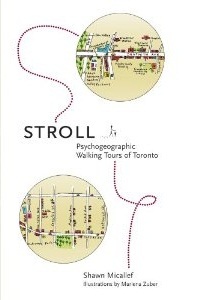
Review | Stroll, Shawn Micallef

…there’s something about the proximity of those quiet woods to the nearby village that makes Frost’s poem [Stopping by Woods on a Snowy Evening] seem cozy and urban – a quick escape into the wild but never far from civilization. How wonderful it would be to walk through a forest on the way to a friend’s house, or to a tavern or movie in another part of the city. In Toronto, the best of nature and the city often intersect… [p. 202]

Only Shawn Micallef would pair “cozy” and “urban,” and only he would link Robert Frost’s poem about the woods to a city, let alone Toronto. His view of Toronto having the intersection of nature and city is a tad more romantic than I would normally think, and it’s just this romanticism that makes Micallef’s Stroll such a great book. Micallef views his city with an almost childlike sense of wonder. Informed, certainly, by his vast knowledge of the city’s history, as well as conversations he has had with various others, but there’s a youthful excitement in Micallef’s approach to exploring Toronto. Remember how when you were a child, even an office cubicle can transform into a land of adventure? That’s the view Micallef presents of Toronto — every sidewalk is a path to adventure, every building a potential locale for a story.

I remember when the book first came out. I was working as a bookseller then, and what began as an easy database-search-type recommendation for tourists looking for a book on walking tours in Toronto turned into my go-to recommendation for anyone looking for a book on Toronto. What swayed me is this fantastic bit from Micallef’s “Flaneur Manifesto”:

Over and over, we’re told that Toronto is not Paris, New York, London or Tokyo. We’ve been trained to be underwhelmed… Any Toronto flaneur knows that exploring this city makes the burden of civic self-depracation disappear. [p. 10 – 11]

Hear hear, Mr. Micallef. In Stroll, Micallef chronicles his wandering walks around Toronto, covering the downtown core, and, more significantly, spreading out into Pearson Airport, North York, Scarborough and the Port Lands. I know of Stroll readers who take their copy with them as they walk around Toronto themselves, perhaps using it as a guide, to point out things they may not have noticed on their own. I opted instead to read Stroll at home, enjoying the treat of dipping into it and checking out a neighbourhood or two at a time, mini adventures where my imagination took me on these tours. Reading about neighbourhoods I was familiar with is quite an experience — as Micallef’s narrative moved along certain roads and noted certain landmarks, I could picture these areas clearly in my mind. Once in a while, I’d learn a fascinating tidbit about the history of a building I’d passed numerous times without noticing; other times, Micallef would mention a detail I hadn’t noticed at all, and I make a note to take a look myself next time I was in that area.

Reading about neighbourhoods I’d never visited is a different kind of adventure. In a way, it’s not quite as thrilling — I no longer had the memory of the landscape to guide my imaginary tour. On the other hand, this just means that all these neighbourhoods are still waiting to be explored. As Micallef says, you realize how large Toronto is, to be able to fit all of this in it.

Toronto through Micallef’s eyes is an adventure. His affection for the city is infectious, and he punctuates informational tidbits with humour and whimsy. I highly recommend this book for tourists, new Torontonians, people moving away from Toronto, and anyone, really, who wants to view the urban landscape in a new way.

I recently joined a Jane’s Walk that Micallef led. At one point, he stopped walking, glanced around and, for no discernible reason (at least to me), stepped onto a patch of dirt and grass and zigzagged through that rather than stick to the pavement. So much of my walking around, at least, involves getting from one point to another (in other words, I would most likely have stuck to the pavement). Micallef’s seemingly aimless wander opens up familiar locales to adventure, and that’s why Stroll is such an amazing book.

It helps as well to have Micallef’s highly romanticized view of his surroundings, picking out random details that would usually escape attention and finding the whimsy in them. During that Jane’s Walk, Micallef stopped by the 403 and told the group to close our eyes and listen to the cars zipping past. You could almost believe, he said, that you could hear the ocean. That’s a bit of a stretch, Mr. Micallef, but hey, why not? I’ll give it a try.