
Review | The Serpent’s Shadow (Kane Chronicles 3), Rick Riordan

Rick Riordan’s The Serpent’s Shadow is the best of the Kane Chronicles trilogy. Anophis, the snake god of Chaos, is on the loose and will destroy the world in three days, and siblings Carter and Sadie Kane must stop him and restore Ma’at (order) to the world. Carter and Sadie have grown quite a bit since their first appearance in The Red Pyramid Serpent’s Shadow begins with the pair understandably apprehensive, but definitely in charge of the fight against Anophis. They manage a school for magicians, training even kindergarteners to help in the upcoming battle, while still making sure the magician students attend regular school classes.

The Kane Chronicles have never captivated me as much as his Percy Jackson and Heroes of Olympus books have. I’m not sure if it’s just because I find the Greek/Roman gods, or because the format of the stories make the Kane Chronicles a bit more slanted towards children, stylistically. For example, because Kane Chronicles heroes Carter and Sadie narrate the story by dictating it into a tape, we have regular interjections, e.g. of one complaining that the other was pinching him/her. Regular sibling horseplay, and sure to elicit a laugh from eight-year-olds when read out loud, but a bit too much played for laughs.

There’s quite a lot packed into this book, and with so many god and mortal characters and such a big task (how to stop an unstoppable snake god), Serpent’s Shadow gets right into the action and assumes you remember the previous two books. It does get a bit confusing at times, and a bit difficult to care, really, about events you know are momentous because the narrators say so. Still, once Sadie and Carter figure out a plan and set off after Anophis, the story becomes more exciting.

The stakes are really high in Serpent’s Shadow — Carter and Sadie admit they’re not sure their plan will work, and worse, their plan will most likely require both of them to sacrifice their lives. Even their love interests have major sacrifices to make, and the gods can only help so much. The only thing perhaps that bothered me is that the consequences of Anophis taking over the world weren’t really explained, beyond a generic idea of the world ending. So we know how much Carter, Sadie and their team are willing to sacrifice to stop Anophis, and we know it’s important, but mostly just because they tell us so, which lessens the significance of their mission somewhat. There is a great moment where Carter realizes Anophis’ motivation and, for a few seconds at least, understands Anophis completely. That gave dimension to the villain, and added depth to the story.

I like how Riordan handles his female characters. Carter may be the designated leader, but both Sadie and Zia are really strong leaders as well, and they play even bigger roles in the battle. The romantic subplots were also interesting, at certain points more interesting than the main story. Carter’s feelings for Zia cause him to make an absolutely idiotic decision at one point, which I thought unnecessary and too convenient a plot device (he’s really not that stupid), but overall, I like the romance in the book. I liked the somewhat creepy twist in the Carter/Zia love story, but I personally found the resolution of the Sadie/Walt/Anubis love triangle rather disturbing.

Overall, a solid book. The best of the Kane Chronicles, and certainly an epic way to end the series.

+

Thanks to Hachette Book Group Canada for a finished copy of this book in exchange for an honest review.

Review | Dare Me, Megan Abbott

Megan Abbott’s Dare Me was much more chilling than I’d expected. Remember high school? Friendship is important no matter how old you are, but somehow, in high school, the status of friend took on an almost do or die quality. Friendship was a status symbol, as was the ever elusive BFF tag. This is not to diminish high school friendships — many of the deepest, most lasting friendships I have were forged in high school. Still, the thrill of having a popular classmate, the Queen Bee of whatever social group, notice you, even validate you, seems to have been strongest in high school.

Dare Me is a cheerleading novel, depicting a world Bring It On and Sweet Valley never revealed. Cheerleading in Dare Me is like ballet in Center Stage: tough, competitive, borderline physically abusive. Yet unlike Center Stage or any similar sports movie, Dare Me uses cheerleading as the backdrop for an exploration of female teenage friendship and its entrenched social hierarchy. We have passages about cheerleading, poetic descriptions of bodies knifing through the air in death defying stunts, yet these descriptions never feel romantic like, say, Chris Cleave’s depiction of cycling in Gold felt romantic. There’s anger and defiance in Abbott’s descriptions of cheerleading stunts — in the parlance of her characters, a big fuck you, bitches, watch me fly.

The story is narrated by Addy, lifelong lieutenant of cheerleading captain Beth, until Coach French takes over the cheerleading squad, and wins Addy over. In some ways, Coach French is the kind of inspirational leader/mentor young people long for — she believes in the squad’s competitive potential, and has the ability to make the members exceed their limitations. She also takes her role too far, demanding both athletic excellence and eating disorder level diets from her squad.

What makes Coach French truly creepy however, is that she is a Mean Girl that never grew up. She clashes immediately with Beth, mostly because there can be only one Queen Bee, and the whole idea of a woman in her late twenties waging war against a high schooler for clique supremacy shows just how lonely and messed up Coach French is. She tells Addy that Beth’s scheming is amateur, yet ironically, her own tactics are very high school. For example, to cut Beth down to size, she fires her as cheerleading captain (even removes the role completely) and assigns Flyer (the star in squad routines) to a girl Beth always picks on. This could have been an empowering move by an adult, but Coach French’s glee in seeing Beth’s frustration keeps her just as immature as her adversary.

Beth is hardly a character that evokes sympathy — she’s bitchy and manipulative, and she tears down other girls just to win the battle against Coach French. Yet, buried deep inside is a touching vulnerability, most clearly seen in her friendship with Addy. At several points in the story, she calls Addy stone cold, tough, a fox. “It was always you,” she says. Addy may have been Beth’s second-in-command, but we see how much the power dynamic is really reversed from Beth’s point of view. Even though Addy doesn’t realize it, Beth really craves her approval, her validation, above all, her friendship. So when Addy, like the rest of the squad, becomes enthralled with Coach French, Beth’s battle against the coach becomes personal — much more than supremacy over a cheerleading squad, it’s a battle to be Addy’s BFF. Dare Me dares to explore just how far some girls will go to win such a battle, and kudos to Abbott for not holding back.

Dare Me is ultimately Addy’s story, however. At the centre of Coach French and Beth’s power struggle, Addy is embroiled in a lot of seriously messed up events, and when everything seems to be about power dynamics, she is unsure who she can trust. Addy is in a state of flux, both uninterested in going above her lieutenant role and secretly yearning to be the Flyer on the squad, the Queen Bee as it were. Well, why not me? she asks. Why not, indeed?

Dare Me didn’t blow me away. It started off slow for me, possibly because Abbott’s language sometimes slipped into Virgin Suicides-style philosophizing and navel gazing, e.g. an early rumination on how long it takes to wash off the glitter after a game. The whole cheerleading-as-metaphor angle also seemed overdone at times — at one point, a former squad member comments that being a spectator rather than a participant for the first time made her realize that the cheerleaders looked like they were killing themselves, literally. The comment was just overly dramatic, and the message far too hammered home.

However, Dare Me definitely exceeded my expectations. A dark and twisted take on friendship and cheerleading as blood sport, Dare Me thrills and disturbs.

+

Thank you to Hachette Book Group Canada for a finished copy of this book in exchange for an honest review.

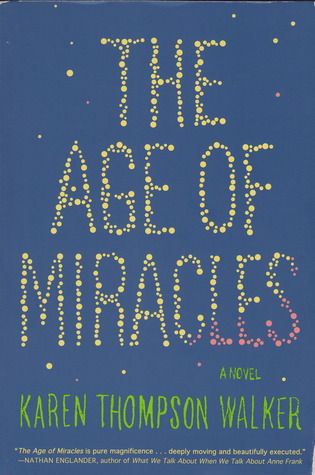
Review | The Age of Miracles, Karen Thompson Walker

What a lovely, lovely book! Karen Thompson Walker’s The Age of Miracles takes a terrifying science fiction idea and turns it into a touching coming of age story. When the Earth’s rotation begins to slow, eleven year old Julia barely even notices. Some people were terrified about the end of the world, but when the entire world is affected, where can you run? The effects are slow but inexorable, and even as a reader, panic turns to horror and, eventually, to resignation. Julia’s world is ending, and Bruce Willis isn’t about to launch a spaceship to save it.

This then is where the power of Walker’s story lies: when you can’t prevent the end of the world, what else is left but to live your life as best you can? Walker creates a complex world, and offers social commentary. Society, for example, is divided into those using clock time (following the 24-hour clock despite the schedule of daylight) and those using real time. “I’ve never liked her lifestyle,” Julia’s mother sniffs, speaking of real time user Sylvia. “It’s not our business how she chooses to live her life,” Julia’s father responds. This type of conversation sounds familiar, eh? The world stops spinning, people will go on being judgmental. Another real time user tells Julia’s family:

You probably think we’re a bunch of pipe dreamers out here […] but it’s just the opposite. We’re not the ones in denial. […] We’re the realists. You’re the dreamers. [p. 214]

Indeed, the clock time users are dreamers, desperately clinging on to a world that no longer exists. Ostensibly about something as quotidian as telling time, Walker creates a powerful metaphor here, a searing portrait of our own society.

Even more potent perhaps is the deeply personal thread to this story. In an especially poignant scene, Julia decides to buy herself a training bra. This insistence on a ritual of growing up, even in the face of the world ending, is a lovely fist pump against circumstances. It also stands out as one of the few times Julia, an all-around good girl who hesitates to cut class even with the world going topsy turvy, deliberately defies her mother. It’s that important to her. And that’s why it’s utterly heartbreaking when she gets home and realizes the bra is much uglier than it seemed at the store:

One of the seams was already coming loose. Even worse was the way the cups rippled unsexily across my chest, like two empty water balloons waiting to be filled. [p. 155]

It’s a young girl’s heartache, and a deeply moving reminder that she may never have the chance to fill those cups. Julia’s concerns about family, friendship and friendship are all rendered even more poignant by the urgency, and inevitable futility, of her situation.

The ending, the final chapter in particular, is absolutely beautiful.

+

Thank you to Random House Canada for a finished copy of this book as a prize in the Random Reader Challenge: John Irving. I read this book as part of Random House’s Random Reader Challenge: Debut Novels.