Tiger, Tiger, Margaux Fragoso #50BookPledge

Wow. What an incredibly powerful book. Margaux Fragoso’s memoir Tiger, Tiger is not an easy read. There were moments where I literally had to stop reading, because I was just either getting too uncomfortable or too angry. A co-worker admitted to me that she was hesitant about starting Tiger, Tiger; having young children herself, she was afraid that she would find the book too disturbing. This same co-worker found Emma Donoghue’s Room difficult for that same reason. I did sympathize with Jack and his mother in Room, but I was fine reading it. I found it difficult to read Tiger, Tiger, and I mean that in the best way possible.

When Margaux was seven, she met fifty-one year old Peter at a swimming pool. Peter invites her and her mother to visit his house, ostensibly to meet his wife and hang out with his two sons. Margaux’s father is very verbally and physically abusive, especially to Margaux’s mother, who is on psychiatric medication, so the mother jumps at the chance to form a friendship with a seemingly nice man. Turns out Peter is really interested in Margaux, and the way he seduces and manipulates her is just disgusting. Without any of Humbert Humbert’s eloquence or, let’s face it, Jeremy Irons’ seductive voice in the Lolita audiobook, Peter’s pedophilia is just there, horrific and disturbing and outright disgusting.

Part of what makes this such an emotional read is that Fragoso writes each chapter solely from the point of view of the age she was when the events occurred. So, when Peter attempts to use guilt to make eight-year-old Margaux perform oral sex on him, we as readers don’t have the filter of present-day Margaux Fragoso in her twenties to distance us from the eight-year-old girl’s emotions. Her disgust at the request, mixed in with guilt because he had given her a treat earlier, is all too real, and Margaux’s descriptions are bitter reminders of her eight-year-old mind.

The vividness of Fragoso’s writing reveals her relationship with Peter in stark, unforgiving detail. We see the young Margaux confused and angered that her father would make fun of Peter’s false teeth; later on, we see the teen Margaux realizing how wrinkled Peter’s skin is, and how emotionally dependent he is becoming on her. We see the turmoil of her discomfort, then possessiveness and even love for Peter. We see her grow up, and as she becomes more aware – of the way in which Peter manipulates her and of how she can use her sexuality to turn the tables and regain power – we root for her, not just to gain power over Peter, but to become free of him. In a way, the latter half of the book, where Margaux has become a teenager, is easier to read, because while Margaux is still definitely being victimized by Peter, she is no longer just a victim. She is, albeit slowly, beginning to take back her life.

I’m not even sure if I can describe how I felt reading this book, and I’m just amazed that Fragoso was able to write such a compelling, cohesive account of such experiences. I was furious at the way Margaux’s father kept belittling her and her mother. I was disgusted at Peter’s actions, at his insistence that society just doesn’t understand that he and Margaux are in love, and at his attempts at emotionally manipulating Margaux into staying with him rather than building her own life. Margaux is never overtly furious in her depiction of Peter, and, in a way, such a straightforward, matter-of-fact account just makes the horror of his actions so much starker.

Tiger, Tiger is not an easy read, but it’s definitely well worth the effort. Highly recommended.

Die with Me, Elena Forbes #50BookPledge

Elena Forbes’ Die with Me is a classic police procedural. A serial killer targets young, vulnerable women. He cultivates a relationship with them, then murders them and makes it look like suicides. The odd thing is that the killer didn’t appear to have raped the victims (at least one victim had died a virgin).

This is the first book in the DI Mark Tartaglia series, and unlike other mystery series I enjoy (e.g. Donna Leon’s Guido Brunetti, Ian Rankin’s John Rebus, Robert B. Parker’s Spenser), nothing about Tartaglia really made him stand out to me from other literary detectives. He’s a fairly standard old school cop, skeptical about psychological profiling, and he has a complicated love life, with an ex-lover coroner, a new boss with whom his relationship goes from antagonistic to protective, and his partner DS Sam Donovan, with whom he has unacknowledged chemistry.

Despite it being “A Mark Tartaglia mystery”, Donovan seemed to take at least as much of a central role in the investigation. In complete honesty, I found her character to be more fleshed out, and  left the book with the sense that I saw her detective work more than I saw Tartaglia. Donovan’s definitely a very likable character, and I look forward to reading more about her in future books.

Forbes chooses to focus on the investigation, and this is a good thing, because the investigation itself is pretty compelling. The killer targets really vulnerable girls, those who are ostracized in school or aren’t physically attractive, and minor details (e.g. he can’t stand the scent of Pear soap) hint at the source of his psychosis. The red herrings are fairly easy to spot, but the ultimate solution, I admit, surprised me.

Reading Die with Me is like watching an episode of Law & Order or CSI. It’s a fast-paced, entertaining, engrossing police procedural. It’s a lot of fun to read, and I for one found myself racing through the pages to see what new clues Donovan and Tartaglia have uncovered and who the killer will ultimately turn out to be.

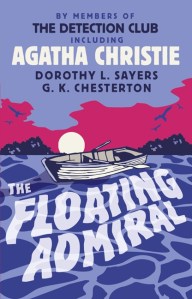
The Floating Admiral, Members of the Detection Club #50BookPledge

“The one thing that has been lost with the passage of time is the sense of fun that used to be associated with crime fiction,” current Detection Club President Simon Brett writes in his Foreword to the 2011 80th anniversary edition of The Floating Admiral. I beg to disagree. There is quite a market for light hearted mysteries, which still deal with murder and other such crimes, but are very funny, fun to read books. Think Diane Mott Davidson, Laura Levine, Sookie Stackhouse and M.C. Beaton.

Still, his point about detective fiction in the Golden Age being primarily about the fun of solving puzzles holds true, especially with regard to this book. If you’re a major mystery buff like me, The Floating Admiral is definitely worth checking out. Written by the members of the Detection Club 80 years ago (which included such authors as Agatha Christie, Dorothy L. Sayers and G.K. Chesterton), this is more a fun exercise by the club than a serious detective story. Floating Admiral highlights the “sense of fun” Brett mentions in his Foreword by turning detective fiction writing into a game. Essentially, each member of the club writes a chapter, then passes it on to the next member in line. The only rules are that each writer must have a solution in mind and write a chapter towards that solution and that each writer’s solution must take into account all the difficulties presented in previous chapters. As Dorothy Sayers says in her Introduction, this is more difficult than it sounds: what one writer thinks makes a certain solution obvious makes the next writer think of a completely different solution. Essentially, the story gets more and more convoluted as it goes along, and I must admire Anthony Berkeley, who had the unenviable job of writing the final chapter. He had to make quite a few leaps in logic to tie up all the loose ends, but he did it.

The best part was probably all the solutions suggested by the various writers at the end of the book. Agatha Christie’s was, true to form, probably the most unexpected, and certainly the funniest. Several writers wrote their solutions in point format, showing how they struggled to tie everything together, and one even admitted, “I am, frankly, in a complete muddle as to what has happened, and have tried to write a chapter that anybody can use to prove anything they like.”

So, read it not because you want to be dazzled by a confounding mystery with an elegant solution. The solutions are mostly far from elegant, and usually require giant leaps of logic. Anthony Berkeley’s attempt, the “official” solution to the mystery took up probably a quarter of the book in his attempt to explain everything.

The Floating Admiral is a valuable piece of detective fiction history. Read it for the utter sense of glee palpable in the writers’ struggle to find a solution that fits everything. Because there is glee, and lots of it. These great mystery writers had fun writing it, and I had fun reading it.