
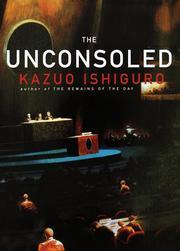
The Unconsoled, Kazuo Ishiguro

The Unconsoled is a challenging read. It’s over 500 pages long, and even though I can usually go through a book or two a week, it took me several weeks to read this, because I found myself having to stop once in a while to absorb what I’ve just read. And it is just so worth it. I’ve read a lot of good books (Ishiguro’s Never Let Me Go among them) last year, but this is the one that I think really blew me away.

The story begins with Ryder, a world-famous pianist, checking in at a hotel in a city he doesn’t know for a concert he cannot remember having agreed to give. Lost and extremely confused, he decides to just go along with it, hoping to learn more as he goes. The story has a very surreal, dream-like quality to it. You know how in dreams, things that wouldn’t make sense in real life seem realistic because they fit in with some weird internal logic within the dream? So many things that Ryder undergoes shouldn’t make sense, and yet we somehow accept that they do, because Ishiguro maintains an undercurrent of internal logic throughout. In this way, we as readers undergo the experiences with Ryder, and Ishiguro keeps us as off-balance as Ryder must be feeling. Ryder is sucked into a whirlwind of publicity stunts, interviews and parties to promote his upcoming concert. Not knowing anything about the concert or his agenda, Ryder sometimes stands back and watches in a daze as things unfold, and other times, he interacts with people, and performs his public relations duties perfectly, though with a sense that he does it all by rote without really understanding why.

It would be easy to dismiss the entire story as just a dream, a completely nonsensical Alice in Wonderland type tale. But as the story progresses, it becomes clear that all these seemingly nonsensical threads are propelling the reader, and Ryder, forward in a very logical, purposeful pattern. Even more important, despite all the seeming superficiality of events, deep, complex emotions are slowly revealed in characters. Even though Ryder walks around in a daze, the other characters are very clear about what’s happening, and are genuinely confused at Ryder’s befuddlement.

Reading The Unconsoled, I went from trying to figure out what was going on to deciding that was impossible and simply sitting back and enjoying the ride. The story’s emotional core crept up on me, as I imagine it must have crept up on Ryder. I started understanding more of what was going on, as I saw Ryder was doing as well. The blurb at the back of my book describes Ryder’s world as possibly ”the day-to-day reality of a man whose public self has taken on a life of its own,” which explains it perfectly, I think. Eventually, all the public relations-type events Ryder attends blur together, with little distinction between them. In contrast, Ryder’s relationship with his family develops in deep, complex ways. We begin to learn less about his public life and more about his private life, and it is only when we do that the story becomes less dream-like, and more real.

I am a major Ishiguro fan, and I especially love the beauty and cadence of his language. He uses it extremely well in Unconsoled, taking readers into a world of dreams and reality and the reality of dreams. Funny, complex and haunting, this is an amazing novel.
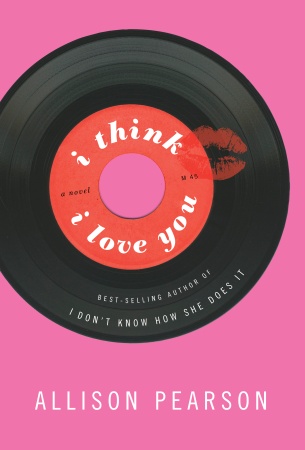
I Think I Love You, Allison Pearson

I think I love this book. Thirteen-year-old girls Petra and Sharon are huge David Cassidy fans who love reading The Essential David Cassidy Magazine, especially the section with a letter from David himself. Alternating chapters reveal the other side of the story: Bill, a writer in his twenties, who ghostwrites David’s letters, has a musical snob for a girlfriend and sneers at the young girls who go gaga over David. Petra enters a contest for a chance to meet David Cassidy in person, and only finds out she’s won twenty-five years later.

I’ve never listened to David Cassidy myself, and in fact, when a friend told me about this book, I had to ask her who David Cassidy was. But I could definitely relate to Petra and Sharon’s obsession. Can barely even remember the titles of the magazines I read (Tiger Beat?) and under no duress will admit my personal versions of David Cassidy (okay, so I attended a recent Backstreet Boys concert and shrieked like anything). But I do remember the squealing, the dreaming, and above all, the pure girly bonding, with much affection. And that’s what I Think I Love You celebrates. With Petra, we relive our own teen idol years. Like Petra, we’ve all had a Gillian, the popular girl everyone wants to impress and befriend, and for whom we may even consider, however briefly, betraying a Sharon, the true blue yet less popular BFF. And like the adult Petra, we have become more jaded, and look back at our teenage years with nostalgia.

The chapters from Bill’s perspective lend a nice, adult POV that balances out the story. In one of my favourite scenes, Bill sees a photo of David Cassidy at his job interview and says, “Not my type. That bird there, on the cover.” Bill vacillates between contempt for teen girl fantasies and grudging affection for David Cassidy fans. As David’s ghostwriter, for all intents and purposes, Bill is the David Cassidy these fans know. And against his better judgement, against his own desire to be too cool for David Cassidy, Bill is also drawn into the world of fandom, and as an adult reader, these sections really spoke to me as well. I may poke fun at fans of Twilight and Justin Bieber, but that’s kind of like poking fun at the tween girl me who liked Sweet Valley and boy bands.

At times, I Think I Love You gets a bit too pop psychological. I get that teen idols are a non-threatening psychological transition between stuffed animals and real, adult males. I didn’t need characters in the story telling me that. Other times, adult commentary interrupts a teenaged Petra scene, which just felt like too much telling rather than showing. The action and dialogue are strong enough, and tug on the reader’s memories powerfully enough, that overt commentary just seems superfluous.

Overall, though, I love this book. When Petra gets a chance as an adult to meet David Cassidy, she realizes it won’t be the same at all – she’s not the same Petra who was in love with David, nor is David the same teen idol millions of girls had swooned over. In an especially poignant passage, Petra realizes what she really wants is to go back in time and take her thirteen-year-old self to meet David Cassidy. I Think I Love You speaks about female friendship, music fandom and the always complex, ultimately unfulfilled desire to recapture that innocence we had at thirteen, where we joined millions of other girls in believing that a celebrity was singing especially, solely, to us.

The Paris Wife, Paula McLain

I love Ernest Hemingway. His ability to write such evocative stories with the bare minimum of words amazes me. His dialogue is crisp, witty and a lot of fun to read. So when I saw The Paris Wife, a book that depicts the relationship between Hemingway and his first wife, Hadley Richardson, I was both intrigued and wary.

I know it’s not fair to compare McLain’s writing to Hemingway’s, especially since her narrator isn’t Ernest himself, but Hadley, who would understandably have a very different speaking voice. Still, I couldn’t help feeling disappointed at the dialogue. Ernest’s lines show none of the personality that shines through in his novels. Rather, it felt like reading a fairly forgettable romance novel. Take for example the following exchange:

“Do you want some wine?” He reached into his nest and pulled out a corked bottle and a teacup.
“What else have you got hidden in there?”
“Come in and find out.” His voice was light and teasing.

It’s not completely stilted in itself, but after reading so many similar conversations in the book, it finally just felt too artificial to make me care about their relationship.

The good news is that I found myself liking the story more after Ernest and Hadley’s relationship sours. When the story focuses in tight to Hadley and Ernest is in the background, the scenes seemed to flow more naturally. Maybe it’s because I couldn’t separate Ernest Hemingway the character from Ernest Hemingway the historical figure, whereas with Ernest out of the picture, I could feel like I was reading about a completely fictional woman with marriage problems and therefore allowed myself to be drawn in more.