
Review | Woman on the Edge, Samantha M. Bailey

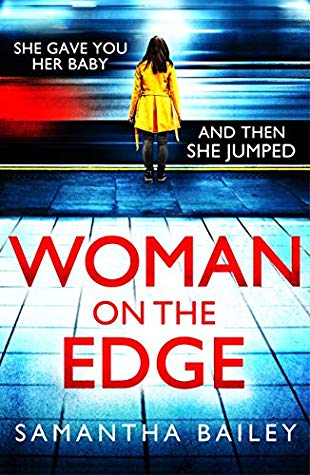
46640067._SY475_What if you’re on a subway platform and a total stranger hands you her baby then jumps in front of a train? It’s an incredibly tense concept, and one that hooked me immediately.

Woman on the Edge is a quick and exciting read. The first half was really strong, as the novel introduces us to the cast of characters. The woman who jumped turns out to be Nicole, a powerful CEO of a health and wellness organization who is haunted by the death of a baby in her care twenty years ago. The woman who receives the baby is Morgan, a social worker whose husband defrauded the women’s shelter she founded then died by suicide. Morgan doesn’t remember ever meeting Nicole before, yet Nicole has named her the legal guardian of her baby, Quinn.

As the story unfolds, we learn that Nicole has been the subject of harassment by a red-haired woman for years, and that the harassment has started up again and intensified ever since Quinn was born. A red-haired woman also begins stalking Morgan, at one time almost running her over, and Morgan must solve the mystery behind Nicole’s death in order to protect her own life and the life of Nicole’s child. It’s a gripping thriller, told in alternating chapters between Nicole and Morgan’s points of view, and like Nicole and Morgan, it’s hard to know whom to trust.

Unfortunately, the momentum flags a bit as the story approaches its conclusion. The latter half of the book doesn’t really reveal a lot of surprising information, and the red herrings aren’t quite developed enough for any of the potential villains to really have an impact. The last few chapters are a series of reveals that felt a bit too cursory to really make an impact, and felt a bit more like an info dump than anything.

The big reveal about the villain was also disappointing. Their motivation was explained, but it fell flat given how strong the story had started and how rich Nicole’s backstory had been. The villain’s actions also didn’t quite make sense given the rest of the story; I wish there had been more hints earlier on about what they were up to. Overall, it felt more like a need to tie up loose ends than a natural outcome of events.

Still, the first half is super strong, the hook is killer, and the bits about postpartum depression and mental health are sobering. I also like how real the connection between Morgan and Nicole turns out to be, and how much a minor encounter can result in a genuine connection between two strangers.

+

Thank you to Simon and Schuster Canada for an egalley in exchange for an honest review.

Review | Missing Person, Sarah Lotz

36204287I was really intrigued by the premise of this book. Shaun, an Irish bookseller, learns that his Uncle Teddy didn’t die in a car crash after all, but instead went to New York to escape his homophobic family and hometown. Shaun’s search for his uncle leads him to an American missing persons cold case website, where one of the users posits the possibility that Teddy is dead after all, and that he’s actually the true identity of the cold case labelled ‘Boy in a Dress.’ The website’s users — founder Chris (Ratking1), moderator Ellie (RainbowBrite), Chris’ sometime-lover Scott (Aqualung), and former cop Pete (BobbieCowell) — all team up to restart the investigation into the case, and possibly get Shaun the answers he seeks. What they don’t realize is that the person who actually killed the Boy in the Dress is among them, posting on the site, working the cold cases, and keeping tabs on their investigation.
It’s a chilling premise. I like how Lotz explores the relationships built online, and how she acknowledges the characters’ obsessive tendencies and often sad life circumstances while still maintaining a level of respect for them. She delves into their motivations (e.g. Chris’ missing mother) and their dreams (e.g. Ellie’s unsupportive husband and somewhat-but-not-really crush on BobbieCowell). We are also told who the real murderer is fairly early on, and it was fascinating to read the chapters from that character’s perspective, and to see how they’re manipulating the investigation to protect themselves. I also liked learning about Shaun’s family and their backstory, and how circumstances led to Teddy leaving for New York in the first place.

But overall the book just moved too slowly for me. Things unfolded at a very slow pace, and while the book was only 480 pages long, it felt a lot longer. Because we know the identity of the murderer early on, and can pretty much figure out how Teddy fits into the whole situation, the thrill is a lot more about whether or not the other users of the site can figure it out and bring the murderer to justice. Despite some scenes where characters are legit in danger, the overall feel of the book is just sad and a bit sordid.

Missing Person is a very character-driven thriller, but while the characters all had their own interesting tidbits, I just wasn’t invested enough in any of them to stay interested despite the slow pace.

+

Thank you to the publisher for an egalley in exchange for an honest review.

Review | The World We Knew, Alice Hoffman

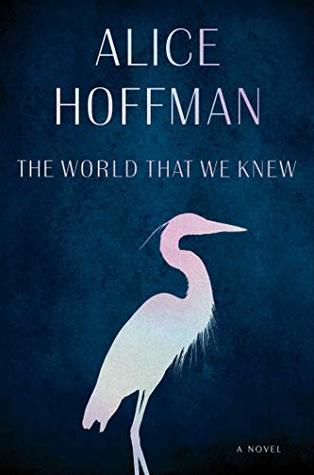
44175791._SY475_Just when I thought I know what to expect from a WWII novel, I come across The World We Knew. Known for novels like Practical Magic, which weaves magic into the real world, Hoffman delivers a novel where magic — dark, forbidden magic — is a tool by which a Jewish mother keeps her daughter safe from Nazis. It’s a lovely infusion of hope into the bleak reality of war, but more importantly, it also raises questions of how far women are willing to go to protect the ones they love.

The novel follows the life of Lea Kohn, a twelve year old girl escaping Nazi Germany. Her mother Hanni has commissioned a rabbi’s daughter Ettie, to create for her a golem, a creature made of clay whose very existence has the single purpose of keeping Lea alive and safe. The catch is that once Lea is safe and no longer in need of protection, she must kill the golem so that it doesn’t grow too powerful to control.

The World We Knew is a moving, fiercely emotional novel that practically bursts with love. Along with the love between Lea and her mother, the girl also can’t help but grow affectionate towards the golem Ava, who becomes a maternal figure to her during their escape and who therefore becomes almost impossible for Lea to kill. There are moments where Lea sees her mother in Ava, or remembers how much her mother loves her because of something Ava does, and it’s absolutely heart-wrenching to read because we know what her mother has sacrificed for Lea’s safety. Alongside that is the heron who follows Lea and Ava throughout their journey, who is linked to the golem in some way that is never fully explained, but that feels just as tangible as the bonds between the human characters.

There is also the fierce love between Ettie and her younger sister, whose safety is the reason Ettie agrees to create the golem in the first place, even though such magic is forbidden. Their escape doesn’t quite go as planned, and the experience shapes Ettie’s determination to help rebel forces take the Nazis down.

Despite its setting in a world filled with hate, the novel’s overarching message is that of love. There are many tragic moments throughout, many instances of sacrifice and of fear, but ultimately, we are left with a promise of hope. And even though the literal angel of death makes several appearances — at one point, unable to see Ava because she is not created by God (I forgot how Hoffman phrases this, but it’s beautiful, chilling and heartbreaking all at once) — the overarching feel is a celebration of life.

While the story is fantastical, kernels of it are rooted in reality. In her letter to the reader, Alice Hoffman writes about a woman who approached her at a book event, wanting her life story to be told. Like Lea, the woman was born Jewish, but was then sent to a convent during World War II to be raised Catholic. Unlike Lea, the woman didn’t have an Ava to protect her, and so while she survived the war, her reality is likely a lot bleaker than the story in this novel.

In that same letter, Hoffman writes, “Fairy tales tell us that we may be lost, we may be forsaken, but there is a path.” And perhaps that’s why the fairy tale treatment in this novel resonated so much with me. Despite all the horrible stuff happening in the world, Hoffman’s world promises a benevolent force protecting you from experiencing anything too horrible. Yet even that reassurance is a complicated one, as it requires much sacrifice and possibly a compromise of one’s own values. Like many fairy tales, the hope Hoffman offers is an ambiguous, complex one filled with foreboding. And that, paradoxically enough, makes it feel even more realistic, and therefore possible, much more than an uncomplicated happily ever after would.

+

Thank you to Simon and Schuster Canada for an egalley of this book in exchange for an honest review.