
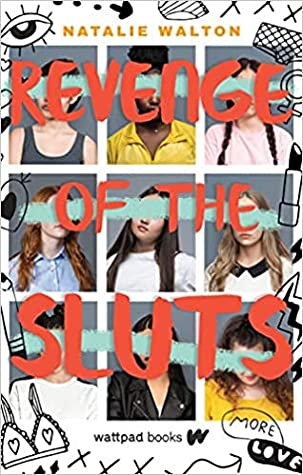
 Revenge of the Sluts begins with an email sent to the entire student body at St Joseph’s High School: nude photos of seven girls in the graduating class, with a promise from the sender, the self-named Eros, that this email was only the beginning. School reporter Eden Jeong and her editor-in-chief Ronnie Greer decide to cover what students have begun to call ‘Nudegate’ in the school newspaper, and give the girls in the photos a chance to have their stories told. Except all the school administration wants to do is forget about the incident, and local laws say that unless any of the girls are under 18, having their nudes circulated against their will is not technically a crime. Cue the ‘Slut Squad’, the group formed by the girls in the photos to support each other and fight for justice even if the laws and their school won’t support them.
Despite the fraught subject matter and the slut-shaming the girls in the photos are subjected to, even from their own families, ultimately, I found Revenge of the Sluts to be a satisfying, sex-positive, feel-good novel. Revenge porn / Non-consensual pornography is a terrible crime that’s sadly become more common and easier to perpetrate with so much of our lives going digital. While this novel is fiction, I have no doubt that what Sloane, Alice, Claire, and the other members of the Slut Squad went through happens in real life high schools. And as horrified as I am by the book’s revelation that, in some states, this kind of act is technically legal unless the victim is a minor, I have no doubt that that’s true as well.
The author doesn’t shy away from the terrible effects the email had on these girls and their classmates (Eden learns about group chats among the boys in her school where nude photos of girl classmates are regularly exchanged, and she worries about nudes she’d sent her ex-boyfriend when they were still together). However, rather than focusing on the girls’ victimhood, the story highlights the girls’ heroism in fighting back, and the strength the girls find in banding together.
I loved Sloane and the Slut Squad, and the care the author took in showing the range of reactions among the girls, and the helpful therapist who offered resources for anyone who wanted to talk. I did cringe when one of the girls invited Eden to the first Slut Squad meeting, which I understand was necessary for the plot, but it still felt like a violation of the safe space Sloane had set up. Some of the Squad’s activities also felt a bit too rah rah — for example, I’m surprised Claire was okay with a particular gathering of the Squad that impacted something she worked hard on. I also wish we’d gotten more insight into how the girls’ families and loved ones responded to their activism, which, given the principal’s desperation to sweep things under the rug, I presume posed material risks to the girls’ graduation and college admission. But ultimately, the thought of these girls rising up together and reclaiming their stories felt too good to begrudge, and I was happy the Squad fought strong.
I also loved the insight into investigative journalism at a high school level. We see Eden and Ronnie deal with school bureaucracy, conscientious journalism practices, and the excitement of knowing you’re sharing important stories that need to be told. I also love that both Eden and Ronnie are BIPOC, and that this shared experience partly shapes their friendship. Ronnie is one of only four Black students at the school, and when she assigns the Nudegate story to Eden instead of writing it herself, because other students are turned off by her political activism, it’s easy to imagine that her Blackness played a role in her classmates’ discomfort as well. Eden is first-generation Korean-American, and I love the little details that show how her family stay connected to their Korean heritage. Even when it’s something as simple as her father cooking Korean food or her mother watching K-dramas with Eden, the author shows us how Eden actively uses these touchpoints to connect to her Koreanness.
The ending fell a bit flat for me, only because I was disappointed with the reveal of who Eros actually was. The perpetrator and their motivations seemed to counter, for me at least, the messages of strength and solidarity that I loved in so much of the story. The story’s strength, for me, was seeing how these girls from disparate social groups, and some of the guys in their social circles banded together and supported each other. I thought the story’s trajectory was hopeful in a fist-pumping, tear-down-unjust-systems kind of way, and while I admit Eros’ identity did make sense, I also felt like the reveal detracted from that hope a little bit.
Still, I found it an engaging book overall, and I love how some of the characters really came through for each other to fight the system and ensure that justice is done.
+
Thank you to Raincoast Books for an egalley of this book in exchange for an honest review.
 Fourteen months ago, Ruby Fletcher was convicted for the murder of her neighbours Brandon and Fiona Truett. The evidence against her contained security cam footage and testimony from her neighbours, including her roommate Harper Nash. Now, Ruby’s conviction has been overturned, and she’s back at Harper’s house, claiming her innocence and vowing to uncover the real guilty party.
  It feels churlish to admit that I struggled to get through this book. (Full disclosure: I started this in December, and I’m tapping out for now in March, at approx 69%. I likely will finish it some time, just because it feels even more curmudgeonly not to finish it at all.)
 Literary Treats