
Review | Lake Crescent: A Creature X Mystery, by J.J. Dupuis

Pale bluish purple cover of a lake with mountains in the background. In white, all caps text are: J.J. Dupuis, Lake Crescent, A Creature X Mystery.In the second Creature X mystery, documentary filmmaker Laura Reagan travels to Newfoundland in search of the legendary giant eel Cressie. Instead, she and her team find a dead body, wrapped in a tarp (“like a taco,” a character observes), and pulled from the depths of Lake Crescent.

From the start, Lake Crescent is a much tighter and snappier mystery than the first instalment, Roanoke Ridge. Part of it is that Laura’s search for Cressie doesn’t carry as much emotional baggage as the one for Bigfoot. She doesn’t have to contend with her father’s legacy, nor rescue a mentor/father figure, so Dupuis can just take us right into the mystery without needing to set up all the backstory.

Also refreshing is that the question of Cressie’s existence isn’t the main focus of the mystery. As much as I enjoyed Roanoke Ridge, I had to keep suspending my disbelief to remain immersed in the world, because all the Bigfoot sightings and resulting debates had me expecting a Scooby Doo reveal every chapter. In Lake Crescent, Laura and her team recognize from the start that Cressie likely isn’t real.

So despite some attempts by her boss at sensationalism, Laura’s project explores Cressie as an anthropological study. How do legends like Cressie begin? What scientific basis can there be for the existence of giant eels in a lake? And perhaps most importantly, what does it mean for the people who live in the area to have that story capture people’s imaginations? Dupuis peppers his novel with fascinating research into Indigenous stories, evolutionary mutations, and so on. There’s at least one resident in the town who truly does believe Cressie exists, and even with the novel’s pragmatism, both Laura and the narration treat this resident with respect. As a result, I was absolutely captivated by the legend, and after I finished the novel, I immediately went online to see if Cressie were real. (She is!) There’s even a wonderful moment where Laura reflects on the ethics of her investigation — given Cressie’s impact on this town, what would she actually accomplish if she debunks the eel as a myth?

Beyond the fascinating stuff about Cressie, the main mystery in Lake Crescent, a cold case murder, was also very well done. I didn’t guess the villain or their motivations at all, and I loved the Agatha Christie-like feel of Laura actually explaining the solution to a roomful of people for the big reveal. Laura is a fantastic sleuth and series lead. She reminds me of Nancy Drew — intelligent, capable, and brave. But where Nancy can sometimes feel superhuman in her feats, Laura’s humanity feels more rounded. She’s empathetic, which helps in sussing out clues, and it also informs some lovely moments with other characters. For example, she picks up on the nuances of the complicated relationship a local blowhard has with his powerful father.

I also love the friendships between Laura and her co-workers Lindsey and Saad. They work well together, and are all smart and kickass in their own ways, but throughout this novel, Dupuis gives us many moments where we can see how their mutual respect has deepened into mutual trust. Dupuis handles his scenes of emotional vulnerability with a very light, somewhat restrained touch, and manages to make incredible depths of emotion come through. There’s a wonderful scene between Laura and Lindsey, where Lindsey mentions how something in the case brought up traumatic memories for her. Their dialogue is sparse, but speaks to a shared understanding, and by the time the scene ends with Laura saying she was there if Lindsey ever wanted to talk, I just wanted to give both of them a hug. I was also thrilled to see Saad trying on an action hero role in one of the later scenes — I loved him from Roanoke Ridge, and from what I said about him in my earlier review, I love the character growth his actions in Lake Crescent show.

Overall, Lake Crescent is a fantastic instalment to the Creature X Mystery series. As fun as Roanoke Ridge was, I thought Lake Crescent was even better. I felt like the series characters had more room to breathe, and there was a classic, psychological feel to the murder mystery that I loved. The novel ends with a hint at the next instalment: it’ll take place somewhere tropical. Anyone have any ideas what the next Creature X could be?

+

Thank you to Dundurn Press for an advance reading copy of this book in exchange for an honest review.

Review | The Retreat, by Elisabeth de Mariaffi

Book cover of The Retreat: it's dark blue with a front-facing silhouette of a woman with her hair surrounded by light. The book's title is in white all-capps, adn the author's name is in red all-caps.I love locked room mysteries, so I was immediately intrigued by the premise of The Retreatan avalanche strands the guests and staff at a remote mountain retreat for artists. Tensions rise, old wounds come to the surface, and then someone dies in mysterious circumstances. We see the story unfold from the perspective of the only newcomer to the group, Maeve, a former ballerina who’s on the mountain for inspiration as she plans the next steps of her career.
The Retreat had many locked room elements I love: suspicious characters, layers of drama, and a situation with no escape. I liked Maeve’s backstory: she’s just coming out of an abusive marriage, so her experiences with her violent and stalkerish ex increase her anxiety about the situation. Those same experiences also come to her aid in the climax, and I really like how the author turns Maeve’s trauma into a useful tool for her survival.

The author is also very good at creating atmosphere: the remoteness of the mountain lodge and the deadly blanket of snow surrounding it felt almost claustrophobic on the page, and I can only imagine how much worse it was for the characters trapped in the situation. The setting itself plays a role as a villain, and there’s a definite sense that even if the murderer doesn’t get you, the snow and lack of access to resources very well could.

Unfortunately, I also found the book to be very slow. Each chapter spans a full day in the retreat, so the entire book is composed of only about 7 chapters. The final one was a whirlwind, and I was racing through the pages to find out what happens next, but the first half or so was a bit of a struggle to get through. It wasn’t enough of a slog that I ever seriously contemplated not finishing it — there was enough of a hook to keep me at least mildly curious throughout, but I never actually felt an urgency to keep reading until the last couple of chapters or so. 

Much of it is that with the exception of Maeve, most of the other characters never really came alive for me enough to care about what happened to them. There was a bossy guy Dan, the sexy but kinda creepy guy Sim, the grouchy young woman Sadie, and other characters Anna, Justin, and retreat owner Karo. All of them played significant roles in the drama and the mystery, but despite their character details and backstories, they all also fell flat for me. Even Maeve took me a while to understand, and she had the most complex backstory. And while Anna and Karo are probably two of the most important side characters in the novel, I don’t have enough of a handle on their personalities to describe them.

Perhaps an even bigger problem was that I also found the characters’ motivations obscure. Possibly this was the author’s choice, because even after the big reveal, there was still a lot of ambiguity around some of the details. But because the strength of a locked room mystery depends so much on the strength of its characters, not understanding the characters made it hard for me to really get into the story.

There are also some odd shifts in behaviour that either didn’t add to the story or didn’t really get explored enough. For example, when Maeve arrives at the resort, Sadie seems to be a major fan. But because Maeve was rude at first, Sadie seems to immediately decide she hates Maeve, and acts all grouchy for the rest of the novel? For someone who works visitor experience, I’d expect Sadie to have a bit of a thicker skin.

The Goodreads blurb identifies this book as a literary thriller, rather than just a thriller, so that may explain the slow build-up and somewhat ambiguous reveals. As I said, the author does a great job in creating and maintaining atmosphere, and I really like how she used Maeve’s backstory within the mystery. Ultimately, this wasn’t quite the book for me — when it comes to thrillers, I prefer the faster-paced, more straightforward style of authors like Ruth Ware, Mary Kubica, and Kelley Armstrong. But I can see the style of this novel appealing to readers who prefer more subtlety and a slower burn.

+

Thank you to the publisher an Netgalley for an e-galley in exchange for an honest review.


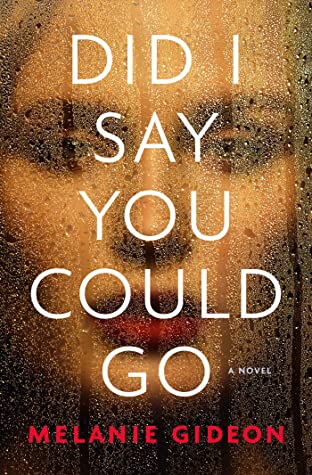
Review | Did I Say You Could Go, by Melanie Gideon

DidISayYouCouldGoCoverThere are times when I’m in the mood for a high octane, nail biting thriller, and other times when I’m more in the mood for a genteel (yet still murderous) Agatha Christie-type story.

And then there are times when I just want the drama. Bring on the scheming, the backbiting, and all the pointed little barbs beneath the bright smiles of frenemy-ship! Did I Say You Could Go brings all of that and more, with a pair of mother-daughter duos who become BFFs mostly just because the girls go to school together.

The dynamics of the mothers’ friendship is set up early on: Ruth is a wealthy divorcee who latches on to Gemma for friendship; Gemma is a widow / financially struggling single mom, who can’t resist the lure of Ruth’s generosity with her wealth. While they were estranged for some time, a scandal at Gemma’s tutoring company provides Ruth the opportunity to burrow her way back into Gemma’s friendship, and while Gemma has misgivings, she also can’t afford to turn down Ruth’s help.

I love how the author sets up both women as being kinda shady when it comes to their friendship. From the start, it was easy to typecast Ruth as the creepy, too-intense one, so learning that Gemma is also using Ruth for her money added a nice layer of complexity to their relationship.

The story does take a bit of a sadder, more troubling, turn than I anticipated, primarily when it came to the daughters. We learn that Ruth’s neediness for Gemma’s friendship translates to cruelty and abuse when it comes to her own daughter Marley, whose shyness and awkwardness are nowhere near the kind of daughter Ruth wishes she had. The question in the title turns out to be endemic to Ruth’s relationship with Marley, and I found the scene where it was asked to be especially heartbreaking.

In contrast to Marley, Gemma’s daughter Bee is one of the coolest, most popular girls in her class. But we later learn that she has some mental health struggles of her own, and a bad choice in love leads to a downward spiral that’s also heartbreaking to see. As a reader, I wanted so badly to reach out and intervene on both Marley and Bee’s behalf, and help them out before their respective situations turn totally hopeless. Those parts of the book were more emotional than I expected, and kudos to the author for getting us so invested in her characters.

Overall, Did I Say You Could Go is both a taut and fascinating page-turner about a rather toxic friendship, and a heartbreaking and heartwarming exploration of the relationships between mothers and daughters. TW for attempted suicide.

+

Thank you to Simon and Schuster Canada for an e-galley of this book in exchange for an honest review.