
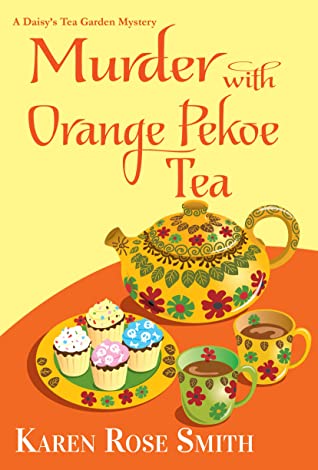
Review | Murder with Orange Pekoe Tea (Daisy’s Tea Garden Mystery 7), by Karen Rose Smith

MurderWithOrangePekoeTeaCozy mysteries and tea are two of my favourite things, so I was excited to settle into a few quiet evenings with this one. The premise for the mystery was interesting: a lawyer is murdered after taking on the case to defend a fertility clinic where staff error led to the failure of some in-vitro procedures. The daughter of one of Daisy’s friends is a client of the clinic and her husband was caught on camera threatening the lawyer, so as much as Daisy tries to demur becoming involved in the investigation, she gets pulled in anyway.

The novel was pretty good. It was a fairly easy read, the characters were likeable, and the reveal, when it came, took me by surprise. It’s also the 7th book in the series, and while I’ve only read one of the other books, long-term readers will likely enjoy seeing the deep dives into the series characters’ lives. For example, Daisy’s older daughter Vi is dealing with motherhood, and going to mommy groups. Her younger daughter Jazzi is getting ready for college, leaving Daisy with a bit of pre-empty nest syndrome, which Daisy’s boyfriend Jonas seems more than ready to fill. And there’s also a sweet subplot about a family of three women (teenage girl, mother, and grandmother) trying to figure out a living arrangement that’ll keep everyone happy, which I think may resonate with some readers dealing with a similar family situation.

That being said, the book felt overstuffed with subplots for me, many of which didn’t feel relevant to the mystery. I’m not sure if it’s simply because I haven’t gotten to know or care about many of these characters yet, but often, a plot thread would appear, but either not really go anywhere, or fail to catch my interest. For example, the novel begins with a fundraising event to build a homeless shelter in the town, which is crashed by protesters led by a young man named Eli who’d grown up Amish but chose to leave the community. Eli and his motivation for protesting became a huge part of Daisy’s investigation, but the reveal felt anticlimactic, and while there was a scene where Daisy forces his girlfriend to confront some hard truths, we also never quite see the fallout between the couple. Worse, the homeless shelter is barely ever mentioned again. Perhaps it’ll play a big role in a future book, but otherwise, it felt like a big buildup that didn’t really go anywhere.

Some aspects of the case also didn’t make sense. The clinic’s plan for defending against lawsuits is to pin the blame on the clinic tech who’d made the error, but only the CEO and the lawyer knew who the tech was. When the lawyer is killed, the CEO flees the country and still refuses to reveal the tech’s identity, for fear of his life, and much of Daisy’s investigation focuses on finding out who this tech is. But if the whole defence strategy was to blame the procedure’s failures on the tech, why would the CEO care so much about protecting their identity? On top of that, some of the clinic’s clients apparently prefer to go after the tech rather than the clinic as a whole, but I don’t understand why. Unless the staff person was super rich, wouldn’t it be much more lucrative to sue the clinic? All the focus on this staff member’s identity made me imagine all sorts of dramatic possibilities why they would have been protected by the CEO and targeted by clients, so the eventual reveal was anticlimactic.

As well, a minor quibble, but beyond dozens of scenes with characters drinking orange pekoe tea, the special of the month from Daisy’s tea garden, the tea in the title doesn’t really play much of a part in the mystery. The murdered lawyer did happen to be drinking a cup with a bag from Daisy’s tea garden when he died, but Daisy never seriously seems like a suspect, and from the droves of customers requesting the special, that detail turned out to be incidental at most. I was hoping for more. And to be honest, part of me kept wondering why orange pekoe was such a specialty at a tea garden. Isn’t it one of the most common grades of black tea? I feel like most grocery store brands use orange pekoe. Wouldn’t a tea shop spotlight a more unusual blend or a rarer type of tea?

Still, overall, this is a pretty good mystery, and despite what I feel was a surplus of subplots and characters at times, I did become invested in a few of them. Like I said, I didn’t guess the villain. I also enjoyed seeing Daisy and Jonas reflect on the future of their relationship after Jazzi leaves, and there’s a super adorable subplot about Jonas getting a dog.

+

Thank you to Kensington Books for an e-galley in exchange for an honest review.
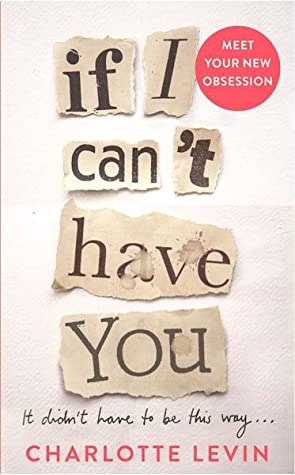
Review | If I Can’t Have You, by Charlotte Levin

IfICantHaveYouCoverIf I Can’t Have You is a compelling, surprisingly emotional psychological thriller that’s kinda like a gender-flipped version of Caroline Kepnes’ You. However, while Joe in You is downright chilling in how charming he is, even when we see how messed up his actions are, this novel’s heroine, Constance Little, is disquieting in a completely different way.

Our first introduction to her is a dramatically visual callback to Kill Bill, with Charlotte in a wedding dress soaked with blood and vomit, while riding the Tube amidst commuters of all ages. The next chapter introduces us to her obsession / love interest, Samuel, a doctor at the clinic where she works as a receptionist, and from the first few lines of Constance’s letter to him, we realize there’s something off about their relationship:

As much as I’ve been desperate to tell you how much I miss you, think about you until my head spins, my stomach constricts, it was Dr Franco’s suggestion that I write. [p. 4]

The intensity of her language hints less of love than of obsession, and the reference to a doctor immediately raises questions about the status of Constance’s mental health. And when we finally meet Samuel, and we see how he interacts with Constance, contrasted with how Constance seems to view these interactions, it becomes obvious that she’s setting herself up for heartbreak.

Like Joe in You, Constance doesn’t deal with rejection well, and as the story progresses, her interest in Samuel becomes increasingly obsessive. Yet unlike Joe, who becomes ever more creepy the more we get to know him, Constance actually becomes more sympathetic over time. Even when we recognize how messed up her actions are, it’s hard not to feel for her, and possibly even empathize with her a bit.

Part of it is, unlike the arrogant, ultra charismatic Joe, Constance is a really sad, unremarkable person. She has a tragic backstory — she’s lost both her parents, and the extent of tragedy behind their stories is revealed to us very gradually — and as a result, she truly fears that everyone whom she loves will eventually leave her. She’s forced to confront this fear in the present-day story, partly through Samuel, but, more heartbreakingly, with an elderly man whom she befriends, and honestly, there are times when you just want to give her a hug.

There’s a particularly powerful scene early on where Constance writes her father a birthday card, as she does every year, but because she doesn’t know where he is, or if he’s even still alive, she mails it in without an address. And in this scene, the mailman notices she didn’t include an address, and helpfully returns the letter to her. Levin writes this scene with beautiful restraint, tucking such depth of emotion between her lines, and honestly, the image of that envelope, with stamps but no address, and of Constance trying to pretend she just left the address at home, just about broke my heart.

But for me, what really turned Constance into a subject of sympathy more than censure is that karma actually hits her within the story. Just as she stalks, and obsesses over, Samuel, her friend Dale also becomes obsessed with her. Ironically, Constance totally misses the parallels between their situations, but her fear and discomfort in the situation are palpable. Her frantic attempts to manage his emotions and maintain her safety are distressingly relatable, and while it’s super messed up that she thinks her actions towards Samuel are somehow completely different and justified, her experiences with Dale are nerve-wracking.

Samuel is also an interesting character study for me. His careless treatment of women raises quite a few red flags. As a reader, who’s less oblivious than Constance, it’s clear from the start that he’s interested only in sex and not in anything deeper, and it’s kinda shady that he chooses not to address that directly until a few weeks into dating. He also continues to ask Constance for sex, even after he’s learned of her deeper feelings for him, and sometimes, it doesn’t so much seem as if he’s misunderstood Constance’s feelings as that he doesn’t care. But the biggest red flag to me is that he dismissively describes his ex-girlfriends as clingy and unreasonable, which is so often used by men to justify their crappy treatment of said girlfriends. Then again, it wouldn’t be inaccurate for him to describe Constance in that way, so perhaps there’s more truth to his depiction of his ex-girlfriends than I originally thought.

Overall, this is an entertaining story that I devoured in a couple of days and found hard to put down. And Constance is a fascinating anti-heroine, a perhaps softer and more vulnerable alternative to the usual fare of charismatic villains.

+

Thank you to Publisher’s Group Canada for a copy of this book as part of their holiday giveaway in December 2020.

Review | The Time for Murder is Meow, by T.C. LoTiempo

TheTimeForMurderIsMeowCoverThe Time for Murder is Meow has so many things I love in a cozy mystery: compelling lead and sidekicks, adorable kitties, bits of Hollywood behind-the-scenes, and red herrings that truly create a tangle. In this mystery, series lead Shell McMillan wants the local museum to do an exhibit of her late aunt’s movie poster collection, but her proposal is blocked by a board member who reportedly had a long-standing feud with Shell’s aunt. When the board member is murdered, Shell becomes the prime suspect, and must figure out the real killer to clear her name.

I was super confident for most of the book that I knew the villain, even while Shell pursued other suspects, but when my main suspect was unexpectedly cleared at the 82% mark, I realized this mystery was even twistier than I realized. I did figure it out within the next few pages, and am super proud of still solving the case before Shell did, but overall, I give major kudos to T.C. LoTiempo for a truly twisty and challenging whodunnit.

The characters, both series mains and suspects, are fantastic. Lead character Shell is a former actress who left the biz to move to Fox Hollow, Connecticut and take over her late aunt’s pet store, the Purr N Bark. It turns out she’s never enjoyed the glitz and glamour of Hollywood life anyway — she’d always wanted to be a veterinarian, and only fell into acting due to pressure from her actress mother. I love her backstory, and while she does make some questionable choices (pro tip: don’t yell at someone that you’ll make them while within earshot of a homicide detective), she’s a good detective, and it’s fun watching her wrap her head around the various clues.

Equally awesome is her former co-star Gary, who initially flies out to convince Shell to do their show’s cable reboot (unfortunately, despite Gary’s gorgeous head of hair, it’s Shell whom the producers consider the star attraction), but then quickly gets caught up in her investigation. I love his and Shell’s friendship, where their banter conveys mutual respect and affection. And Gary is hilarious — I love the running gag about how he keeps wanting to try new restaurants (because he’s always hungry and Shell’s a terrible cook), but just before they can actually eat, they get a new lead in the investigation, and poor Gary’s stomach has to wait. I don’t know if I’d last long as Shell’s investigative partner — unlike Gary, I’d probably tell her to go ahead while I have my lunch! — but these scenes made me laugh every time.

To the surprise of perhaps no one who knows me, the highlight of this book for me are Shell’s two cats, Kahlua (a Siamese her snobbish mom gave her before Shell could adopt from a shelter) and Purrday (her aunt’s one-eyed Persian ‘roommate’). I absolutely love how rich and vivid these cats’ characterizations are, and how distinct they are from each other. They’re larger-than-life, and their personalities are given as much depth as the human characters, and as a cat lover, I just fell all the more in love with this book because of that.

While I generally love cats in cozy mysteries, this series has won a special place on my shelves because of how much I can actually see my own cats in these characters… and yes, how much I also see myself in Shell’s cat lady-ness. The relationship between these two cats is hilarious, from Kahlua’s initial jealousy and territorialism over Shell’s bed, to their eventual teaming up when it comes to the all-important mission of demanding that Shell give them food and treats. Goofy and affectionate Purrday, with mischief that leads Shell and Gary to uncover important clues, is the more obvious feline hero, but any cat lover will also melt for the haughty and elegant Kahlua, who likely sees herself as far too smart to engage in such antics herself. These cats are a delight, and I can’t wait to see more of them! I also love how so many of the town’s residents seem to have their own pets, and I bet future instalments will give us more of a glimpse of these animals as well.

Overall, this is a fantastic beginning to a cozy mystery series. I’m hooked, and I can’t wait to read more!

+

Thank you to Midnight Ink for an e-galley of this book in exchange for an honest review.