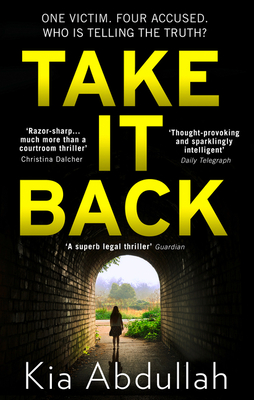
 A white girl with facial deformities accuses four handsome Muslim boys from immigrant families of rape. The boys’ versions of events match; the girl’s fluctuates slightly. But Jodi has a good explanation for the inconsistencies: she doubts anyone would believe her original story, that Amir, the most handsome of the boys, actually wanted someone who looked like her. Who’s telling the truth? And as events unfold in court, what does justice look like?
Take It Back is absolutely brilliant. Beyond being a taut and compelling legal thriller/courtroom drama, the story also dives deep into the various complexities that the case unearths. At its heart is Zara Kaleel, a former barrister turned advisor at a sexual assault clinic. She believes Jodi; it’s her job to help rape victims get justice. Yet as a Muslim woman, she also faces pressure from her community for her role in amplifying the racism towards Muslims in Britain.
Abdullah does a fantastic job at showing these traces of racism even in the initial press coverage of the case, where the journalist notes the increase in Muslim residents in the area, as if that had anything to do with this particular accusation. Other articles mention misogyny in the boys’ families’ countries of origin, and the danger they pose to ‘native’ British girls like Jodi. There’s a whole social media movement called Justice 4 Jodi that, for all that justice for rape victims is good, turns truly ugly in the comments about the boys.
Abdullah also does a great job in showing the escalation of these tensions, and the true extent of the danger faced by Zara and the boys being accused. Whether or not they actually did it, their families are all impacted by the accusation. And there’s a fantastic conversation between two of the boys, Mo and Farid, where Mo says he can’t wait for the case to be over, and Farid points out his friend’s naivete. Farid says it’ll never actually be over for boys like them; the accusation has already taken away their college enrolments, and will likely follow them into their future careers. It’s particularly true for Mo and Farid, because they are from working class families and don’t have the financial resources Amir and Hassan do. Abdullah confronts some of these realities head-on within the story, and the way some of the plot threads turn out is truly devastating.
And on the other side, of course, are the realities around sexism, and the misogyny that girls like Jodi, who aren’t conventionally attractive, face. Accusing someone of rape is a terribly traumatic act, and not entered into lightly. In Jodi’s case, she already knows her story will be met with skepticism; both her mom and her best friend doubt such handsome boys would rape someone like her. There’s a great moment in the courtroom where the barrister (prosecutor) gives his opening statement and refers to Jodi as ‘ugly’, and Zara is grateful that Jodi isn’t in the room at the time. The barrister said it to build up the case for Jodi, but Zara knows ‘ugly’ is a trigger word for Jodi, and hearing it would shake her confidence even before she gives her testimony. The scene of the defence lawyers cross-examining Jodi is heart-wrenching, and all too realistic.
Then there’s a great scene with a psychologist who’s an expert witness for the prosecution. She says rape is about power rather than desire, but sexual desire also isn’t off the table because of Jodi’s looks. She explains that some men are attracted to the ‘other’, and when Amir’s lawyer pushes her for stats, she retorts (brilliantly, in my view) that he needs to set more specific parameters for his question. Because in today’s society, even men who like larger women may be considered as desiring an ‘other’, but ‘chubby chasers’, as the psychologist termed them, are hardly outside the realm of common behaviour.
So there’s a lot in this case as well about how women are viewed in society, and how our worth is often measured by our physical appearance and society’s measures of desirability. There are some incredible quotes from Zara on this that just made me pause my reading to applaud, they were so good. Like how women aren’t born warriors; we learn to fight because we have to.
And all of this works so well because Abdullah deliberately keeps the truth about the incident unclear. The back blurb invites us readers to “take our place on the jury,” and indeed, this is the perspective we’re given on the incident in question. We see the pieces of evidence and the testimonies as they unfold in court, and we make our own deliberations based on them. We do see Zara’s responses to the evidence, but I at least responded differently at certain points; like when one of the boys uses the c-word on the stand and Zara thinks this’ll turn the jury against him, whereas as much as I disliked the boy, I didn’t necessarily think he was guilty just because of that.
In fact, I was torn for most of the book about who to believe. My interpretations of the evidence, and, yes, my own personal biases both as a woman and as a BIPOC immigrant, all played a role in how I responded to the way the story unfolded. There were moments I felt genuine anger towards one or the other of the participants in the case, and then had to ask myself why I felt so strongly about that piece of the story; what biases are in play and am I being fair to the other side? When the verdict came down, I had a brief moment of glee at justice being done, only to have more compassionate views from other characters make me question my response.
One of the characters calls the verdict ‘a Pyrrhic victory,’ in that no one actually wins in the end, and I think this totally sums up the realities of the case. It has brought up so much hatred within the community the characters live in — hatred against Muslim men and immigrants, hatred against unattractive women — that, as Abdullah makes abundantly clear throughout, this case has never been just about an allegation of rape.
All to say, this is an absolutely brilliant book, one of the best I’ve read this year. I’m definitely planning to read more in this series. I can’t wait to read about Zara again, and the wonderful cast of supporting characters: Zara’s friend Safran who is just super friendship goals; the investigator Erin, who is super beautiful and with some secret pain in her past; and the police detective Mia, who is compassionate and fair, and who helps Zara recognize that it isn’t weak to ask for help.

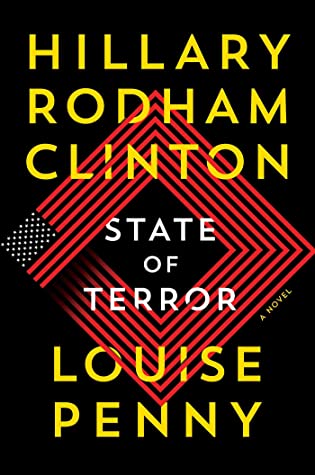 State of Terror is such a taut, gripping thriller, and heartfelt ode to friendship and love. The heart that makes Louise Penny’s Gamache mysteries so good is here in Ellen’s relationships with her children and her BFF Betsy, and in the General’s random references to John Donne poems.
 Literary Treats