Review | The Sense of an Ending, Julian Barnes

To be honest, I don’t really know what to say about Julian Barnes’ Sense of an Ending, and I mean that in the best way possible. I was chatting about it with @bookgaga on Twitter, and the more we talked about the book, the deeper and more complex I felt the book was. I liked Ending. It’s one of those books I wish I owned rather than just borrowed, because there were just so many passages I wanted to highlight. Reading it at a coffee shop, I alternated between “Hmm…” and “Ooh, so true.”

I read Ending because my co-worker, whose book taste I trust, told me to. “You told me to read Major Pettigrew’s Last Stand,” she said. “I’m returning the favour and telling you to read this book.” We both adore Major Pettigrew (my review here), and Ending is such a wonderfully short book (only 150 pages!) that I figure I might as well. (For the record, I still like Major Pettigrew better, because I got more lost in that story than in this one.) Ending is about Tony Webster, an elderly man who receives a letter from a lawyer that causes him to think about his past. A huge part of that past are Tony’s school friend Adrian, and Tony’s first serious girlfriend Veronica. As the book’s jacket tells us, “[m]emory […] is imperfect,” and Tony is forced to rethink some of the ways he’s viewed the events in his life.

Barnes caught me with the first chapter, but that may be just because I’m a sucker for school stories. I love the schoolboy humour: for example, asked to elaborate on what he meant by there being “unrest” during Henry VIII’s reign, a student replies, “I’d say there was great unrest, sir.” Juvenile, but the narrator uses that same line (“There was unrest. Great unrest.”) to end the book, and that just blew me away. What had begun as a throwaway schoolboy comment had, by the end of the story, become utterly profound. What else, after all, is there to say about life?

I also love the self-conscious reflection of the adult narrator: “Yes, of course we were pretentious — what else is youth for?” I cringe now when I remember how self-righteous and self-important I was at various episodes in school — were we ever really so naive? Barnes’ school scenes remind me of Paul Murray’s Skippy Dies (brilliant book!), but with too much adult self-reflection to enter the teenage psyche as completely as Murray did.

Ending isn’t about a schoolboy, but about a man having to give up the pretensions and illusions he’d had as a boy. From looking forward to having a girlfriend to falling in love with Veronica only to have her break his heart. From dreaming of changing the world only to end up with a rather unremarkable life.

I have to admit, it took me a while to warm up to the post-school part of the book, and that’s mostly because I found Veronica such an unlikable character. She’s cold and manipulative and I just got really annoyed at Tony for being so much in love with her. I kept wanting him to dump her, and, with such a short book, was afraid the book was going to be all about their romance. In my snap judgment of Veronica, I admit I fell into the same trap Tony falls into over and over again, and perhaps my reaction to Veronica is a testament to how skillfully Barnes has used Tony as a narrator. I went from accepting Tony’s view as gospel to realizing he jumps to conclusions so often that his opinions can’t really be trusted.

“History isn’t the lies of the victors,” Tony tells us. “It’s more the memories of the survivors, most of whom are neither victorious nor defeated.” It’s a profound statement, and one that raises so many questions about the nature of history. What role then would these survivors have played in history, and what kind of agenda do they now have in telling us the story? If they were on the sidelines, how much did they actually know about what happened? In the case of Tony’s history, we learn that he constantly has to rewrite his view of the past, as he continues to find out new things. Barnes gets a bit too obvious with comments like “Annie was part of my story, but not of this story.” We get it! Tony  is a narrator controlling the information we get, and I’m sure university English classes will have lots to discuss about lines like that and the role of the narrator. Luckily, however, Barnes also reveals it well through the plot.

We learn, along with Tony, that history, even personal history, isn’t absolute. Just because we learn another facet of someone’s story doesn’t mean we know his or her whole story. So, in the end, when certain discoveries lead Tony to revise his thinking on a couple of major characters, I found his new views yet another absolute and therefore not to be trusted. Yes, certain discoveries cast a more damning or more sympathetic light towards some characters. However, by the end of Ending, I’ve read enough to say, not “Now I understand him/her better,” but “what else have we not been told about him/her?”

Author Encounter & Giveaway | Peter James

Now how could I resist an invitation like that? Meet an author, meet Harper Collins people I chat with on Twitter, and, most of all, eat snacks. Seriously, though, if you’ve caught my review of Peter James’ Dead Man’s Grip, you’d know that I’ve recently become a fan of his Roy Grace series. After meeting him last Wednesday, I must say I’ve become a major fan of the man as well.

Sometimes called the real-life Castle, Peter James researches his novels by going out with actual police officers on their beats. Once, he was with some police officers when they encountered a group of drunken men. Off to the sidelines taking notes for a book, Peter realized it was about to get violent and that he had to do something. “So,” he told all of us gathered at the Harper Collins Canada office, “I immediately looked for the smallest guy.” That brand of heroism explains the tiny handcuff pin he was wearing on his lapel, a joke gift from a police force because that was about the size of the criminals he was capable of arresting.

I don’t really know what I was expecting when I met Peter James, but it certainly wasn’t the super smiley, sweet and absolutely delightful man he turned out to be. After all, this was the man whose book turned me off salmon for weeks. (Interesting side note: I actually ate smoked salmon before meeting Peter, and regretted it when he mentioned the salmon scene in his talk.) Still, when he walked in with a glass of wine and a huge smile, he looked mostly like a kindly librarian, and you just can’t help but smile back.

I’m very nervous when meeting authors, so it helped that Peter was so friendly. It was so easy to chat with him that Cory from Harper Collins finally had to step in at around 9 pm and suggest that we ask our questions while getting our books signed.

Interesting things I learned about Peter James

  • He once had himself locked inside a coffin for half an hour, to see how it felt like, so he could write a scene authentically. “I wasn’t completely stupid,” he said. Before getting into the coffin, he’d asked someone how much air he’d have inside. Answer: 3 hours if he didn’t panic, 1 hour if he hyperventilated. So Peter went for 30 minutes. Still, as the funeral parlour man was walking off after sealing him in, Peter couldn’t help thinking about how old the funeral parlour man was. Plus, “What if he gets run over before coming back?”
  • He allowed himself to be locked in a van and submerged in Shoreham Harbour as a publicity stunt for Dead Man’s Grip. Why? Well, Jeffrey Deaver’s James Bond novel Carte Blanche was being released at about the same time. Peter wanted Roy Grace to give James Bond a bit of competition in publicity. Don’t believe me? Check out this video:

I asked Peter if he ever spoke to criminals for his research. I personally found Tooth (cold-blooded killer for hire in Dead Man’s Grip) a very well-developed character, without us getting too much of his back story, which is very rare for thrillers. Turns out, he does. He wanted to find out the motivations behind various crimes, so, for example, he once interviewed a career burglar. It also turns out that Peter intentionally shows all three perspectives in his books: victim, cop and killer. It’s an interesting choice, something I liked in Dead Man’s Grip, and definitely not an easy balancing act.

Win a signed copy of Dead Man’s Grip

It was a fun evening, and I especially love the way Harper Collins packaged our event swag. As I mentioned in my Dead Man’s Grip review, Shannon from Harper Collins had already kindly given me a copy a few weeks ago. Personally, I think he’s a fantastic writer, and if you haven’t read him before, I think Dead Man’s Grip is a great way to get into the series. (My review here) I’d love to introduce you all to this mystery series. (Or, if you’re already a major Peter James fan, I’d love to let you read his latest!)

So here’s the deal: leave me a comment on this post by October 15. Imagine you’re a novelist. What’s the wildest stunt you’d pull to research or publicize your book? (If you can’t think of anything, just leave whatever comment you want. I just think it’ll be fun to see what kind of stunts you’d come up with. 🙂 ) One of you, randomly picked, will win a signed copy of Dead Man’s Grip. (Sorry, I’m keeping the cool bookmark and ever cooler yellow crime scene tape for myself. 🙂 ) Canada only, please.

Vote Peter James

By the way, Peter is also in the running for ITV3 People’s BestsellerDagger Award. You can vote for him here till Oct 7th, 9 am. Whether you’re already a huge fan of the Roy Grace series, or you just want to give props to an author who’d actually lock himself in a coffin and risk drowning himself in a van, you can vote there up to 5 times. Bonus: If he wins, Cory from Harper Collins Canada has promised to throw an authentic English fish and chips party like the one Peter James promised his UK fans. Personally, I like Roy Grace, I think Peter locking himself in a coffin is insane but kinda cool, and I love fish and chips. So I voted.

EDIT: Yay! Peter James won the People’s Bestseller Dagger Award! Very well deserved, in my opinion.

Another Dagger winner is S.J. Watson, whose novel Before I Go to Sleep kept me up all night, literally. Loved it and blogged about it here.

Congratulations, Peter and S.J.!

Do leave a comment for your chance to win a signed Dead Man’s Grip. Trust me: you’ll love it.

Happy birthday, Jess! ~ Review roundup in honour of my sister

My sister Jessica is celebrating her birthday today. She’s introduced me to some of my favourite books and writers ever, including:

  • The Harry Potter series by J.K. Rowling
  • The Rebus series by Ian Rankin
  • The Spenser series by Robert B. Parker
  • The Guido Brunetti series by Donna Leon

… and lots, lots more. So, I figured, what better way to celebrate her birthday on my blog than by writing about some books and genres she loves?

The Hunger Games trilogy, by Suzanne Collins

I don’t have to tell you how awesome this series is, do I? It’s one of the most brilliant YA series I’ve read, possibly second in my mind only to Harry Potter. It took me months to convince Jess to read it, and she’s now an even bigger fan than I am. It just has everything: an inspiring heroine, self-sacrifice, politics, reality TV, family, kick ass action scenes, and yes, a love story.

If you’re one of a handful who hasn’t read the book yet, check out the website here to find out more about it. Better yet, read the books already. Trust me on this one.

Even better, there’s a movie out in 2012.

Love The Hunger Games and looking for your next read? May I suggest Moira Young’s Blood Red Road or Veronica Roth’s Divergent.

And, if you’re a nerd like me, check out The Girl Who Was on Fire, full of essays about the books.

View my review of The Girl Who Was on Fire 

To Kill a Mockingbird, by Harper Lee

One of Jess’ favourite books ever, and I’m sure a lot of you already agree about how awesome this book is.

Harper Lee’s To Kill a Mockingbird still feels as relevant today as it did when it was first published. Despite all the tense race relations Lee depicts in her story, Lee also offers us some of the most inspiring characters in literature. How often do we watch the news and wish we had lawyers or politicians with as much integrity and passion for justice as Atticus Finch? How much do we wish we had the same staunch beliefs in right and wrong that Scout has? In Lee’s tale of a white lawyer defending a black man in a racist town, we simply fall in love with her characters, and cheer them on, whole-heartedly, in their battle, which is a battle for justice, but more importantly, a battle against hate.

The Sigma Force series, by James Rollins

Actually, any book by James Rollins is guaranteed to have two things: insane thrills and science that seems too weird to be true, but is actually based on extensive research. The Sigma Force series, which Jess introduced me to and we both love, has the added bonus of starring a team of kick-ass nerds. Seriously, imagine Sheldon Cooper with a black belt in karate and Iron Man type gadgets.

Reading Rollins is always like watching a good movie: you’re riveted by the action, and freaked out by the knowledge that there’s a kernel of truth in the story. His latest, Devil Colony, isn’t my favourite of his books, but it’s still pretty damn good.

View my review of Devil Colony

For Rollins fans: he’s a very active tweeter, and chats often with fans.

Follow James Rollins on Twitter

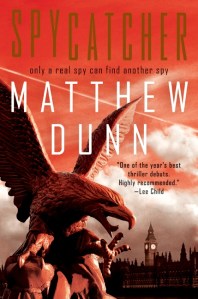
Spycatcher by Matthew Dunn

Jess is a huge fan of spy novels, especially those that feel “close to the ground.” John Le Carre, Alan Furst and Len Deighton, rather than Ian Fleming. Matthew Dunn’s Spycatcher caught my eye as something she’d enjoy. To my delight, I absolutely fell in love with this book myself, and I’m not even much of a spy fiction fan.

Dunn is a former MI6 agent, and like Le Carre, his field experience is almost palpable in his writing. (Unlike Le Carre, Dunn doesn’t use a pseudonym, which I find interesting.) Spycatcher follows Will Cochrane as he tries to stop an Iranian terrorist. It’s a thrilling story, and while Cochrane and his team appear almost superhuman at times in their strategies, Spycatcher works so well because we see Cochrane’s vulnerability, his humanity. We feel his pain at not having seen his sister in eight years, and we long as much as he does for him to be able to settle down with the woman he loves. Incredible book, and I can only hope Dunn writes even more.

View my review of Spycatcher

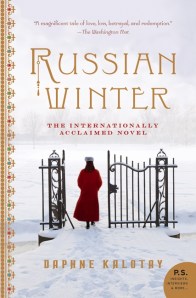
Russian Winter by Daphne Kalotay

Jess loves books about Russia, especially books written bySolzhenitsyn, Dostoevsky and Chekhov. I haven’t blogged about any of their books (I’ve also never read Solzhenitsyn, though Jess assures me he’s really good), so here’s the next best thing: Kalotay’s Russian Winter is about Nina Revskaya, a former ballet dancer now living in Boston and auctioning off her jewelry. A mysterious link between her and a man who appears to own a necklace that belongs to one of her sets leads Nina to remember her past in Russia under Stalin. The present-day scenes were okay, but I just love the scenes in Russia. The descriptions of ballet are just beautiful, and Kalotay makes us feel both the fear of Stalin and the characters’ desire to escape this fear through art.

View my review of Russian Winter