Review | Mangaman, Barry Lyga (writer) and Colleen Doran (illustrator)

What a fantastic concept! A boy from the world of manga (Japanese comics) lands int he real world and falls in love with the prettiest girl at his high school. Only thing is, in true manga fashion, his eyes literally turn into hearts when he sees her. His classmates find this rather… odd. There’s that added sly wink at the reader because, to us, Marissa and her classmates are as much characters in a comic book as Ryoko is to them, and writer Barry Lyga and illustration Colleen Doran certainly make the most of this metafictive aspect. I love Mangaman for its hilarious and surprisingly touching love story, and I especially love its fantastic mash-up of two completely different comic book styles — American realism working with Japanese fantasy. Ranma in Riverdale. Love it. Check out the book’s site for a preview: http://mangamanlives.com/.

I expected to be delighted by Mangaman; I did not expect to be moved by it. Ryoko’s manga-style special effects are involuntary and therefore hilarious, but there’s also an element of tragedy to them, because all he really wants is to fit in, and he never can. I love Ryoko and Marissa’s first encounter: It’s a party and Ryoko is introducing himself to his classmates and asking them not to be afraid of him when he catches sight of Marissa. Immediately, flowers and excitement lines burst from him, and his entire body transforms into a drooling, flappy-armed beanie doll with bulging heart eyes and fiery hair. “I’m sorry,” he says, squishing his cheeks back to ordinary proportions, and poking a heart back into an eye socket. “I’m not going to hurt anyone.” Marissa stares in shock, flowers still fluttering down around her. Hilarious image, yes, yet Ryoko’s humiliation is palpable, and the image of him so desperately, so physically, trying to mould his features back to normal touched me. I just wanted to hug him and tell him there’s nothing wrong with literally exploding out of your skin when you see the one you love.

Cultural misunderstandings arise as well. When Marissa’s ex-boyfriend tells Ryoko to stay away from her, Ryoko exclaims “I know this part!” He strikes a fight pose and says “Big-time high school challenge! Awesome karate fight!” Special effect-filled battles may be fairly common in manga, where characters never really stay hurt, but they have real consequences in Marissa’s world, and Ryoko’s certainty that he’s finally found a familiar custom dissolves into the realization that he’s just set himself apart as more alien than ever.

I was cheering on the love story all the way. While Marissa’s classmates are turned off by Ryoko’s strangeness, she is drawn to him. He offers her something different from a life she finds bland and restrictive. Her choice of a Japanese outfit for the party at the beginning of the book is a bit kitschy, but her desire to reinvent herself without a clear idea of what she wants to become is something many will relate to. In their own ways, neither Ryoko nor Marissa fits in, and their romance works because their relationship allows them to view their standing out as something to celebrate.

Mangaman can be as much of a lark or as deep and textured of a tome as you choose. Ryoko is the ultimate visual metaphor of children and teens who feel they don’t fit in, and can never help but stand out, for whatever reason. The story encourages new perspectives — you need to look beyond the frame (literally for comic book characters) to discover the more exciting world beyond your own experiences. I also enjoyed the metafictive aspects — a comic book character in the “real world” of another comic book within our real world and what are the boundaries of reality, etc. I like the cross-cultural angle — West meets East, comic book style. At its heart, however, Mangaman to me is ultimately a funny, sweet story, told in beautiful, genre blending illustrations, and I hope it will touch and delight you as it did me.
Review | The Giver (The Gift Edition), Lois Lowry, illustrated by Bagram Ibatoulline

Lois Lowry’s The Giver changed my life when I was young, about 14, I’d guess. I was trying to figure out what I wanted to do with my life, and all I knew was that I didn’t want to become a businessperson. My relatives were all businesspeople, and not even in exciting jobs like manufacturing toys or selling books. With the exception of one uncle whose job required him to travel often, everyone else’s jobs seemed a vague, bland mass known only by the generic term “business.” I wanted to be something more exciting — a writer, maybe, or a lawyer or detective! My career dreams were heavily influenced by books I loved to read, where characters seemed to lead such exciting lives. Yet I was also afraid an office job would be my most practical, viable option. At 14, I wasn’t sure what I wanted, only that I wanted to LIVE, all caps, flashing lights and everything.

So Jonas’ world in The Giver really spoke to me. An orderly, “perfect,” yet ultimately colourless society, it is an ambiguous utopia, much like Anarres in Ursula le Guin’s The Dispossessed, where the inhabitants are content enough (no Hunger Games style scrounging for food) but no one’s truly happy. Everyone’s life is strictly planned out since childhood; your career is chosen for you at twelve based on your observable skills and you enter a few years of training before starting to work. All the memories of the world we know — all all the joy and pain that come with them — are stored in one person, The Receiver, who shields the rest of the town from those experiences. This society has sacrificed individual freedom and extreme emotion for peace and satisfaction.

I love how Lowry launches us into this society’s mindset right away, showing how even thought and language are restricted from the very first paragraph:

It was almost December, and Jonas was beginning to be frightened. No. Wrong word, Jonas thought. Frightened meant that deep, sickening feeling of something terrible about to happen.

Jonas almost immediately corrects himself: he doesn’t feel frightened, he feels “apprehensive.” Can you imagine the twelve year olds — or heck, even the adults — in our society, who can easily say things like “OMG, I’m freaking out!” about standing in line for the upcoming Hunger Games movie censoring their emotions like Jonas does automatically? To 14-year-old me, all eager to LIVE, Jonas’ world seemed like hell.

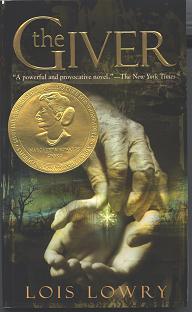
cover of my original copy from 1990s

When Jonas starts to realize himself that his world isn’t as perfect as he’d always been taught to believe, I wanted him to start a revolution. His battle was my battle, in the way only the very best books, read at just the right time, can do. If he can introduce passion to his world, it somehow meant that I too would be able to inject passion into my own future.

A lot of dystopian YA has been written since Giver, so let me make this clear up front: Giver doesn’t have the action or thrills of Hunger Games or Divergent. It’s a quieter, more contemplative and philosophical book. It’s also absolutely brilliant, a great book for anyone from eight years old up. It blew me away when I was 14, and it still blows me away now, at 28, though in very different ways.

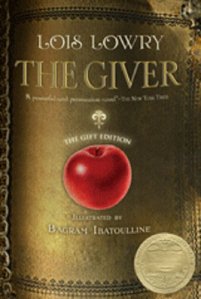
So imagine my delight when HMH published a gorgeous gift edition, complete with illustrations and a ribbon bookmark. It’s utterly beautiful, one that I love to think will introduce a whole new generation to this story and grace the shelves of long-time fans like me, right beside the tattered, dog-eared copy with yellowing pages read so many times over the years. When I received this book in the mail, I literally had to stop for a moment, stroke the cover, savour the slow turning of pages, and just, well, stare in awe. My sister too, who first read it when she was 10, almost teared up when I showed it to her. We all have that one book from childhood that stays with us forever. The Giver was that book for me, and seeing it re-released over a decade later, in such a beautiful edition — well, it’s an experience I wish upon all of you.

Minor quibble, and to be honest, I don’t know how they could’ve avoided it, is that the illustrations give away a minor spoiler about something revealed only mid-way through the book. (If you haven’t read Giver yet, skip to next paragraph.) I remember reading how the apple changed for Jonas and not knowing how, because Jonas himself didn’t understand the change. I loved the experience of trying to figure out how it could’ve changed, and being utterly shocked at the discovery later on that colour was a foreign concept to Jonas’ town. Here, the illustration shows the apple bright red between black and white figures, robbing the readers of the experience I had, of imagining all the ways the apple could have changed. The idea of utter colourlessness is as foreign to me as colour is foreign to Jonas’ town, and I remember struggling to imagine how such a town would look. Is everything in black and white or just vague, translucent outlines? Are black, white and grey considered colours and if so, how does this town look? With Ibatoulline’s black and white sketches, however beautiful, this edition takes that mystery away completely. Unavoidable, but also somewhat regrettable.

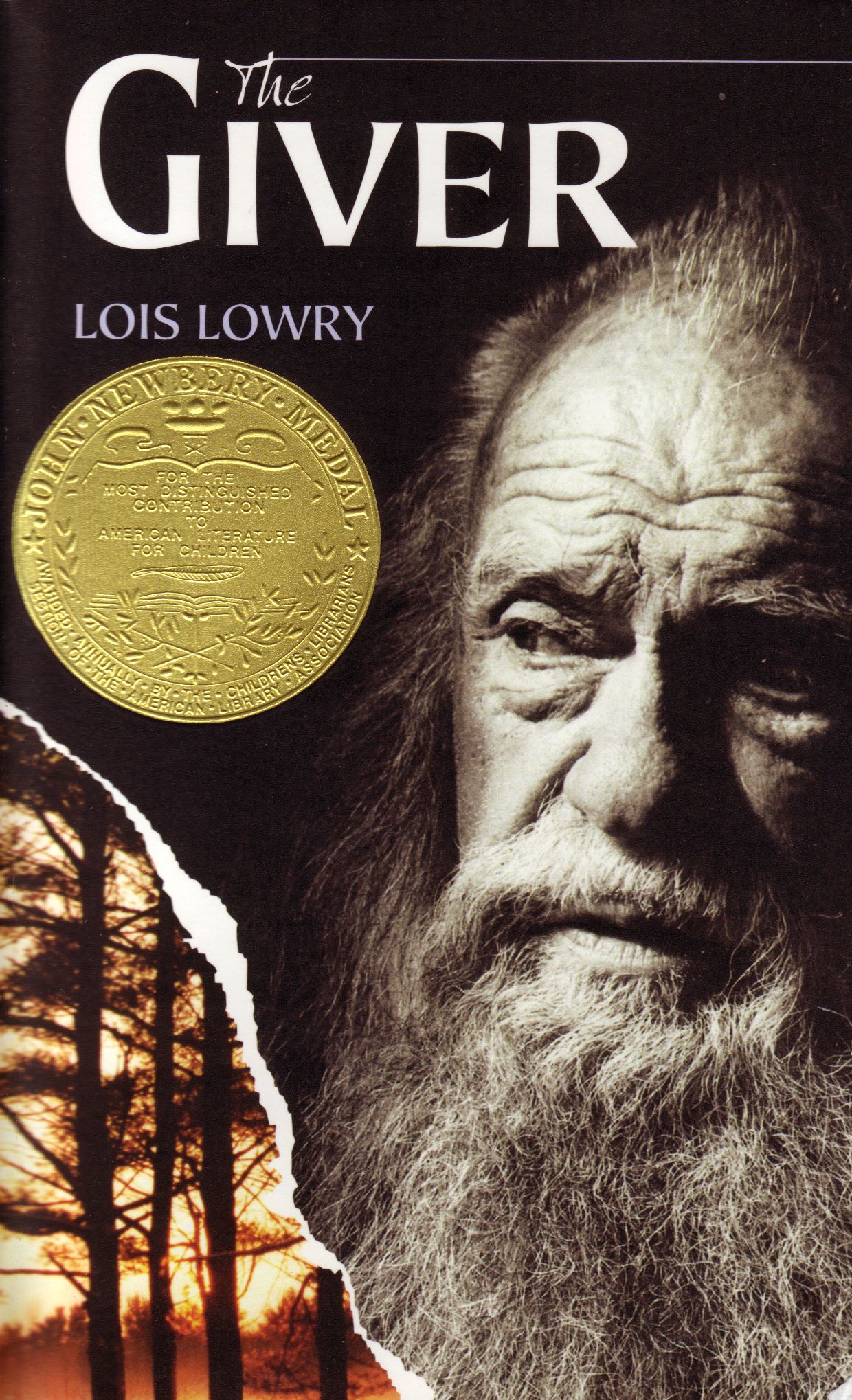
the cover of another edition I own

Overall, The Giver (Gift Edition) is a beautiful, fitting tribute to a mind-blowing classic. I love reading it again at 28 and seeing how much my views have changed since 14. I understand better now the desire to wipe out all pain and just lose all the memories that hurt, and I can see how that can be tempting enough to make me willing to give up even the potential for strong positive emotions. I can see how people would be willing to give up individual choice if that was the only way all wars and conflict would end. I still don’t think I’d make the choice that Jonas’ society did, but I do understand them better now. I see more now the subtle nuances in Lowry’s tale and appreciate its complexity better. What will I think of it at 42? At 56? Even next year, I might read it differently. The Giver is the kind of book that grows up with you, I think, and I love that about it.

For anyone who’s interested about how my 14-year-old self’s dreams turned out: I actually did end up with a business degree. I also ended up with jobs in an art gallery and a bookstore, both of which I think will thrill my inner 14-year-old, and both of which put my business background to good use. I grew up, and learned, among other things, that business doesn’t have to be boring after all. More importantly, I learned that even with a boring job, one’s life never has to be colourless. The most mundane moments come with infinite possibility, and excitement can come from the smallest things. That spark, or rather, the desire to keep that spark ignited, I owe to Lois Lowry, The Giver, and the amazing reading experience I had at 14.

+

Edited January 27, 2013:

For anyone who may not be aware: The Giver is the first book in a series of four. The final book, Son, was published last Fall. My review of Son here.

Review | The Chronicles of Harris Burdick, Chris Van Allsburg et al

“The story of Harris Burdick is a story everybody knows,” Lemony Snicket writes in his introduction to The Chronicles of Harris Burdick, “though there is hardly anything to be known about him.” Over fifty years ago, a man named Harris Burdick appeared at the office of children’s book publisher Peter Wenders. Burdick brought with him fourteen illustrations with captions and left, promising to return with the full stories the next day. No one ever saw Burdick again.

Truth be told, I wasn’t familiar with the legend of Harris Burdick, and immediately Googled him — surely, there must have been some clue about what happened to him? Turns out, he is a creation from the mind of children’s book author and illustrator Chris van Allsburg (also the genius behind the classic The Polar Express). I was somewhat disappointed at this discovery, but I was also in awe of van Allsburg’s imagination. What a marvellous idea! To learn more about Harris Burdick and see some fantastic stories inspired by him, go to www.whoisharrisburdick.com. There’s also a teacher’s guide at www.mysteriesofharrisburdick.com.

What is real is the amazing rush of imagination Burdick’s captioned illustrations inspire. In his 1984 introduction to the original Mysteries of Harris Burdick, van Allsburg writes, “I told Peter Wenders how difficult it was to look at the drawings and their captions without imagining a story.” Indeed, an idyllic image of children by a lake comes with the intriguing, horrific caption “He threw with all his might, but the third stone came skipping back.” An image of a harp in the woods has the caption “So it’s true, he thought, it’s really true,” which holds the promise of wonder and magic. The seemingly ordinary thriller-type caption “His heart was pounding. He was sure he had seen the doorknob turn” raises all sorts of questions with the accompanying illustration of a room with a door barely two steps high. I would love to take these illustrations to a third grade class and see the kind of stories eight year olds can come up with. I can imagine readers and writers of all ages delighting in the imaginative experience of creating the lost stories of Harris Burdick.

In Chronicles, that task falls to several of the best, most imaginative authors of our time. Included are stories by Stephen King, Lois Lowry, Gregory Maguire, Sherman Alexie, Kate DiCamillo, Cory Doctorow, and the creative genius who began all this in the first place, Chris van Allsburg. Seriously, this line-up alone was enough to make me want this book, even before learning the legend of Harris Burdick.

The book lives up to its promise. Put such talented writers together, provide them such inspiration and let their imaginations fly, and you end up with a wide range of really good stories. I enjoyed reading these stories, and I love how I enjoyed each story for a very different reason. Stories range from sweet to spooky and the subject matter from mundane to extraordinary.

Some stories in the collection did stand out for me, and for very different reasons. Sherman Alexie’s “A Strange Day in July” is one of my favourites. Alexie took the Enid Blyton-esque image of children by a lake and went the Neil Gaiman/Stephen King route, crafting a remarkably chilling tale about a pair of strange (to my mind, almost psychotic) children. As a major bookworm, I really enjoyed Walter Dean Myers’ “Mr. Linden’s Library,” about a book that kept writing itself as you read. It’s more sinister than you would imagine. Jon Scieszka’s “Under the Rug” is an amusing horror story that for some reason reminds me of Roald Dahl, about a grandmother who spouts cliche’d wisdom and a grandchild whose laziness creates a Dust Monster. Scieszka’s ending was unexpected, yet it totally fit, and I love how he poked fun at the grandmother’s bite-sized pieces of advice. Linda Sue Park’s “The Harp” is a traditional fairy tale, but its ending is very touching. I love the scientific angle to Chris van Allsburg’s “Oscar and Alphonse” and the Twilight Zone feel of M.T. Anderson’s “Just Desert.”

Chronicles ends with a blast, literally, with another of my favourites, Stephen King’s “The House of Maple Street.” I love how King weaves unexplained supernatural elements into a story about domestic abuse and child empowerment. The stepfather in this story is a total jerk, I felt for the mother, and I was cheering on the kids the entire time. Though it’s the supernatural elements that resolve the conflict in this story, it’s the true-to-life elements that stuck with me.

Chronicles of Harris Burdick is an absolute treat. It’s a wonderful storybook, and I love reading all the stories these authors came up with. But it’s also a marvellous nudge on the imagination. Van Allsburg is right — it is difficult to see these images, especially with their captions, and not have the imagination spark with all the possibility of storytelling. Personally, I’d be fascinated to see the stories other authors would make from these images, particularly J.K. Rowling, Suzanne Collins and Arthur Slade. In the meantime, I think Lemony Snicket’s introduction sums up the experience of Harris Burdick perfectly: “As you reread the stories, stare at the images, and ponder the mysteries of Harris Burdick, you will find yourself in a mystery that joins so many authors and readers together in breathless wonder.” Breathless wonder, indeed.