
Review | Stroll, Shawn Micallef

…there’s something about the proximity of those quiet woods to the nearby village that makes Frost’s poem [Stopping by Woods on a Snowy Evening] seem cozy and urban – a quick escape into the wild but never far from civilization. How wonderful it would be to walk through a forest on the way to a friend’s house, or to a tavern or movie in another part of the city. In Toronto, the best of nature and the city often intersect… [p. 202]

Only Shawn Micallef would pair “cozy” and “urban,” and only he would link Robert Frost’s poem about the woods to a city, let alone Toronto. His view of Toronto having the intersection of nature and city is a tad more romantic than I would normally think, and it’s just this romanticism that makes Micallef’s Stroll such a great book. Micallef views his city with an almost childlike sense of wonder. Informed, certainly, by his vast knowledge of the city’s history, as well as conversations he has had with various others, but there’s a youthful excitement in Micallef’s approach to exploring Toronto. Remember how when you were a child, even an office cubicle can transform into a land of adventure? That’s the view Micallef presents of Toronto — every sidewalk is a path to adventure, every building a potential locale for a story.
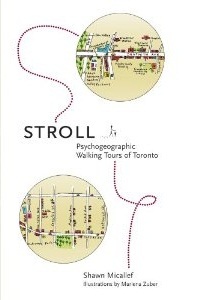
I remember when the book first came out. I was working as a bookseller then, and what began as an easy database-search-type recommendation for tourists looking for a book on walking tours in Toronto turned into my go-to recommendation for anyone looking for a book on Toronto. What swayed me is this fantastic bit from Micallef’s “Flaneur Manifesto”:

Over and over, we’re told that Toronto is not Paris, New York, London or Tokyo. We’ve been trained to be underwhelmed… Any Toronto flaneur knows that exploring this city makes the burden of civic self-depracation disappear. [p. 10 – 11]

Hear hear, Mr. Micallef. In Stroll, Micallef chronicles his wandering walks around Toronto, covering the downtown core, and, more significantly, spreading out into Pearson Airport, North York, Scarborough and the Port Lands. I know of Stroll readers who take their copy with them as they walk around Toronto themselves, perhaps using it as a guide, to point out things they may not have noticed on their own. I opted instead to read Stroll at home, enjoying the treat of dipping into it and checking out a neighbourhood or two at a time, mini adventures where my imagination took me on these tours. Reading about neighbourhoods I was familiar with is quite an experience — as Micallef’s narrative moved along certain roads and noted certain landmarks, I could picture these areas clearly in my mind. Once in a while, I’d learn a fascinating tidbit about the history of a building I’d passed numerous times without noticing; other times, Micallef would mention a detail I hadn’t noticed at all, and I make a note to take a look myself next time I was in that area.

Reading about neighbourhoods I’d never visited is a different kind of adventure. In a way, it’s not quite as thrilling — I no longer had the memory of the landscape to guide my imaginary tour. On the other hand, this just means that all these neighbourhoods are still waiting to be explored. As Micallef says, you realize how large Toronto is, to be able to fit all of this in it.

Toronto through Micallef’s eyes is an adventure. His affection for the city is infectious, and he punctuates informational tidbits with humour and whimsy. I highly recommend this book for tourists, new Torontonians, people moving away from Toronto, and anyone, really, who wants to view the urban landscape in a new way.

I recently joined a Jane’s Walk that Micallef led. At one point, he stopped walking, glanced around and, for no discernible reason (at least to me), stepped onto a patch of dirt and grass and zigzagged through that rather than stick to the pavement. So much of my walking around, at least, involves getting from one point to another (in other words, I would most likely have stuck to the pavement). Micallef’s seemingly aimless wander opens up familiar locales to adventure, and that’s why Stroll is such an amazing book.

It helps as well to have Micallef’s highly romanticized view of his surroundings, picking out random details that would usually escape attention and finding the whimsy in them. During that Jane’s Walk, Micallef stopped by the 403 and told the group to close our eyes and listen to the cars zipping past. You could almost believe, he said, that you could hear the ocean. That’s a bit of a stretch, Mr. Micallef, but hey, why not? I’ll give it a try.
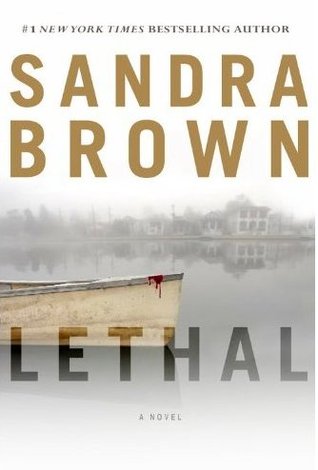
Review | Lethal, Sandra Brown

Lethal by Sandra Brown is a fun romantic thriller. Honor was enjoying a quiet day with her daughter Emily when both are taken hostage by suspected mass murderer Lee Coburn. Hardly the set up for romance, except it turns out that Lee has his own version of what happened the night of the murders. He also thinks Honor’s husband had been killed over a secret, and that that secret has now made Honor and Emily a target for The Bookkeeper, a mysterious, ruthless crime lord. Who can Honor trust, and will Coburn keep her and Emily safe? Lethal goes from plot twist to plot twist rapidly, and the chemistry between Honor and Coburn is great.

It was a bit difficult to see Coburn as a potential hero in the beginning — he was still bloodied up and injured from the evening of the murders, and he kept threatening Honor with Emily’s safety if she didn’t cooperate. So I’m glad Brown kept the sexual tension in these scenes to a minimum — we see hints of Honor and Coburn finding the other attractive, enough to set up the eventual romance, but the focus is on Honor’s fear and her concern for Emily.

Once Honor decides to trust Coburn, the story really takes off with a hunt for Eddie’s secret and to escape from The Bookkeeper. While I don’t usually like the kid characters in thrillers like this, I thought Emily was well done. Her innocence and charm help counterbalance Honor’s fear, and urge out Coburn’s softer, sweeter side. The mystery was well done — I had no idea what Eddie’s secret was, and with even Coburn in the dark, I had no idea how they could find out. I somewhat guessed the identity of The Bookkeeper before the big reveal, but that was probably more luck than anything (as in I had about three major suspects and one of them turned out to be right).

On a minor note, there’s a subplot that I loved, about the FBI agent Tom, his wife Janice and their special needs child Lanny. Tom is a desk jockey, somewhat out of his depth in a murder investigation (the manhunt for Coburn), yet hopeful that his more exciting role will impress his wife. In a touching scene, Tom suggests to Janice that they put Lanny in a facility.

…he spoke before she could. “That’s not a criticism of you. Your patience and endurance amaze me. Truly. But caring for him is killing you.”

“You’re exaggerating.”

“Am I? It’s shredding you, body and soul. I see evidence of it daily.”

“You can look into my soul?”

Her sarcasm was more effective than a flat-out rebuke would have been. [p.101]

In the midst of all the thrills and adrenaline over Honor and Coburn’s story, Brown gives us this quiet, fraught exchange between a long-married couple. It’s an intense scene, one that immediately made me care for both characters and want them to work things out. That scene ended even more sadly, with Tom going to bed and realizing his wife preferred playing word games on her phone with someone in Singapore to sleeping with him. The Tom and Janice story turned out to have a bit of a twist in the end, adding even more layers to their relationship. Personally not too happy with their part in the story, but I do like their characters.

I’m also not too thrilled with the way Lethal ended. It just felt gimmicky to me, and I wish Brown had opted for a more traditional ending. Still, I like the chemistry between Honor and Coburn, and I thought the mystery was fun and fast paced. Overall, Lethal is a fun, exciting, romantic read.

+

Thank you to Hachette Book Group Canada for a finished copy of this book in exchange for an honest review.

Review | Summerland, Elin Hilderbrand

“That was the thing we realized: for visitors, Nantucket wasn’t just a place; it was also a fantasy of American summertime that kept people warm and happy all year long.” [p.238]

Elin Hilderbrand’s Summerland presents a different side of Nantucket — the real people, so to speak, who live there year-round, and have lives beyond the “fantasy of American summertime” that draw tourists in. The novel centres around a tragic car accident involving high school seniors just after graduation. Penny, a promising young singer, is the designated driver and killed on impact. Her twin brother Hobby is in a coma, her boyfriend Jake and her friend Demeter are both fine. People say they saw Penny, just before getting into the car, being visibly upset about something Demeter told her behind the dunes. Whatever she heard, it had upset her so much that she drove recklessly, seemingly with the intention of killing herself. The question of what Penny heard becomes the driving force of the narrative, as Hilderbrand delves into the various secrets of the town’s residents, and Penny’s circle of family and friends.

Summerland seemed like a great read for a lazy summer day — small town intrigue, colourful cast of characters, picturesque setting. There are certainly moments of real drama, and characters are given depth in various ways. I was especially touched for example when reading about Demeter’s alcoholism, which stemmed from her insecurity and weight issues. I was also sympathetic to Jake’s mother Ava’s desire to go back home to Australia, and less sympathetic to Jake’s father Jordan’s workaholic tendencies. The explanation of why the death of Ava and Jordan’s younger son in infancy has hit the couple so hard was especially poignant, and made me even more sympathetic to Ava. Other characters had their own form of drama, and their stories all intersected. As Hobby observes, everyone had secrets, everyone was fallible. Which of these secrets was enough to push Penny over the edge? And how does everyone deal with the guilt of thinking it might have been theirs?

Because of the length and the number of narrative voices, Summerland appears to be aiming for a sweeping summer epic, a lovely, lazy, intimate look at complex characters in a beautiful town. In a way, I found the book lacked focus — too many stories, too many details, I ended up getting bored and not caring. Yet in another way, the book also seemed too focused on the accident. That’s an odd thing for me to say, because I generally complain if books wander pointlessly, and I do appreciate a focal point to tie together a sprawling narrative like this.

However, the crux of the narrative — what secret it was that pushed Penny over the edge — just wasn’t strong enough to propel almost 400 pages of narrative. I was intrigued, and I wanted to find out what it was, but I didn’t really care. Would learning the big secret really impact of these characters’ lives? They all certainly seemed obsessed with the question, yet it didn’t feel particularly urgent to me. Or perhaps it’s just that I ended up not caring about the characters.

The problem with having such a huge cast of characters, with the story switching constantly between points of view, is that it becomes confusing. This is especially the case in the beginning, when we would get a new chapter, with the main character of that chapter introduced by his or her first name, and I had no idea who that character was. It did get a little easier as the story went on, but — and here’s the other problem with the novel — the story was just so long that I found it difficult to keep track.

I think the problem was compounded by the multiplicity of perspectives, which meant that certain events are rehashed over and over again from different points of view. It wasn’t as repetitive as it could have been — Hilderbrand is skilled at making each character’s story sound fresh — but all the shifting between flashbacks, as well as the persistent focus on the question of what Demeter said that made Penny go nuts with the car, became tiresome after a while. At various points, I just wanted to skip to the end and find out what the big secret was, without having to listen to all these characters emote about their pasts.

Hilderbrand also includes chapters from the collective point of view of Nantucket residents. In the narrative style of Jeffrey Eugenides’ The Virgin Suicides and Hannah Pittard’s The Fates Will Find Their Way, Nantucket becomes a bit of a character itself, and we see how the actions of our main characters are perceived by their community. This approach could work, though I personally think it works best if sustained, as Eugenides and Pittard did. Done well, that kind of language can transport you and pull you into the story. In this book, the Nantucket chapters were well written, but they also felt jarring. Because of how many narrative voices I was already trying to keep straight, hearing a collective narrative voice on top of those just added to the cacophony.

It’s not a bad novel, and I know other people have loved it. There are even scenes in it that I loved, and aspects of characters that I found especially interesting. Overall however, I just found the reading experience interminable.

+

Thank you to Hachette Book Group Canada for a finished copy of this book in exchange for an honest review.