
Review | Weird and Wonderful Christmas, Joe Green

9781579129248Did you know… Donner and Blitzen are named after the Dutch words for thunder and lightning? Also, male reindeer lose their antlers in the winter due to hormonal changes, so Rudolph and Santa’s other reindeer must either be female or castrated males. In an even more scientific revelation, statistics in a 1999 study at the London School of Hygiene and Tropical Medicine show that Christmas is the season of unprotected sex.Joe Green’s Weird and Wonderful Christmas lists these and other random Christmas trivia in this book tailor-made for stocking stuffer season.

Growing up Catholic, I was already familiar with quite a few of the facts Green brings up about the first Christmas. Blame it on Catholic priests who try to make the Christmas homily more interesting with “shocking” revelations about the inaccuracy of the nativity scene. Some factoids, such as the manger most probably being temporary lodging until a guest room could be prepared, were interesting. However, some trivia, such as the observation that it’s a Christmas miracle that despite bypassing non-Christian homes worldwide, Santa Claus has never been slapped with a class-action lawsuit for discrimination, just seemed rather Grinchy. Others, such as the observation that the wise men couldn’t have been so wise because they told Herod about Jesus’ birth in the first place, which then led to the massacre of the innocents, just struck me as the class pedant nitpicking in order to show off how much he knows. Bah, humbug.

That being said, practically everything there is to know about Christmas might just be found in this book — holiday traditions around the world, major historical events on December 25th, famous people in history who were born on December 25th, and so on. There are heartwarming moments, such as temporary ceasefires during battle, where soldiers would cross battle lines to celebrate Christmas together. There are also rather interesting tidbits of information, such as the female Santa who sued for sex discrimination when she was fired.

Green’s trivia is delightfully complemented by Lisa K. Weber’s cheeky illustrations. How can you resist the conga line dancing Santas on the cover? The overall book design is funny, and just makes this a lot of fun to flip through, particularly if you’re reading it to your kids. The design highlights some more lighthearted holiday cheer, such as a multi-page line of Christmas greetings in various languages.

This book will make a great stocking stuffer, particularly for those who love nerding out over Christmas trivia. Trivia party games, anyone?

+

Thank you to Thomas Allen Ltd for a copy of this book in exchange for an honest review.
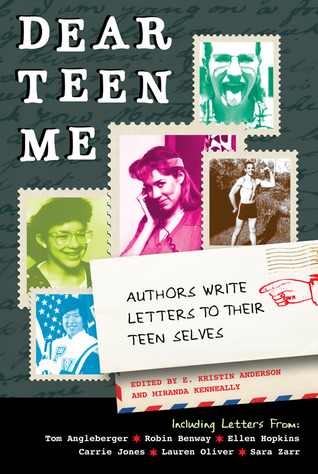
Review | Dear Teen Me, edited by E. Kristin Anderson and Miranda Kenneally

If you had the chance to write a letter to your teen self, what would you say? In Dear Teen Me, YA authors do just that. This book covers topics such as bullying, eating disorders, absentee parents, and teenage crushes. At least a couple of authors mentioned the adage that what doesn’t kill you make you stronger — in the case of Mari Mancusi, she tells her teen self, “What total BS!” Her letter is about being bullied, and her point is that life is hard enough without having to deal with the idea that being bullied can be beneficial. She’s angry at the boy who bullied her and, quite rightly, she’s angry at adults who, well-intentioned though they may be, brush away her feelings with platitudes.

Remember when you were a teen, and adults told you they knew just what you were going through because they’ve been through it themselves? Even then, you know they didn’t, really. You knew they were just trying to help, but even though they may have also gone through a breakup, a flunked test, a mean classmate, whatever, they could never understand exactly what you were feeling. However, what if that adult was you, years in the future?

Dear Teen Me is refreshingly free of the smug, platitudinal knowingness I remember seeing in adults when I was a teen. Or perhaps it’s just because in this case, knowing it all is okay. Somehow it’s easier to accept assertions like “it’ll get better” from someone who knows first hand that your life really does get better. Don’t worry about that boy turning you down; years later you really will find someone else, and you’ll be happily married to him.

Even more powerful are the letters that admit that, guess what, it does get worse. You will get a debilitating nerve disorder. The absentee father you’re jumping through hoops to impress will never notice you. That boyfriend who convinces you to have sex with him will still break up with you. These letters are mostly gentle when imparting harsh truths, because the letter writers know exactly how much it will hurt. Even better though is the message at the end of these letters — it may take years, possibly even decades, but you will survive, you will even thrive.

Reading the book, I kept hearing Kelly Clarkson’s “Stronger” running through my head, to the point that I watched it on YouTube just to get rid of the ear worm. Certainly, the authors writing to their teen selves have become stronger and wiser. Some authors observe their teen selves making mistakes and wryly comment that their teen selves aren’t fooling anyone with their attempts to be cool. Other authors observe more serious mistakes and tell their teen selves to stop — it’s not worth it. One author even told her teen self to go ahead and commit those mistakes, because they’ve shaped who she became. Through it all, however, the primary message seems not so much to be “Do this,” or even “It gets better,” but rather: I understand.

YA authors wrote the letters in this book, and I can imagine the impact this book will have in revealing that these authors grew up just as dorky and out-of-place, perhaps going through similar experiences, as their readers are. I have to admit I haven’t read most of the authors in this anthology, so I felt the impact of these letters, not as a reader discovering a human side to someone I admire, but rather as a lifelong dork reading about other lifelong dorks. There were some things in these letters I would have wanted to tell my teen self, and I’m sure other readers will also find aspects to relate to.

What would you tell your teen self? I’m not quite sure myself, but this book has certainly got me thinking. I probably will write a letter to teen me — I’ve been composing it on and off as I was reading this book. Then I’ll stick it in some journal or other, and ten years from now, write another letter to teen me. I wonder how different it’ll be.

Now to end with some Kelly Clarkson:


Review | Trust Your Eyes, Linwood Barclay

Stephen King calls Trust Your Eyesthe best Barclay so far,” and who am I to disagree with the master of horror? I’ve been a fan of Barclay’s work since No Time for Goodbye. His mysteries begin with a killer hook (in No Time, it was a teenage girl waking up to find her whole family gone), and while his stories usually turn out to have fairly conventional endings (mildly disappointing only because the hook is so gripping), they are fun, entertaining thrillers. I definitely agree with King however that Trust Your Eyes is Barclay’s best one yet — it’s the most tightly plotted of his books, and probably the one I found most difficult to put down.

Family relationships play a big part in all the Barclay books I’ve read, and in Trust Your Eyes, the author focuses on the strained relationship between brothers Thomas and Ray. Their father had just died, and Ray has had to put his life on hold to figure out how to best care for Thomas now that their father is gone. Thomas is a map-obsessed schizophrenic who spends most of his day in his bedroom, travelling the world through a Google Maps-type program called Whirl360. Part of Thomas’ schizophrenia is the belief that it’s his job, practically a calling, to study the world through Whirl360 and commit the streets to memory. The mystery kicks off when Thomas sees an image in a New York window that looks like a woman being murdered.

I have to admit — a major part of this book’s attraction for me is the techie spin on a concept similar to one of my favourite Hitchcock films. The amazing thing is, this story isn’t even futuristic anymore. Who hasn’t used Google Maps and Google Street View to find places? A character admits using Whirl360 to find a restaurant and research their menu, and that’s not even awe-inspiring anymore. The average person probably wouldn’t get involved in a murder mystery like Thomas does — like Ray, we are more likely to choose to ignore odd images and focus on our own lives. So I love how Thomas’ obsession with online maps is disturbing voyeurism on one hand, yet also offers itself to superhero potential in this story.

The mystery itself is fairly straightforward. We know fairly early on the circumstances and key players behind the scene that Thomas witnesses, and a plot thread leading up to that scene runs parallel to Thomas and Ray’s story. Despite our access into the perspectives within this plot line, however, Barclay deliberately obfuscates the thread, so that we are treated to various surprising revelations throughout.

The real hook to this story however is the family dynamics between Thomas and Ray. Their relationship adds a tender, complex angle to this fast-paced high-tech thriller. You feel for Ray, who has no idea how to teach his brother to take care of himself, yet you also feel for Thomas, who, as another character points out, is treated with condescension. There are several subplots about their family — the circumstances around their father’s death, an incident from Thomas’ past that seems to have scarred him — and, to be honest, there were times I found those even more compelling than the main plot. I wanted to learn more about these characters, and Barclay’s given both of them very rich backgrounds.

I generally find Barclay’s endings the weakest part of his books, and Trust Your Eyes is no exception. His endings are still good, just difficult to live up to the expectations set by the absolutely gripping beginnings. I especially love how Thomas’ unique talents played such a big role. Still, the big thriller ending in Trust Your Eyes felt a bit rushed — having taken up all these plot threads, Barclay had to tie all of them up neatly. The big action scene also involves a couple of really convenient twists. The ending also included some really big revelations that, while fairly central to the story, felt like they were placed at the end just to elicit a last minute gasp from the reader. True, there was a last minute adrenaline spike, but it felt artificial.

Still, Trust  Your Eyes is his most tightly plotted, possibly his best novel that I’ve read yet. Compelling mystery, and fascinating story about brothers.