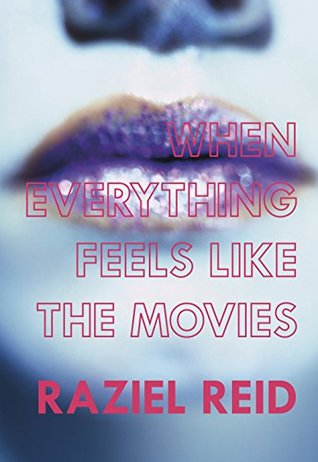
Review | When Everything Feels like the Movies, Raziel Reid

24043806When Everything Feels like the Movies is an unbelievably raw, powerful book. Reading this book is a visceral experience, and I almost didn’t write this review because there is no way I can express the power of Raziel Reid’s writing. He plunges us deep into the mind and heart of his narrator Jude, and creates such a rich, textured voice for his character that Jude will stay with you long after you turn the last page.

Jude is a hilarious narrator whose humour belies the depth of his experiences and pain. A young teen bullied for being gay, Jude copes by imagining himself a movie star. Boys chase him and call him Judy because they are rabid fans. Graffiti about him on bathroom doors are notes from secret admirers. Classmates stare at his outfits and made-up face because the school hallways are actually red carpet premieres and he’s the star. It’s a comforting fiction that crumbles with the first punch, even as he desperately attempts to cling to it. In a particularly heart-wrenching moment, he scrambles to his feet and races away from a group of bullies, describing all the while how he is really acting out a lush, beautiful scene from a movie.

The reason this book is so powerful is the language. Take this passage about bathroom graffiti for example:

They made portraits of me, too. They were my graffiti tabloids. I was totally famous. I’d imagine that the drawing in the handicap stall of my alleged crotch with “Hermafrodite Jude/Judy” scribbled next to it was the cover of the National Enquirer. Misspelled headline included. I was addicted to them. I’d look all over the bathroom and on all the walls in the hallway, and if there wasn’t one waiting for me on my locker for Jim to paint over at the end of the day, I was crushed. I wanted them to hate me; hate was as close to love as I thought I’d ever be. [p. 18]

Passages like that just blow me away. I mean, wow. The studied casualness of stating a desire for this graffiti, contrasted with the subtle dig at the spelling error, and then wrapped up at the end with an almost off-hand remark. Reid manages to pack more sincerity in that final sentence than in the rest of the paragraph, yet the emotion in that last line can be felt throughout, even as Jude pretends otherwise. Bravo, Raziel Reid, is all I can say.

Then Jude falls in love, with a popular boy who happens to be straight. If you know the author’s inspiration for this story, then you already know how that turns out. If you don’t, then I urge you to avoid spoilers at all costs. The ending seemed sudden to me and I thought it came out of nowhere. But I can imagine that’s how it would have seemed in real life as well, especially as Reid keeps us firmly locked within Jude’s perspective.

The controversy around the content of this book has brought it to the attention of many more readers, but it has also almost eclipsed discussion about the book itself, which I think is a shame. Read it to take a stand against censorship, if you like, but also read it just because it’s a very, very good book. Jude is a star, and his story will pull you right in and never let you go.
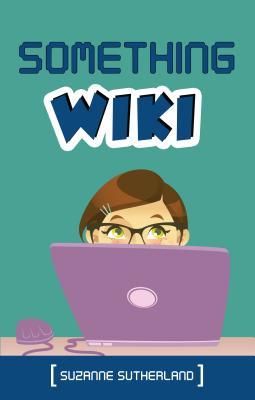
Review | Something Wiki, Suzanne Sutherland

20860645Something Wiki is about a shy twelve year old named Jo, who has three brainy friends and edits Wikipedia for fun. When two of her friends suddenly decide they’re too cool for her, Jo has to deal with a situation unfortunately all too familiar with many young girls. Add to the mix a twenty-four year old brother moving back home with his pregnant girlfriend, and Jo’s dealing with quite a bit to handle.

Sutherland does a great job of capturing a young girl’s voice, and her writing took me right back to my days as a tween. I remember being like Jo — Wikipedia wasn’t around back then so I had to scribble my feelings in an actual paper journal, but I can certainly relate to her worries about bad hair cuts, monstrous zits, and not quite fitting in with friends who are finding new interests. Kudos to Sutherland for giving Jo a real acne problem, rather than the usual trope in movies of otherwise beautiful girls freaking out over a single pimple. The story feels real, and Jo is a sharp, witty narrator. Her sardonic asides give way to real pain though, and it’s almost painful to read about how cruel young girls can be.

I lent my copy to my sister after reading, and about halfway through, she asked me if Chloe (Jo’s best-friend-turned-kinda-mean-girl) ever gets her comeuppance. Unfortunately, Sutherland ends the story before the girls enter high school, which means we never get to see if Chloe gets major zits before the prom or ends up unable to land her dream job after university. There is some closure, but as in real life, things aren’t completely wrapped up in a tidy little package. The book does give a glimpse of hope, however — J, the girlfriend of Jo’s brother, is the cool older sister type who wears awesome outfits and is beyond caring what others think of her. Attitude-wise, she’s who Jo can grow up to become, and both provides emotional support and a reminder that things do get better.

Despite being in the title, the Wikipedia angle almost seems unnecessary. Perhaps it will resonate on a different level with contemporary tweens, but it  mostly just reminds me of those Baby-sitter Club notebook chapter introductions.

Something Wiki is fantastic realistic YA. It’s much tighter — plot-wise and style-wise — than Sutherland’s first novel, and is sure to resonate with many young girls and women who remember all too well the pains of growing up.

+

Thank you to Dundurn for a copy of this book in exchange for an honest review.

Review | Black Dog Summer, Miranda Sherry

23574104When Sally is brutally murdered on her farming commune in South Africa, her spirit remains tethered to this world and the people she left behind. Similar to The Lovely Bones, Miranda Sherry’s debut novel Black Dog Summer is about a family dealing with grief and, more significantly, with all the issues left unresolved before death. Sally watches as her teenage daughter Gigi falls into a deep depression alleviated only by drugs. Her estranged sister Adele, her brother-in-law and unrequited love Liam, and their daughter Bryony are all struggling to come to terms with Sally’s death, and with the addition of a silent, troubled teen into their home.

Sherry’s writing is beautiful, and I love how she describes her characters’ lives as threads of stories that Sally must follow before she can move on. Sherry also weaves in a bit of a supernatural feel — the darkness Bryony senses in the aftermath of her aunt’s murder takes the form of a black dog out to harm her and her cousin. Bryony’s next door neighbour Lesedi is a reluctant sangoma, someone in touch with the spiritual realm and can communicate with the dead, and anchors the story’s shifting between both worlds.

My favourite passage in the novel comes early on, almost immediately after Sally is killed. She hears a noise, a “whispering, humming, singing, screaming awfulness.” She soon realizes that

The noise comes from Africa’s stories being told. Millions upon millions of them, some told in descending liquid notes like the call of the Burchells’ coucal before the rain, and some like the dull roar of Johannesburg traffic. Some of these stories are ancient and wear fossilized coats of red dust, and others are so fresh that they gleam with umbilical wetness…

[My family’s story is] just one story amongst millions, and yet it has become so loud now that it drowns out the others. It is howling at me, raging, demanding my attention. I look closer to find that this small, bright thread of story weaves out from the moment of my passing and seems to tether me to this place. Perhaps this is why I have not left yet. Perhaps I have no choice but to follow the story to its end.

Isn’t that beautiful? From that passage on, like Sally, I too felt compelled to follow this story to its end.

I also really like how Sherry connects the spirit world with the elemental one. Sally feels her being a spirit most keenly when Lesedi looks at her, and ironically, she is both most disconnected from the physical world and intimately connected to its elements. She has become an Ancestor, one with the millions upon millions of stories of the past and connected as well somehow to the potential of the future. What a beautiful way to think of the afterlife!

Black Dog Summer is a very emotional book. Much of the story within the physical world is told through Bryony’s point of view, and as a tween, she is barely able to cope with what has happened to her aunt. She looks up the term “massacre” in the dictionary, and repeats this definition several times. And indeed, when faced with something as incomprehensible as murder (not just murder, but mass murder), when having to deal with the overwhelming grief of a cousin you barely know who is now your roommate, when unable to comprehend the rising tensions between your parents, how can anyone cope?

This is a beautiful, heartbreaking, page turner of a book. Like Sally, we as readers are invested in the story while necessarily being detached from it. And like Sally, all we can do is hope it all works out for this family.

+

Thank you to Simon and Schuster Canada for an advance reading copy of this book in exchange for an honest review.

Please note that the passage quoted above is from the ARC, and may be edited prior to publication.