

Review | Shade, the Changing Girl, Vol. 1, Cecil Castellucci and Marley Zarcone

33233008In Shade, the Changing Girl, an alien takes over the body of a high school bully in a coma and learns how utterly despised this girl is. It’s part of DC’s Young Animal series, which gives a fresh take on classic DC characters.

The best part of this book is the artwork. Marley Zarcone’s psychedelic panels are absolutely beautiful and create the impression of a feverish dream. The story itself feels a bit thin and unnecessarily complicated, but the artwork alone is worth obtaining a copy of this book.

The story started off really confusing. An bird alien named Loma who idolizes a poet named Rac Shade puts on his colourful cloak, and it somehow allows her to possess the body of a young girl, but also will eventually cause her to go mad. Bad guys on her home planet want the coat back and so capture her best friend (who is secretly in love with her) to track her down. The story is based on a character called Shade, the Changing Man, and likely readers who are familiar with his story would appreciate the references a lot more. I was just confused, and it took me a while to figure out what was happening. For example, the cloak makes its wearers go mad, and both the bad guys and Loma’s best friend are very concerned about its impact on her sanity, but I can’t quite figure out how long it’ll take for her to be mad, or if the way she acts in Megan’s body is already symptomatic of her madness.

The heart of the story lies in the human elements. Loma inhabits the body of a girl named Megan, who was the bitchy head of a high school clique. Megan’s classmates react mostly in dismay that she seems to have recovered from her coma, and Loma-as-Megan needs to figure out how to navigate this world being so utterly despised. In that way, the story is a wonderful metaphor of high school — how does it feel to realize how unpopular you really are?

A lot of high school stories that deal with being unpopular drive a sharp divide between the popular and the unpopular girls, so it’s a bit of a karmic twist to have someone who started as a powerful figure suddenly have to come face-to-face with the consequences of her actions. If the story had been about Megan coming to terms with this reality, it would have been an absolutely emotional, heart-wrenching tale. Unfortunately, this story makes it clear that Megan’s spirit experiences no remorse for her actions nor growth from her experiences, and it’s only Loma’s alien possession that accounts for her apparent change of heart. I figure Megan’s spirit is kept evil because it’s Loma who’s the heroine of this series, but I couldn’t help thinking that Megan deserved her body back, even if it meant she’d end up dead. The story does somewhat address this moral ambiguity, with Megan basically saying it’s her right to inhabit her body for better or worse, but it’s done only in passing and I hope future volumes delve deeper into that.

+

Thank you to Penguin Random House Canada for a copy of this book in exchange for an honest review.
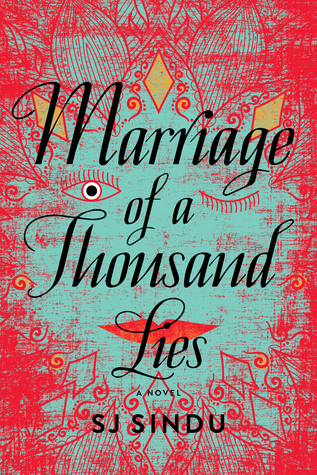
Review | Marriage of a Thousand Lies, S.J. Sindu

32077959Marriage of a Thousand Lies is a moving, beautifully written story about family and love, and the difficult choices we must make to honour both. The narrator, Lucky, is gay, as is her husband Krishna. Theirs is a marriage of convenience, appeasing their families’ marital aspirations for their children while allowing both the freedom to continue enjoying same-sex relationships on the side.

Lucky is forced to reexamine her life when she learns that Nisha, her childhood best friend and first lover, has announced her engagement. Family expectations forced them to break up when they were younger, but now that they’re adults, Lucky feels compelled to save both Nisha and herself from loveless marriages and pursue their own happy ending. But does Nisha even want to be saved?

Marriage of a Thousand Lies is a beautifully written book that just draws you into Lucky’s life and immerses you in her world. More than the love Lucky feels for Nisha, it’s the love she feels for her family that reverberates from the page, as well as the painful tension between what Lucky wants and what her duty to her family dictates. I absolutely love the nuances in the relationships between the characters; Sindu’s writing makes Lucky feel real, and we want her to find happiness.

I also love the character of Lucky’s husband Krishnu. While Lucky scoffs at her grandmother’s desire for them to have a baby, Krishnu admits it’s something he’s been considering. Unlike Lucky, who’s longing to free herself from the constraints of tradition, Krishnu is perfectly happy with their arrangement, and values the stability afforded by the facade of their marriage as much as he does the freedom to go out partying with other men. There’s also a very real power dynamic in play here, as his residency in the US is dependent on his marriage to Lucky, and so his desire to remain married to Lucky is also in part a desire to remain in America.

The book presents no easy answers, but rather gives us family and tradition and love in all its glorious messiness. It’s a fantastic debut, and with so many contemporary LGBTQ books with diverse characters on my radar being YA, this adult novel about a lesbian of Sri Lankan descent is a much welcome addition to my shelves.

+

Thank you to Penguin Random House Canada for a copy of this book in exchange for an honest review.

Review | The Ministry of Utmost Happiness, Arundhati Roy

32388712It seems almost blasphemous to admit I didn’t like Arundhati Roy’s The Ministry of Utmost Happiness. I absolutely adored her earlier novel The God of Small Things when I read it for university years ago, and I was looking forward to reading the story that compelled her return to fiction after twenty years.

In many ways, Ministry of Utmost Happiness feels like an important novel — it spans multiple generations and touches on some significant points of India’s past. There are parts where freedom fighters are imprisoned by a corrupt government and must negotiate their way back to freedom, and I found these chapters particularly strong. These chapters reminded me a bit of Martial Law novels from the Philippines, and I can only imagine how much more impactful they would have been on me if I were more familiar with India’s history. This also happens to be one of several subplots in the novel, all of which depict individual lives within the context of a broader socio-cultural milieu.

Roy is a tremendously talented writer and her language throughout the novel is simply beautiful. Even at sections where my attention flagged, I had to appreciate the cadence of her prose.

Despite all that, I found the book a struggle to read. The review on the blog Sukasa Reads notes that “the onus is on the reader to care but it’s akin to wading through the flora and fauna of a wild jungle without a machete,” and I think that encapsulates much of the problem I had in reading this book. It just felt heavy throughout, likely deliberately so given the significance of the subjects Roy covers, and to Roy’s credit, the novel feels important without feeling self-important. But it is a slog to get through.

There’s a quote on the back cover of the book:

How to tell a shattered story?

By slowly becoming everybody.

No.

By slowly becoming everything.

That’s what the story feels like. The interactions and scenes with the characters all feel momentous, and likely other readers may care enough to pick through the threads and find a wealth of insight beyond the surface. I tried, but there was just so much going on and so many disparate pieces of plot that didn’t quite seem to connect that it just ended up not feeling worth the effort.

There are some lovely moments throughout. I love the character of Saddam, how he was blinded by the glare of the sun’s reflection all because his boss made him work long hours and wouldn’t allow him to wear sunglasses at work nor look away. I love that he chose his name because he admired and was inspired by Saddam Hussein’s dignified pride at his own execution without knowing, or really caring much about, the broader circumstances that led to this execution. I love the activism of Tilo and how her romantic history influenced her political life. I liked the scene of groups of protestors convening at a single plaza, and the idea of someone being hired to ensure people pay the fee to use the single toilet.

I don’t quite understand the story of the two babies nor the story of Anjum, and there were parts I ended up just skimming over, so there are likely large chunks of the story I don’t understand. I also don’t quite know how everything intersects.

I’m glad I finished the book because my favourite parts involving Tilo’s story are near the end, but it was a struggle to get through. There may be readers who’ll find themselves caught up in the language, and able to parse through the various threads to find the brilliance of what Roy is trying to say. Then there are readers like me for whom it just ends up not worth the effort.

+

Thank you to Penguin Random House Canada for a copy of this book in exchange for an honest review.