
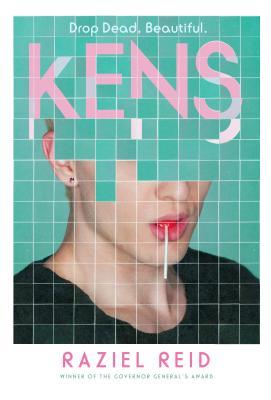
Review | Kens, Raziel Reid

37777879In the high school of Raziel Reid’s Kens, the key to popularity is being a gay Ken doll — literally. Ken Hilton’s father is a plastic surgeon who turns all subsequent Kens into perfectly sculpted, blonde, blue-eyed clones. They rule the town with their utter hotness until uncool guy Tommy and hot newcomer Blaine team up to take them on.

Kens is described as Heathers meets Mean Girls with a gay twist, but the writing reminds me more of the reviews I’ve read of Tyra Banks’ Modelland. The jokes are bawdy and crass, which isn’t bad in itself, but they’re just too obvious to really land. The humour seems better suited to a South Park scene or an SNL sketch — it’s so reliant on shock value that it loses its impact when dragged out for a full book.

Kens attempts to be a satire/parody on celebrity culture in the Instagram age, but isn’t quite sharp nor incisive enough to be effective. At times, it’s hard to tell what the target of its humour is — for example, I assume one of the Kens being a drag queen named Sandy Hooker who wears a necklace of bullets is supposed to skewer people like Ken, who appropriate tragedy for likes, but it’s a sight gag that also seems to poke fun at the Sandy Hook tragedy itself.

Or when [spoiler redacted] going viral sets of a trend of copycat attempts, I can see how Reid takes the trend of videotaping dangerous stunts for views to the extreme for parody’s sake, but I can’t help feeling like the story sneers not just at the celebrities who knowingly encourage dangerous behaviour, but also at the people who follow suit. A lot of the dark humour in Kens tries to punch up, but ends up inadvertently punching down at the same time. In a way, it almost feels worse, that while the story deliberately tears down the Kens of this world, the countless, often nameless, other characters end up as mere cannon fodder.

+

Thank you to Penguin Random House Canada for an e-galley of this book in exchange for an honest review.
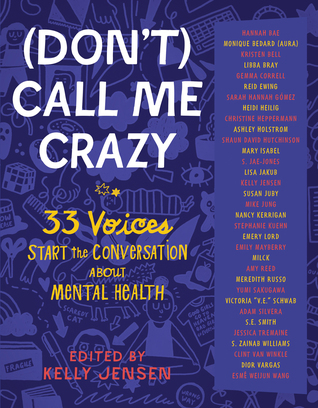
 

Review | (Don’t) Call Me Crazy, edited by Kelly Jensen

33803157(Don’t) Call Me Crazy is a powerful collection of own voices accounts of mental illness. The contributors include actors, visual artists and a veritable who’s who of young adult fiction, and I’m glad young readers will have such people showing them that they’re not alone in their experiences.

I love that in most of the pieces, mental illness is simply something that the writer or artist deals with. Unlike the usual portrayal in pop culture, it isn’t necessarily linked to some huge traumatic event and can simply be as inexplicable a condition as suddenly getting a cold.

Some of the stories that stood out to me:

  • Hannah Bae, who grew up dealing with her father’s anger issues and her mother’s paranoia, and who immersed herself in school and then in work for survival. I loved how her Korean American identity, her parents’ Korean upbringing, and the Korean dramas they watched all played a role in her story, and how Hannah’s therapist, who is helping her come to terms with her parents and her guilt at leaving them, is also Korean-American.
  • I loved all the comic panels, but Gemma Correll’s illustrations on anxiety really hit home and Yumi Sakugawa’s pages on letting go of self-hate are just beautiful and calming.
  • Shaun David Hutchinson saying that depression is a part of him but doesn’t define him, and that his boyfriend and his boss bringing up his mental illness during an argument / after an emotional confession is a form of silencing because it reduces his responses to just his illness
  • S. Jae-Jones who realizes a friendship is over when the guy conflates her with the manic pixie dream girl trope, when she knows real-life mania is so much more than the trope portrays
  • Meredith Russo, who sought treatment at a psych ward for hallucinations, but ended up with suicidal ideations because the staff insisted on misgendering her and refusing her access to a razor to shave
  • Reid Ewing who did multiple plastic surgeries, partly because of feeling like his looks weren’t good enough, but also partly because the surgeries often led to complications that needed to be fixed
  • Ashley Holstrom coming to accept her trichotillomania, Christine Hefferman’s fear of the devil, and Stephanie Kuehn’s overwhelming and irrational anger at particular sounds like her father eating

I just realized I’ve listed about a third of the works by now as highlights, and the thing is, the book spans such a broad and diverse range of experiences that the various parts are bound to impact different readers in different ways.

Conversations around mental health are important, because these normalize people’s experiences, and more to the point, they give people the power and security in naming whatever it is they’re going through.

I’m glad these contributors chose to share their stories, and that thousands of young readers will have access to the experiences that have been shared. I hope this book makes it into the right hands, and finds the readers who take in one or more of the stories and realize, finally, that they aren’t alone.

+

Thank you to Thomas Allen Ltd. for an advance reading copy of this book in exchange for an honest review.


Review | The Home for Unwanted Girls, Joanna Goodman

35604040I had never heard of the “Duplessis Orphans” until I read The Home for Unwanted Girls. It’s a harrowing part of Canada’s history, and one that must’ve caused a lot of damage to the children who were affected. Basically, because hospitals received more funding than orphanages, some orphanages in Quebec rebranded themselves as psychiatric institutions and pretended that the orphans in their care all had mental health conditions. To keep up this facade, they subjected these orphans to unnecessary medication and electro-shock treatment, partly as a means of maintaining discipline, but also to continue receiving funds for their care.

Joanna Goodman’s novel is not an easy read, but neither is it a wholly depressing one. The story focuses on Maggie, a Quebecois teenager whose English father disapproves of many things French, and treats with somewhat mild disdain his French wife. When Maggie falls in love with Gabriel, a French boy at a neighbouring farm, her father’s disapproval forces her to keep the relationship secret, until she becomes pregnant and can no longer hide the truth. The book also weaves in the story of Elodie, Maggie and Gabriel’s daughter, who is sent to an orphanage and later to a psychiatric institution, and it is through her childlike perspective that we see the full extent of what these children were subjected to.

I loved learning about stuff in Canada’s history that were totally new to me, such as what happened to orphans in Quebec during that time period, and also the tensions between the English and French communities in Quebec in the mid-20th century. Goodman doesn’t shy away from portraying the bigotry from some of Maggie’s family and neighbours, nor does she pull back from showing us the extent of shame in being an unwed mother at the time.

I also loved Maggie’s story. She’s such a compelling character, and I loved how she developed from a somewhat naive and optimistic teenager to a determined woman pursuing her own brand of happiness. When she runs into Gabriel again as an adult, and decides to try to track Elodie down, I was cheering for her the entire way. I also love how she stuck to her dreams of running her father’s shop, and how even the risk of losing the possibility of a romance with Gabriel didn’t deter her from pursuing her own happiness.

The Home for Unwanted Girls is a fascinating and compelling story, and important in bringing light to a dark period in Canada’s past.

+

Thank you to Harper Collins Canada for a copy of this book in exchange for an honest review.