
Archie Comics’ Bold New Direction and Why It Matters

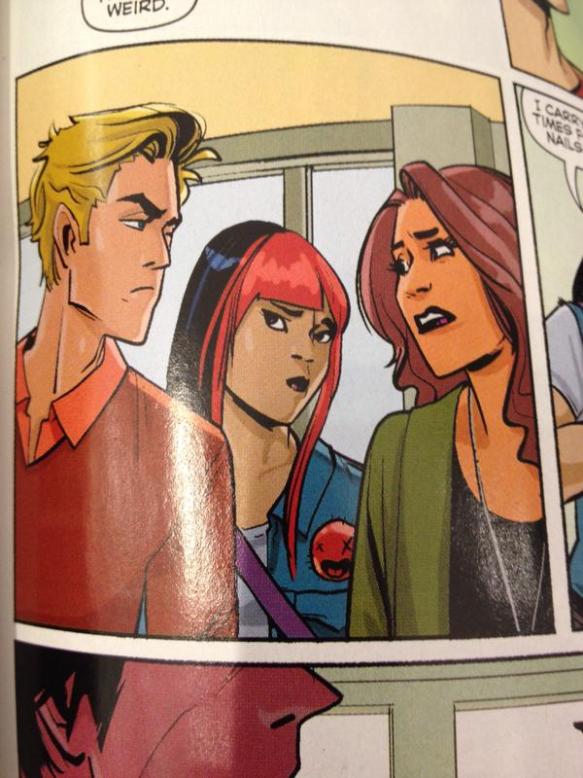
I can still remember how I felt when I opened up the first issue of the Archie Comics reboot and saw Sheila for the first time:
Archie1panel

So excited about this character!

Sheila is the girl in the middle, and the caption is the one I used in my original blog post about the issue. When I posted that review, and when I squee’d over this panel on Twitter, I knew nothing about the character except that she was Asian and she appeared to be a main character in the new series.

I admit that my reaction surprised me, because up until that point, I don’t think I ever quite really thought much about Riverdale needing an Asian character. It’s a lack that I didn’t realize so much until it was filled, and that’s really important, because as an Asian woman growing up with Sweet Valley and Nancy Drew and, yes, Archie Comics, I never really expected to see myself in those pages. I wish now I’d appreciated more the character of Claudia Kishi in the Baby-Sitters Club, but I’d always been drawn more to Stacey the math genius and big city fashionista. Growing up, I never really noticed how few Asian main characters there were in the books I read and loved, and it’s sad to realize that the presence of a character like Sheila is so surprising to me.

I even remember a story Archie Comics did a few years ago, where a Japanese student started at Riverdale High. It was a one-off story in a digest, and basically had the student explaining her life in Japan and how the customs are very different in America. I remember wishing that Archie Comics had given that student a story beyond making her an object lesson in Japanese culture, but also found myself happy that they featured a Japanese character in the first place.

Sheila’s addition to the gang is huge to me. She is an aspiring fashion designer who appears to have grown up with Archie and the gang, and in a recent issue, was even unwittingly a part of one of Reggie’s schemes. She’s like a Dilton or a Midge who will have her own part to play in the Riverdale story moving forward, and I think that’s awesome.

All this to say that I really love the new direction Archie Comics is taking. Kevin Keller, who was introduced a few years ago as the first gay character in Riverdale, has since become firmly entrenched as a main character. I love that, because unlike that Japanese student whose name I can’t even remember, Kevin’s inclusion in the series is as a fully fleshed out character, whose story arc is developing right alongside Archie’s and Betty’s and Veronica’s.

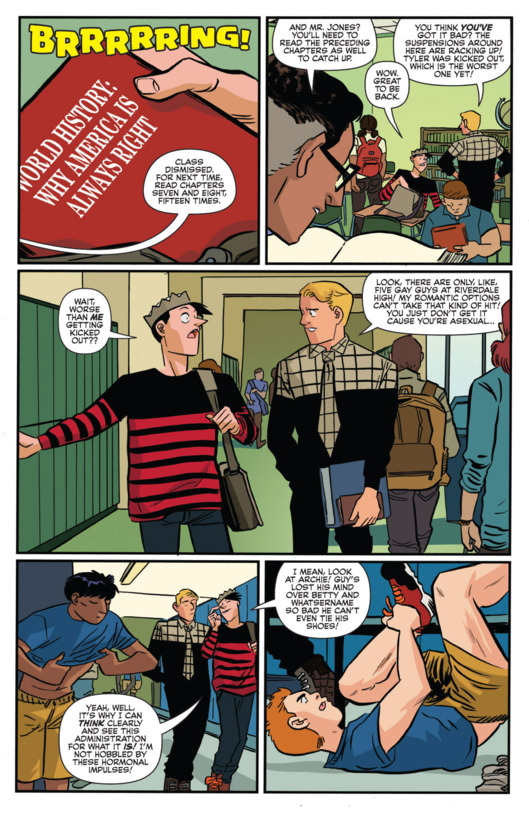
And then Archie Comics goes ahead and does this with the rebooted Jughead #4:
Jughead

It’s one thing to make a classic, beloved, main character like Jughead gay — and Archie Comics didn’t even dare do that in 2010, opting instead to add a completely new character — and it’s quite another to make him asexual. Can you think of any asexual character in popular books, movies or TV right now? I can’t. Gay and lesbian characters are thankfully becoming more visible on screen, trans characters are starting to become more visible, and while a lot more work can still be done in terms of representing the full gender and sexuality spectrums, I can honestly say that I can’t think of any character in books, TV or movies right now who is asexual.

And now we have Jughead Jones, probably the smartest, savviest character in the Riverdale universe. Bravo to Archie Comics for, not just featuring an asexual character, but also daring to do this with an already established main character, instead of adding a completely new one whom they can keep or discard depending on public response.

Here’s the thing: I’m imagining how many Archie Comics readers are out there who are asexual and who never expected to see themselves in a book, never mind in a comic book series whose target audience is children and whose main story revolves around a love triangle. How many of them will see this and squee with excitement much as I did when I first saw Sheila? It’s too early to say if this is a one-off, or if it’ll even be picked up in other Archie series. But even this one panel is huge.

To be honest, I don’t know how readers who are asexual feel about this panel, if they are as excited about it as I am and as media outlets are, or if they wish Archie Comics had handled it differently, much as I felt about that Japanese student story. I’d be interested to find out, but for now, I hope that it meant at least as much to them as having an Asian character in Riverdale meant to me.

What does the new Archie Comics have coming up next? I’m excited to find out, but more importantly, I’m excited because now I actually feel like I can dare to hope. I hope that a Filipino character eventually moves to Riverdale. I hope that a plus size woman joins Riverdale High and is considered hot enough to capture Reggie Mantle’s eye. I don’t even know what else I hope for, but I do hope. And for once, I don’t feel like I’m daring to hope — I’m just hoping. Because the new Archie Comics has already proven its willingness to push boundaries and inject reality into Riverdale, and now the possibilities are endless.
Review | In the Unlikely Event, Judy Blume

There are writers whose books you love, and then there are writes whose books have actually helped define your childhood. Judy Blume is such a writer. I remember reading Are You There God? It’s Me, Margaret when I was a child, and feeling that the author just got me. Somehow, Judy Blume placed her finger right on the pulse of pre-teen female anxieties, and while Margaret’s experiences may have differed from my own, in a way, I was Margaret. (“I must, I must, I must increase my bust.” Dear god, did we ever believe such an exercise would work?)

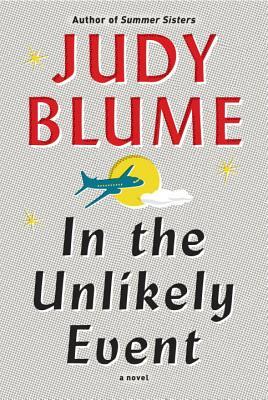
23899174I also enjoyed Blume’s adult novel Summer Sistersbut it’s where her characters are young adults, just beginning to figure out who they are, that I think Blume’s writing really shines. I feel the same way about her most recent adult novel In the Unlikely Event, which was inspired by a true incident in her childhood, when a succession of planes crashed near her New Jersey hometown and caused a ruckus in the community. Commercial air travel was still relatively new then, and much like the 1990s movie The Net warned of the potential dangers of the Internet, the real-life incident in the 1950s must have caused much anxiety over the safety of airline travel and the possibility that the crashes may not have been accidental.

In the Unlikely Event focuses on the story of Miri Anderson, who was fifteen when the airplane crashes occurred, and who was flying back home thirty-five years later to commemorate the anniversary of the incident. We learn about various stages in Miri’s life, all the way until adulthood, as well as receive glimpses of the lives of the passengers in the planes that crashed. Blume also incorporates newspaper articles, written in the somewhat novelistic, emotionally fraught style of the day, which help provide a wider picture of what’s going on. (Fun fact: In Blume’s Toronto talk about this book, she said that because she was so busy and the deadline for the manuscript was coming up so quickly, her husband stepped in to write the newspaper articles for her.)

As with Summer Sisters, I felt it was really the scenes of Miri’s childhood that shone. Her wonder at silk stockings, her desire to be a journalist, and later, her increasingly outlandish conspiracy theories about the real reason behind the crashes all took me back to childhood. Whereas an adult would likely think of practical solutions to planes crashing, or otherwise engage in knowing rhetoric about the perceived, widely accepted, “true” cause for the accidents, children are freer with their imaginations, and freer as well to admit that no one is telling them anything and that the situation is all the scarier for it. While the plane crashes formed the impetus for the plot, I especially loved the idyllic scenes of Miri and her mother in the small town. I love the saving up of pennies for silk lingerie, which is impractical but oh so pretty. I love reading about the gossip amongst the townspeople, and the way everyone pretends to know everyone else’s business. I don’t necessarily know that I would want to live like that, but I certainly love reading about it, and Blume’s narrative voice just lends itself so perfectly to nostalgia.

The intermittent vignettes about the airplane passengers were interesting as well. On a whole, I thought they distracted from the main story. But on quite a few instances, I actually found myself more compelled to read on about the vignette rather than return o the main story. I’d get all caught up in some passenger’s life, feel disappointed that they died in the crash and that I’d never get to hear more about how their lives could have turned out. And then I’d realize just how utterly, horribly tragic accidents could be. How much of a life, of a potentially beautiful and exciting rest of one’s life, can be cut off in an instant, and how utterly, horribly unfair it is to not even know the reason this death occurred. With these vignettes, Blume brought home the tragedy of these accidents, and suddenly, Miri’s theories make much more sense, not so much because they become more logical, but because in a small way, we too have developed a need to make sense of what has happened.

Judy Blume in Toronto, June 2015

In case you’ve never heard Judy Blume speak, she is simply marvellous. The Toronto Public Library hosted an event with her last summer. It was a sold-out event, with so much overflow that I believe the overflow room was just as crowded as the main one, and even though I had a ticket, I ended up perching on a bar stool somewhat behind a column at the very back of the room. It was so worth it though and made my inner thirteen year old squee.

Here is the Library’s video of the event:

+

Thank you to Random House Canada for a copy of this book in exchange for an honest review.

Review | Gender Failure, Rae Spoon and Ivan E. Coyote

18406194Gender Failure is a beautiful, candid, moving account of Rae Spoon and Ivan E. Coyote’s “failure” to fit into the traditional gender binary. Its roots as a stage production are evident — the tone is conversational, even intimate, and you can almost imagine the authors telling you these stories in person. Photos from the show are interspersed throughout, and I wish I’d seen the production live, as it must have been an even more powerful experience than reading it on the page.

The casual tone of the narration belies the depths of emotion that Spoon and Coyote express. Spoon recounts the experience of a man approaching them after a show and laughing because he’d originally thought Spoon was “a dude,” until they started singing and he then “knew you were a chick.” The man appeared to expect Spoon to share in this hilarity, even grabbing them by the arm in a show of comradeship. Spoon’s response struck me: they walked away, and only then corrected the man that he’d been mistaken both times. The need to walk away before correcting the misconception speaks to Spoon’s awareness of their vulnerability. Not only do they experience “a feeling that I have failed to be seen” every time they are misgendered, they are also all too aware of the dangers in revealing themselves as trans.

Both Spoon and Coyote share their fear of public washrooms. Coyote writes about developing the skill to hold their pee for hours, in the hopes that they may not need to use the wheelchair-accessible gender-neutral stall and potentially inconvenience someone with mobility issues. “[Women] are afraid of men in a women’s washroom, because of what may happen,” Spoon says. “I am afraid of women in a women’s washroom because of what happens to be all the time.” Experiences include being assaulted with a handbag and being dragged out from a stall by security guards, not to mention the less physical but no less violent experience of being glared at in disgust. Spoon’s frustration is evident when they say that they can’t even react in anger, “because if I get angry, then I am seen as even more of a threat. Then it’s all my fault, isn’t it? Because then there is a man in the ladies’ room, and for some reason, he’s angry.”

Coyote writes about their difficulty in trying to get medical approval to have their top surgery funded. Ironically, their difficulty lay in finding a psychologist who could provide an unbiased assessment on whether Coyote was “trans enough” for the procedure, because most of the psychologists had studied Coyote’s work when training to make such assessments. They also speak about the intrusive questions people feel entitled to ask. In one interview, for example, the reporter tried to be coy around the question of sex assignment surgery, and when Coyote told her to just come right out and ask the question, they realized that the reporter didn’t even know what sex Coyote had been assigned at birth. “She couldn’t even be sure what I might want removed or added on to me,” Coyote says. “But still. She had to know. She just had to ask.”

The section about the Trans Day of Remembrance is especially moving. The event honours those who have died by reading their names aloud, but as Coyote notes,

What will be missing are these women’s stories… What will also be missing is a discussion about the difference between excluding someone and actively including them, and intentionally making space. And the day after we are suppose to remember, most of this will be forgotten.

In particular, Coyote remembers their friend Rosie, a trans woman who left town and is presumed dead, and whom Coyote memorializes in this book. “I refuse to reduce her life to nothing more than a name on a list of the deceased,” they say. “I will remember so much more about Rosie than just her absence from my life.”

Gender Failure is such a powerful, beautiful book. Spoon and Coyote have moved me, and I can only imagine the impact their stories can have on transgendered readers, particularly those who are young and still trying to figure things out. I cannot recommend this book enough, and I’ll just end this here, with Coyote’s words:

I realize that the English language is sadly devoid of names for people like me. I try to cut the world some slack for this every day. All day. And the day after that, too. But the truth is that every time I am misgendered, a tiny little sliver of me disappears, A tiny little sliver of me is reminded that I do not fit … I remember that the truth of me is invisible, and a tiny little sliver of me disappears. Just a sliver, razored from the surface of my very thick skin most days, but other times right from my soul, sometimes felt so deep and other days simply shrugged off, but still. All those slivers add up to something much harder to pretend around.

+

Thank you to Arsenal Pulp Press for a copy of this book in exchange for an honest review.