
Review | Stowaway, Pam Withers

36323502I should preface this review by admitting that, with everything going on today in the US around undocumented immigrants at risk of deportation and refugees seeking asylum being separated from their children at the border, I’m already predisposed to be wary when encountering a book about human trafficking, particularly when the story itself consistently uses the term “illegal immigration” and is a high-energy adventure-at-seas tale.

As an adventure story, Stowaway reminds me somewhat of the action-packed scenes of Hardy Boys or Jonny Quest, with each chapter revealing a new twist or hurdle to be tackled. Pam Withers is a talented writer, and the story is high octane and exciting. While the hero and his friends get into one scrape or another, we know a bit of ingenuity and courage will get them out of trouble eventually. It’s a fun ride, and I think children interested in an adventure story will enjoy reading this.

The book is about a Canadian teen, Owen, who stows away on a boat for kicks, and unwittingly stumbles on a people smuggling operation: the captain and his first mate Arturo are transporting a group of private school boys from Guatemala into Canada. The captain decides Owen knows too much to let him go, but Owen rallies Arturo and the other boys to work together to free themselves from the captain.

Some things in the story did make me uncomfortable. First, Owen was really excited in the beginning to help his Coast Guard friends deal with illegal immigration. About halfway through the story, it’s made explicit that the Coast Guard’s target is really people like the captain, who take payment from the boys’ parents but don’t actually get the boys safely into Canada. (In this story, the captain sends the boys to labour camp unless the parents pay more money, and then ends up trying to kill them.) The problem is, it’s no longer as easy to take for granted, as Owen does, that people in authority have these boys’ welfare in mind. While I’m sure the author intended Owen and the Coast Guard’s motives to be mostly about protecting immigrants from unscrupulous people like the captain, I also couldn’t help but feel like Owen’s glee also had to do with protecting Canada’s borders from the boys themselves, and that turned me off.

I was also wary about the idea of Owen as a Canadian being the one to save the Guatemalan boys, mostly because I’m a bit tired of the white saviour trope. In fairness to Withers, the Guatemalan first mate Arturo has just as much of a narrative voice as Owen (they alternate chapters) and turns out to be just as much a hero as Owen is. Still, Owen was the one mostly driving the heroic actions, and convincing Arturo and the other Guatemalan boys to get on-board, and I’m kinda meh about that.

There also seemed a very clear-cut dichotomy between Guatemala as impoverished and filled with fear and violence, and Canada as the land of hope and opportunity. To be fair, there’s a valid reason the boys’ families wanted them to immigrate in the first place, but all the boys kept talking about was how bad it was in Guatemala and how much better it’ll be in Canada, and I couldn’t help wishing the portrayal of Guatemala was more nuanced. Even if they went to Canada to escape bad conditions in Guatemala, isn’t there anything they miss about their old lives and their country of origin?

Those are things that detracted from my personal enjoyment of the book, but overall, the book was a strong adventure story. There were a lot of twists and turns and feats of daring, and Withers is a strong writer who keeps the action on high the entire time. There’s also a nice emotional subplot about Owen’s brother that fuels his desire to help the boys on the boat, and I love the way that subplot played out.

+

Thank you to Dundurn Press for an advance reading copy of this book in exchange for an honest review.
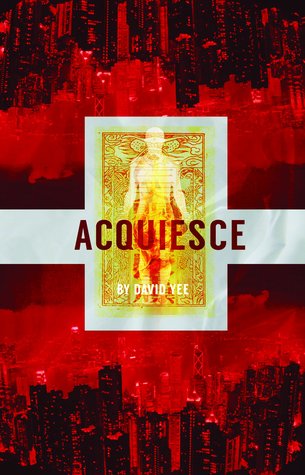
Review | Acquiesce, David Yee

36152805acquiesce is such a powerful, emotionally resonant play about a man flying to Hong Kong for his father’s funeral. Sin is a Toronto author, who hasn’t spoken to his father for years, and so feels ill-qualified to do tasks expected of a dutiful son, such as giving his father’s eulogy. As the play progresses, various characters — Sin’s cousin, his father’s doctor — call him out for his lack of filial piety, but gradually, the story also unfolds to let us know the reason behind the estrangement in the first place.

There is so much to unpack in this play that I don’t even know where to start. I can attest to how strong it is on the page and can only imagine how powerful it plays out on stage.

The themes of family and filial piety are even more resonant to me because of the cultural context Yee incorporates so well into his play. There’s a lot of references to Chinese traditions around death, and how Sin is expected to honour them, and how difficult these are for Sin to do given how he feels about his father. One example is how Sin is expected to give his father’s eulogy — a difficult task in itself, made more difficult by the requirement to give it in Cantonese, a language Sin doesn’t speak. Sin’s cousin translates the eulogy for him and tells him to read it phonetically, and this just emphasizes how artificial the act of eulogizing his father feels for Sin.

The theme of cycles is also really strong. This is emphasized in the narrative’s non-linear structure, and most powerfully driven home in the reason behind Sin and his father’s estrangement. When Sin has to wash his father’s body for burial, he learns that he and his father may have had more similar childhoods than he’d initially realized, and that the things his father did may have been learned behaviours. Worse, Sin finds himself acting in a similar way towards his girlfriend, and realizes he himself has just as much potential to continue perpetuating a harmful cycle.

There’s also a surrealistic feel to the story, with a talking Paddington Bear and symptoms of hallucinations in both Sin and his father. For Sin’s father, the hallucinations were symptoms of the disease that ended up killing him, and tellingly, Sin pleads with the doctor for a similar physical reason rather than face the possibility that his hallucinations may be psychological. Tellingly, the scene ends with the doctor coughing up pearls, which Sin did a few scenes ago, and one wonders if this scene actually happened or if it was all in Sin’s mind.

The play keeps us off balance in terms of what is and isn’t real, but the emotional core ultimately rings true. The ending almost feels too pat for such a complex story, but I can also imagine how powerfully that moment can play onstage. As a fun sidebar, I see from the cast list in the book that Richard Lee was in the original cast, whom I remember seeing in the 2017 stage production of Kim’s Convenience. He impressed me as Jung in Kim’s Convenience, and I can imagine how great he’d be as Sin’s cousin Kai. (See the Globe and Mail’s review of the stage version here.)

+

Thank you to Playwrights Canada Press for a copy of this book in exchange for an honest review.

Review | The Josephine Knot, Meg Braem

39789091“Grandmothers will always die and their houses will always be pulled apart like meat from ribs.” So begins Meg Braem’s The Josephine Knot, a compelling play about a woman and her father settling Baba’s (her grandmother’s) estate upon her death. Various relatives have come to the grandmother’s house to lay claim on the belongings they wish to keep, before the rest of the objects in the house are either sold or thrown away. As the eldest son, David has taken charge of the proceedings, and coordinates the movements throughout the house with efficiency. His daughter Samantha is having a visibly harder time coming to terms with her Baba’s death, and hates the thought of her Baba’s belongings going to relatives who barely knew her and who wouldn’t value the objects in the way they deserve.

It’s a moving play, and made even more powerful because the play features only two actors, and the various relatives are played by the same actors who portray Samantha and David. I loved reading stage directions like “The actor playing DAVID shifts physically into playing BABS.” It drives home the point about how interconnected all these characters are, and I can imagine how much emotional nuance it adds to see the same actor depicting such a diverse range of emotions. In one of the latter scenes, the actor playing Samantha shifts into the role of Baba herself, in a conversation with David shortly before she dies. It’s a powerful scene in itself, but I love imagining how having the same actor play both roles blurs the lines between generations, and recalls the emotional tensions between David and both characters at the same time.

The play also shows some very real, visceral glimpses into what it’s like when someone dies. There’s a great scene where Samantha and her cousin Stephie are discussing a pair of plastic deer. Stephie wants them for the front yard of the house she and her fiance Robbie will move into when they get married; Samantha wants them because:

I played with them when I was little. I made us be very still so the hunter couldn’t see us. I love their glass eyes that glow orange. [p. 24]

The catch is that only one of the deer can fit into Samantha’s apartment, and Stephie convinces her they need to be taken as a set. Eventually, Samantha agrees to let Stephie take the deer and, in an aside, Stephie admits she plans to saw off the tops and plant begonias inside.

The Josephine Knot is a moving story about families, and the complex emotions that can arise after a family member dies. It’s compelling in print and I can imagine how moving it is when performed.

+

Thank you to Playwrights Canada Press for a copy of this book in exchange for an honest review.