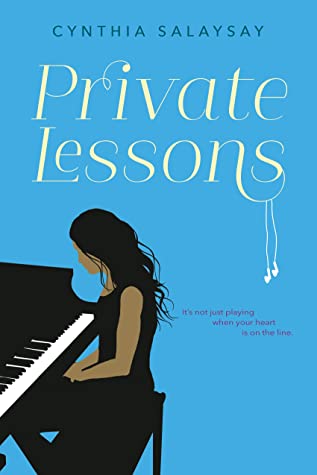
 Private Lessons is not at all an easy read, but it’s done really, really well.
(TW: grooming, rape, death of a parent, racism, casual mention of off-page animal death)
Claire Alalay is a 17-year-old piano player who takes lessons from the charismatic and talented Paul Avon. The blurb says it’s a book for the #MeToo era, so I don’t think it’s a spoiler to say that Paul does something unforgiveable.
I’ll be delving deeply into how well Salaysay treats the #MeToo stuff, so first, I want to say that I also really like how Salaysay explored the casual racism and sexism Claire and other BIPOC characters experience. I especially love a scene at a music competition where a white man asks Claire, her mom, and Claire’s Vietnamese-American BFF Tash what their nationality is, because it was so realistic. I especially love the little details that make it especially realistic: how the man assumes the three Asian-Americans are part of the same family and is shocked that Tash isn’t Filipino-American; how Claire’s mom doesn’t know how to respond and so just giggles nervously; how Claire’s white BFF Julia is totally oblivious of what’s happening; how the man has no idea how to respond when the question is turned back on him, and especially, how this isn’t the first time in the story that someone asks Claire this question. Having been asked that question many times myself, I can attest that this scene felt incredibly nuanced and real, and I love how Salaysay wrote it.
There’s also Julia’s perception of Claire’s looks, which again Salaysay handles so subtly that it’s hard to tell whether Julia is somewhat jealous of Claire’s looks because she genuinely thinks Claire is pretty, or if Julia is also somewhat being racist and fetishizing Claire’s Asian-ness. Salaysay kinda blurs the line on this several times, with just-subtle-enough comments from Julia that it makes you a bit uncomfortable, but also, maybe you’re imagining things? There’s a particularly gross moment after Julia learns about the #MeToo stuff, where she outright tells Claire “You’re very sensual. Asian girls. Men kind of slobber all over them.” This was said somewhat within the context of Julia saying Paul’s behaviour was “disturbing” and so could be read as an indictment of Paul’s possible Asian fetish, but it’s also equally possible that Julia believes that Asian girls are “sensual”, in which case, how much of a friend is Julia, really, to Claire? Either way, Salaysay handles this with just enough ambiguity that it’s difficult to label Julia as racist or otherwise, which again feels very realistic and true-to-life.
I also like how Salaysay depicted Claire’s mom’s grief (and possible depression) over Claire’s dad’s passing. Again, it’s the subtle details that Salaysay gets right that makes this work: how Claire’s mom can spend an entire day in bed but then turn cheerful when a church friend comes over; how Claire’s mom turns to her faith for comfort and, for a long time, resists the idea of therapy; how Claire’s mom also finds moments of joy, like in eating a burger and fries with Claire from a drive-through. I love the subtle Filipinisms that make Claire’s mom real — how she says “don’t open the light” instead of “don’t turn on the light”; how she calls Claire “anak” as a term of endearment; how she has a bunch of Virgin Mary, Jesus, and saint statues around the house; how she says prayer is what gets her through; even how she responds when Claire says prayer doesn’t seem to be enough. I love how Salaysay has created Claire’s mom, and I love the relationship between mother and daughter.
Now on to the #MeToo stuff, which as I said, I think Salaysay handles really well. (Minor spoilers follow — nothing surprising, I think, if you’re familiar with the #MeToo movement, but if you want zero spoilers, just skip the rest of my review.)
There are unfortunately far too many possible permutations of #MeToo stories, and I think the one most people immediately think of are incidents when the perpetrator physically forces themselves on the victim, or the victim is drugged or incapacitated in some way.
Less well-known, yet equally horrific, are the more gradual scenarios, where the perpetrator grooms the victim in many subtle, hard-to-pinpoint ways. In this case, Paul is a very demanding teacher, who uses Claire’s admiration of him to push her sometimes to the point of physical injury (at one point, her wrist hurts from her practicing, and she thinks at least Paul will think she worked hard). He also touches her, ostensibly to adjust her position so her playing improves, and something the author does really well is keep the entire thing super subtle. We’re seeing the story from Claire’s POV, so like Claire, we can see all of Paul’s comments on her appearance, his overtures of friendship beyond their lessons, his subtle bits of emotional manipulation to keep her starving for his approval, etc, as potentially innocent, simply a demanding teacher pushing his student to do better. Yet because we’re also distanced from Claire’s situation, we can also feel the slight sheen of wrongness throughout, the slight twinge of something not being right, even though Paul has technically not yet done anything wrong.
Paul’s behaviour throughout the novel is a particularly insidious form of abuse, because it’s so hard to pinpoint exactly what he’s doing that’s wrong, yet we can already see how his behaviour is already starting to change Claire, and make her more dependent on his approval.
Something else that may also be easy to miss in conversations around #MeToo — and that Salaysay explores especially well in this novel — is how easy it is for #MeToo victims to feel complicit in what happens to them. Claire is undeniably attracted to Paul. With the particular #MeToo incident, she specifically sets out wanting Paul to kiss her. Salaysay takes us through Claire’s thoughts and emotions in this particular chapter with heartbreaking clarity, as things shift from giddiness over Paul’s attention to confusion, shame and guilt at how things turn out. In particular, when Paul shifts from tender contact to a more explicit, self-serving act, Salaysay’s language shifts as well. We are right with Claire when she realizes that Paul doesn’t care about her as she cares about him, and because of that, what she ends up doing for Paul feels dirty. There’s a point where Claire tries to back out, and Paul physically stops her from doing so, which I figure Salaysay included so it’s super crystal clear that what happened was criminal. But even without that moment, I think the wrongness in the entire scene felt heartbreakingly real. Salaysay also handled the fallout from the incident in a sensitive, all-too-realistic way.
+
Thank you to Candlewick Press for an e-galley in exchange for an honest review.


 Your Truth or Mine? begins with a knock at the door of Mia and Roy Kapoor. A young woman has gone missing, and the police want to bring Roy in for questioning.
 I’m a huge fan of Sandhya Menon’s contemporary YA romances.
  Literary Treats