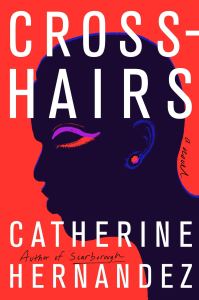
 Crosshairs is a powerful, highly relevant, gut-punch of a book. It’s technically a “dystopian”, but a lot of the subjects it tackles feel uncomfortably contemporary. Crosshairs is particularly powerful because it explores how social injustices disproportionately impact marginalized communities, in this case BIPOC LGBTQ2S+ folks.
The main character is Kay Nopuente, a Jamaican-Filipino drag queen who is forced to run when the Canadian government rounds up persons they consider “Others” to work in forced labour camps. In this world, the Canadian PM is basically a Trump twin, and the US and Canada are united in a singular philosophy that dehumanizes Others, and reduces them to means of production.
Race, sexuality, wealth, and disability are all factors in how one is classified as an Other in Crosshairs’ world, and Hernandez is very much on point in showing how much intersectionality plays a role in these determinations. Black and Brown LBTQ2S+ characters talk about how they cannot simply “pass”, because of their skin colour, whereas a chapter mentions how white gay men are back to walking along Church Street, albeit with somewhat adapted movements.
Hernandez also explores the varying degrees of Other-ness across BIPOC folks. A Black restaurant worker is immediately dismissed as an Other (we have no indication about whether or not his sexuality played a role), and some wealthy Others (we have no indication about specific identities that rendered them Other) have tried to assimilate but failed. In contrast, within the forced labour camps, some Asian women (we have no indication of particular ethnicities beyond “Asian”) are helping the military maintain control over the Others, in exchange for their children’s safety. With all three examples, perhaps most troubling is that while Hernandez didn’t go into too much specifics on these characters’ intersecting identities, many of us likely have ideas on how to fill in the blanks. Which in itself is an indication of how real and how contemporary these subjects are, despite the fictional nature of the story playing out.
Beyond Kay, we also have a full cast of characters of colour — Bahadur Talebi, a non-binary person who just wants to lay low so they can survive; Firuzeh Pasdar, a social worker who tries to help as many Others as she can until she herself is captured; Emma Singh, a Deaf woman who befriends Firuzeh; and so many more. The government’s targeted attacks on Others affects each of them in different ways, and while some don’t survive, all their stories are shown to matter. Hernandez also presents us with white allies: Liv, a woman who goes undercover in spaces of power by marrying a powerful man; and Beck, a white gay man who provides Kay and Bahadur with shelter and combat training.
This book is a compelling read, but by no means an easy one. Hernandez pulls no punches in talking about racism, homophobia, violence and all sorts of things. She does so in a respectful manner — offensive slurs are x’d out, and when describing the aftermath of a violent death driven by racism, the narration focuses on the victim’s humanity rather than the gory details — but it’s all very disquieting. There’s a fury within the narration that demands our attention, and beyond that, our action. While the details of the world in Crosshairs are fictional, it’s a reality that’s far too easy to imagine events playing out as Hernandez has outlined. In the event of a natural disaster (in this book, a flood), we know that wealth, skin colour, and so on, all play a factor in how well each of us will fare. We only need to look at how the COVID-19 situation is playing out in Toronto to see that the communities most affected by the pandemic are also the communities most likely to be labelled Others in Crosshairs.
A couple minor snags for me with this book: first is that the narrative moves between timelines, from present-day to flashbacks, often told as stories between characters sharing their experiences. I found some of the shifts confusing, and particularly with such a large cast of characters, I sometimes found myself having to think hard to remember who a character was and what their role was in the story.
Another snag for me was the cringeworthy exercises Beck, Liv, and other white allies did to embody allyship. Their reasoning was sound: their needed to unlearn an entire lifetime of white supremacy, and particularly of accepting their culpability in propagating this, despite being, by most markers, woke. But then they do this by doing movement exercises at dawn, while chanting mantras about how the world should not be all about them. Possibly, Hernandez intended this to be cringey — certainly, Kay and Bahadur are both as skeptical at first as I am.
But then this part of the story takes an earnest turn. Beck’s mom decides to try the exercises, and we see her entire, painful process of unlearning: from acting super awkward to Kay and Bahadur, to arguing that she’s a “good person” and “not at all racist”, to eventually responding with genuine empathy to a story Kay tells. And in the big march scene at the end, all the white allies perform a gesture that is basically designed to show their support without taking the spotlight away from Black and Brown folks.
As I write this, I’ve come to believe that Hernandez did intend this plot thread to be uncomfortable. As a woman of colour, the whole morning exercise routine struck me as being very performative. And even the allyship gesture at the end, while certainly done in earnest by the white characters, still felt not-enough. I give characters like Liv, Beck, and to a lesser extent, even Beck’s mom a pass, because I see how they have actually risked themselves to support Others, but the fact that they have to do a literal daily dance to make this support genuine added a sheen of performativity to their support. To me, at least.
Crosshairs invites multiple readings. It’ll likely cause some kind of discomfort for every reader, and deliberately so. And it invites us to sit with this discomfort, and reflect further on what we read.
The novel ends on a note of hope, of collection action finally being taken, of triumph laced with dread. We know enough of how the world really works to believe that the story will end happily for all the characters we’ve come to love. Yet we at least have this scene, where they are fighting back and making themselves heard. And while that can never be enough, it’s something, and it will spark something more.
+
Thanks to Simon and Schuster Canada for an e-galley in exchange for an honest review.


 Do you know how common the name Jessica is, particularly for women born in the 1990s? How about the surname Williams? In
  Literary Treats