
Unknown's avatar

About Jaclyn

Reader, writer, bookaholic for life!

Review | The Time for Murder is Meow, by T.C. LoTiempo

TheTimeForMurderIsMeowCoverThe Time for Murder is Meow has so many things I love in a cozy mystery: compelling lead and sidekicks, adorable kitties, bits of Hollywood behind-the-scenes, and red herrings that truly create a tangle. In this mystery, series lead Shell McMillan wants the local museum to do an exhibit of her late aunt’s movie poster collection, but her proposal is blocked by a board member who reportedly had a long-standing feud with Shell’s aunt. When the board member is murdered, Shell becomes the prime suspect, and must figure out the real killer to clear her name.

I was super confident for most of the book that I knew the villain, even while Shell pursued other suspects, but when my main suspect was unexpectedly cleared at the 82% mark, I realized this mystery was even twistier than I realized. I did figure it out within the next few pages, and am super proud of still solving the case before Shell did, but overall, I give major kudos to T.C. LoTiempo for a truly twisty and challenging whodunnit.

The characters, both series mains and suspects, are fantastic. Lead character Shell is a former actress who left the biz to move to Fox Hollow, Connecticut and take over her late aunt’s pet store, the Purr N Bark. It turns out she’s never enjoyed the glitz and glamour of Hollywood life anyway — she’d always wanted to be a veterinarian, and only fell into acting due to pressure from her actress mother. I love her backstory, and while she does make some questionable choices (pro tip: don’t yell at someone that you’ll make them while within earshot of a homicide detective), she’s a good detective, and it’s fun watching her wrap her head around the various clues.

Equally awesome is her former co-star Gary, who initially flies out to convince Shell to do their show’s cable reboot (unfortunately, despite Gary’s gorgeous head of hair, it’s Shell whom the producers consider the star attraction), but then quickly gets caught up in her investigation. I love his and Shell’s friendship, where their banter conveys mutual respect and affection. And Gary is hilarious — I love the running gag about how he keeps wanting to try new restaurants (because he’s always hungry and Shell’s a terrible cook), but just before they can actually eat, they get a new lead in the investigation, and poor Gary’s stomach has to wait. I don’t know if I’d last long as Shell’s investigative partner — unlike Gary, I’d probably tell her to go ahead while I have my lunch! — but these scenes made me laugh every time.

To the surprise of perhaps no one who knows me, the highlight of this book for me are Shell’s two cats, Kahlua (a Siamese her snobbish mom gave her before Shell could adopt from a shelter) and Purrday (her aunt’s one-eyed Persian ‘roommate’). I absolutely love how rich and vivid these cats’ characterizations are, and how distinct they are from each other. They’re larger-than-life, and their personalities are given as much depth as the human characters, and as a cat lover, I just fell all the more in love with this book because of that.

While I generally love cats in cozy mysteries, this series has won a special place on my shelves because of how much I can actually see my own cats in these characters… and yes, how much I also see myself in Shell’s cat lady-ness. The relationship between these two cats is hilarious, from Kahlua’s initial jealousy and territorialism over Shell’s bed, to their eventual teaming up when it comes to the all-important mission of demanding that Shell give them food and treats. Goofy and affectionate Purrday, with mischief that leads Shell and Gary to uncover important clues, is the more obvious feline hero, but any cat lover will also melt for the haughty and elegant Kahlua, who likely sees herself as far too smart to engage in such antics herself. These cats are a delight, and I can’t wait to see more of them! I also love how so many of the town’s residents seem to have their own pets, and I bet future instalments will give us more of a glimpse of these animals as well.

Overall, this is a fantastic beginning to a cozy mystery series. I’m hooked, and I can’t wait to read more!

+

Thank you to Midnight Ink for an e-galley of this book in exchange for an honest review.
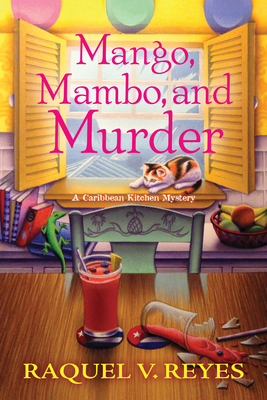
Review | Mango, Mambo, and Murder, by Raquel V Reyes

MangoMamboMurderThis mystery was just an absolute joy to read. It had all the markers of a fantastic start to a cozy mystery series: fantastic lead, compelling characters, and a twisty mystery with a personal connection. Miriam Quinones-Smith has just moved to her husband’s hometown of Coral Shores, Miami, where her best friend, Alma, also lives. When a socialite dies at a Women’s Club luncheon, a tox screen reveals she’d died of a drug overdose, and an anonymous tip fingers Alma as the pusher.

Miriam is determined to prove Alma’s innocence, and believes that a more likely suspect is Dr Fuentes, a Cuban herbalist who sells overpriced herbal mixtures that promise weight loss, fertility, and other such medical claims. All the socialites in town love his products, and the arrogant doctor is a hilariously entertaining character to read about. I enjoyed reading about the investigation, and the somewhat jokey friendship Miriam forms with the detective on the case. Detective Pullman did confuse me at times, since he seemed to alternate between asking Miriam for help, and asking her to stay out of the investigation, but overall, I thought they worked well together. The one big snag for me was the big reveal, which felt anti-climactic. Worse, the way it was handled seemed to render Miriam’s detective work redundant, which just emphasized the sense that she was meddling unnecessarily in the investigation.

That being said, the best part of the book for me was the entire world Reyes built around the mystery. I love Miriam and Alma, and I especially love how awesome their friendship is. I also love how casually bits of Spanish are sprinkled throughout the dialogue, and how colloquial it all sounds, for example, how they say “porfa” instead of “por favor.” The way the author incorporates Spanish reminds me of how my friends and I sometimes speak Taglish rather than just straight Tagalog or straight English, and how we sometimes shorten words or phrases in Tagalog while in casual conversation. So the bits of Spanish make the dialogue sound more natural and true-to-life for me, and I love that the author chose to do that.

I also love how the author explores the racism Miriam experiences in marrying into a white family. Miriam’s parents live in  Her mother-in-law Marjery is racist, but often through microaggressions where it’s sometimes hard to tell whether it’s worth pushing back or whether you should just let it go. So I love how the author depicts Miriam’s responses to Marjery’s microaggressions, and I especially love how this climaxes in one beautiful scene where Miriam finally pushes back. For context, Miriam has a doctorate in anthropology, with a particular interest in how food intersects with culture. In this scene, Marjery makes a snide comment about Miriam’s cooking, and after Miriam snaps back, she thinks,

I’d never pushed back at my mother-in-law. It felt liberating, and I wanted another round. My arsenal of ten-dollar words was at the ready. The socioeconomic legacy of colonialism in the Caribbean was in that pot of peasant stew, and I’d be more than happy to educate her on it. [89%]

Yes, yes, YES!!! As a Filipino, I rarely see my cuisine accorded the same gourmand respect as some Western cuisines, so Marjery’s snobbery around Miriam’s Caribbean dish totally hit me hard. I’ve also experienced how that type of cultural snobbery often goes hand-in-hand with intellectual snobbery, so Miriam’s eagerness to whip out her “arsenal of ten-dollar words” made me cheer out loud. I totally got where she was coming from, and I was more than ready for her to verbally rip her racist mother-in-law to shreds.

The subplot around Miriam’s job at the Spanish language station was also a lot of fun. I love the little touches that gave the station a community hub feel, such as the daycare where Miriam could leave her son Manny while she’s filming, and the way Miriam and the other staff never had to explain culture-specific content for non-Latinx viewers.

A weakness for me was in the subplot around Miriam’s husband getting a job with his beautiful ex-girlfriend, who still seemed interested in him, and who, of course, Marjery very much preferred. Miriam just seemed to jump to outrageous conclusions much too quickly, and more than once, I just wished she made more of an effort to talk to him before spiralling towards the worst case scenario.

Still, overall, this was a really fun book, and I’m looking forward to reading more of this series.

+

Thank you to Crooked Lane Books for an e-galley of this book in exchange for an honest review.

Review | Mrs Rochester’s Ghost, by Lindsay Marcott

MrsRochestersGhostMrs Rochester’s Ghost is a contemporary, gothic retelling of Jane Eyre. Former TV writer Jane takes a job at Thorn Bluffs to tutor the 13 year old daughter of tech entrepreneur Evan Rochester. His supermodel wife Beatrice drowned about seven months ago — Evan insists it was a suicide, but rumours circulate that he murdered her. The Thorn Bluffs estate is gorgeous and, in true Wuthering Heights style, overlooks a cliff atop crashing waves, and is often shrouded in fog. Jane thinks she sees a ghostly figure of a woman amidst the fog, and while she knows it may simply be a product of her naturally overactive imagination, she can’t help but think it may be the ghost of Beatrice Rochester wandering the grounds.

Many re-tellings of Jane Eyre critique the limitations of the original’s feminism by giving Bertha Rochester the opportunity to tell her side of the story. Jean Rhys’ Wide Sargasso Sea filters the ‘mad wife in the attic’ trope through a decolonization lens, portraying Bertha’s ‘madness’ as a British colonial attempt to suppress ‘Other’-ness. Earlier this year, Rachel Hawkins’ thriller The Wife Upstairs reimagines both Jane and Bertha as brilliant, calculating women, who both have their own agendas in their relationships with Rochester. Both retellings explore the patriarchal roots of diagnosing women with madness, and weaponizing this diagnosis against women who may be deemed too much outside the social norms to handle.

Marcott takes a more traditional, straightforward approach to her retelling, which could have been subversive in its own way, but ultimately fell short for me. In this novel, Beatrice is outright diagnosed with mental illness. The story cites her diagnosis as bipolar disorder, but she also hears voices and has hallucinations, which as far as I know isn’t part of being bipolar. I could be wrong, but it made me wonder if she also has other mental illnesses that haven’t been diagnosed, or — more chillingly — if the medicines Evan forces upon her actually caused her condition to worsen.

The snag for me is that the novel holds back from delving too deep into the possibility that Evan is truly a villain, or that Beatrice was truly victimized by his treatment of her. The novel hints at it, mostly through the lens of people warning Jane that he was abusive or that he’s otherwise bad news, but Jane herself doesn’t seem too concerned. The rumours do keep her cautious about her attraction to Evan, and she’s often sympathetic to Beatrice, but there’s little interest on her part about truly understanding Beatrice’s condition, or the ramifications of how Evan dealt with it. Even when Jane learns about Evan having gaslit Beatrice about her fears of him cheating on her, Jane merely comments that it was “unkind”, then thinks no more about it. For a woman in 2021 to see that incident merely as unkind, and not as full of red flags, is a bit tough to swallow.

For that matter, I was very much not a fan of the romance between Jane and Evan. Evan creeped me out even before I learned about the gaslighting, and I just couldn’t see his charm. To be fair, from what I can remember of Jane Eyre, I don’t think the original Rochester was ever particularly attractive either. But while the original Jane’s happy ending was contextualized within Victorian sensibilities, modern-day Jane has plenty more options beyond Rochester, and was in fact offered some of those very options (another job, another home) right within the story.

Worse to me is how the novel treats Beatrice. As with many modern re-tellings, Rochester’s wife is given a voice — she narrates the events leading up to her drowning seven months ago — yet in many ways, she’s still treated like the wild, mad Other of Bronte’s original. She already has a tenuous grasp on reality within her chapters, describing the housekeeper’s language as “witchy”, a professional rival as a literal bird who caws, and a nearby rock as Mary Magdalene. Her violence is primal, almost animalistic, and much of her internal monologue is so metaphorical it sometimes sounds nonsensical.

I don’t feel qualified to speak on the mental health representation in this novel. It’s possible that this portrayal of Beatrice’s mindset is accurate, and true to what some people actually experience. But I very much feel like she deserved better. I wish we’d seen her perspective before she stopped taking her meds. Or her personality beyond the paranoia and fear that characterized that fateful day. She was a beautiful, success model, and I wish her mental illness was explored with more nuance than just as a tragedy that made her completely unable to function in the world. Even when Jane feels sorry for Beatrice, it feels more like pity than empathy, and at many points, I felt like Beatrice was portrayed as less than human.

The author also doesn’t do Evan any favours by not giving us his perspective beyond what he shares with Jane and Beatrice in their respective chapters. His perspective may have given us a clearer idea of any love, affection, or sympathy he ever felt for Beatrice, but with us just hearing it from him telling Jane that he did like Beatrice once upon a time, he just came off as cold and unfeeling.

As a retelling of Jane Eyre, it’s very faithful to the original, and may satisfy fans looking for that. Personally, I preferred contemporary retellings that take more liberties in updating the story and characters for present-day sensibilities. I highly recommend The Wife Upstairs for just that kind of contemporary spin.

+

Thank you to Thomas Allen for a copy of this book in exchange for an honest review.