Unknown's avatar

About Jaclyn

Reader, writer, bookaholic for life!

Review | Looking for Jane, by Heather Marshall

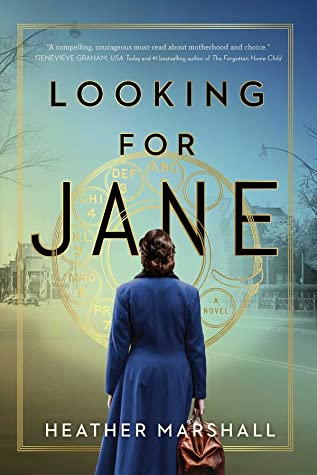
LookingForJaneLooking for Jane is about motherhood, and women’s rights over our own bodies. It follows the story of three women across three timelines: Evelyn Taylor in 1971, who was forced to give up her baby for adoption at St Agnes, a Catholic home for unwed mothers; Nancy Mitchell in 1980, who learns she’s adopted, and that her parents have kept it secret all her life; and Angela Creighton in 2017, who works at an antiques shop and discovers a letter from Nancy’s adoptive mother, mailed when she died in 2010.

The lives of all three women intersect over the years, and the crux of the story lies in the Jane network. Abortion wasn’t legalized in Canada until 1988; before then, many women were limited to underground, and often dangerous, means to end unwanted pregnancies. After one such procedure sends Nancy’s cousin to the ER, Nancy learns that if a future need arises, they can simply “ask for Jane.” Jane is a codeword for an underground network of courageous women, including some doctors and nurses, who use legit medical knowledge and resources to provide safe abortions.

The three characters’ stories converge around the theme of motherhood and women’s rights over their own bodies: In the 80s, Evelyn has grown up to be a doctor, and she and her nurse Alice become key members of the Jane network. Nancy uses their services in the 80s, then, in a desire to give back, becomes a volunteer Jane as well. And in 2017, Angela and her wife are undergoing fertility treatments. Angela’s investigation reveals that Nancy’s mother may be Margaret, who was Evelyn’s best friend at St. Agnes.

The Jane network may be fictional, but the author’s afterword tells us many similar underground networks did exist before abortion was legalized. I love that this story was set in Toronto, and that it featured familiar places like Ossington subway station and St Joe’s Hospital. I’m not very familiar with these parts of history, so it was really cool to step back several decades in time and see how the city may have been.

The St Agnes home where women were forced to give up their babies is also fictional, but like the Jane network, is based on an amalgamation of similar homes. I especially love that in her afterword, the author acknowledges the racist underpinnings of such practices, and encourages readers to self-educate about events like the Sixties Scoop, where Indigenous children were forcibly taken from their families. So much of historical fiction is about white people’s experiences, and while Looking for Jane does feature main characters who are white, I like that the author acknowledges how similar policies were implemented differently for Indigenous persons.

Wherever you stand on the topic of abortion, I doubt this novel will change your mind. As someone who’s very much pro-choice, I came away from this novel with so much sympathy for all the women who were forced to rely on unsafe means to end their pregnancies, and so much admiration for those who, like the fictional Janes, helped give women safer options. I’m fortunate enough to live at a time and a country where such safe options are readily available to me, but I recognize that’s not the same everywhere in the world, and my heart goes out to women who don’t have that kind of access.

In her afterword, the author says she once thought this story was about abortion, but then realized it’s really about motherhood, and I think that’s very accurate. The novel does include characters who make the choice not to be mothers at all, and the narration does present this choice as equally valid. But mostly, through its three narrators, the novel shows how much richer an experience motherhood could be when this state is freely chosen. Evelyn wanted to be a mother; her baby was a product of true love. Her friend Margaret’s baby was a product of rape, but Margaret wanted to keep the baby as well. Both their choices were taken away by the nuns who forced them to sign adoption papers. Nancy’s story shows the contrast between an unwanted pregnancy, and one that happens when the person is ready and eager to be a parent. And Angela’s story of fertility treatments forms yet another piece of the spectrum, where someone actively wants to be a parent, yet biology may not make that possible.

The anti-abortion debate often presents the topic as an all or nothing dichotomy — either women want to be mothers or they don’t. But reality is much more complex than that. Many women who get abortions may already be mothers, or may choose to become mothers later on. Looking for Jane doesn’t quite show the full spectrum of that complexity, but it does show multiple facets of it, which I liked. More than the dichotomy between motherhood and non-motherhood, Looking for Jane frames the dichotomy around choices — do you have a choice over your own body, or is someone else (the state, the Church, your family) taking that choice away from you? In all cases, the novel very strongly supports you having the right to choose for yourself, and provides us with sensitive and textured examples of how such stories can play out.

+

Thank you to Simon and Schuster Canada for an e-galley of this book in exchange for an honest review.

Review | Complicit, by Winnie M Li

complicitAs a #MeToo novel, Complicit plays it relatively straight. Unlike the revenge thriller or dystopian fantasy version that seems more common amongst commercial #MeToo fiction, Complicit tells the tale of a young woman who enters the film industry with major ambitions to be a producer. And from the start, it’s pretty obvious how the story is going to unfold.

Our first introduction to Sarah Lai is when she’s 39, a decade removed from the industry, now teaching mostly disinterested film students at a local community college. She’d once had a promising career in film, and her last project was with Holly, a lead actor who’s since become a Hollywood A-lister, and Hugo, a powerful financier who’s now facing multiple #MeToo accusations. A reporter interviewing Sarah for the New York Times forms the frame narrative.

Two things make Complicit stand out: its heroine is Chinese-American, the middle child of Hong Kong immigrants who own a Chinese restaurant in New York. Most #MeToo stories feature white heroines, so it was nice to see the author explore how Sarah’s Asian identity, and her family’s immigrant background, added even more barriers to her making it big in film. Also, unlike many other #MeToo novels, Complicit — as hinted by its title — explores how Sarah can be both a victim of sexist exploitation, and complicit in perpetrating it towards other women.

The thing is, when the reveals about Sarah’s complicity do come out, they’re more tragic than damning. The journalist, Thom, fully exonerates her of any wrongdoing, and despite Sarah’s own guilt, he’s also very much in the right to do so. In both cases that Sarah played a role in another woman’s victimization, she was also very much an innocent herself trying to survive. And while she probably could have made different and better choices to protect other women, it’s clear that little blame, if any, actually rests on her shoulders.

All this just makes Complicit more depressing than truly disturbing or disquieting. As much as we should never be numbed to #MeToo experiences, Sarah’s story is one we’ve read dozens of times at this point, in newspapers and magazines, and even on Notes screen caps posted by various celebrities on social media. The novel does raise a valid point about how Sarah’s story, and the stories of those like her, are relegated almost to footnote status in splashier headlines about more famous figures like actors, directors, and industry leaders. And perhaps for that alone, this novel is a good call to pay attention to lesser known stories as well.

Complicit is a solid novel, and the writing is good. There are also some really strong standout moments — I love the friendship between Sarah and Holly, and the subtle way in which Li showed how things evolved on that front. I also really liked the scene where Sarah discovers a hole-in-the-wall Chinese restaurant while filming in LA, and how the place anchors her with its tastes of home. And I particularly like the novel’s depiction of Sarah’s boss Sylvia, who, as an older woman with her own film production company, was also a striking depiction of someone both victimized by, and complicit in, a sexist system. The way her star director Xander and Hugo keep sidelining her in her own production company feels all-too-relatable. And the way she tries to protect Sarah at first, yet diminishes her when she becomes a viable threat to Sylvia’s power, is a spot-on depiction of the ways in which surviving in a sexist industry can mean compromising on a bit of your humanity.

Overall, Complicit doesn’t really say anything new or surprising. But it’s a solid story, and well-told. I like how the ending gave a touch of hope.

+

Thank you to Atria Books for an e-galley of this book in exchange for an honest review.


Review | The Heights, by Louise Candlish

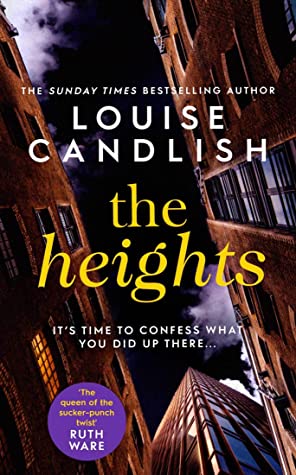
TheHeightsThe Heights is a fun and twisty thriller. I devoured it in a couple of days, which, these days, is pretty rare for me. Ellen Saint’s world is rocked when she sees Kieran on a rooftop terrace: she blames Kieran for the death of her teenage son Lucas, and arranged to have him killed two years ago. Told within the frame narrative of a journalist reporting Ellen’s story, the main narration is from Ellen herself, writing her memoir, Saint or Sinner.

Because we initially meet Kieran through Ellen’s perspective, it’s easy to fall into her immediate suspicion of the teen. She tells us how rude he is, how much he leads her otherwise studious son Lucas astray into a life of partying and drugs, and how he seems to have an irrational hate-on for her, giving her menacing looks when no one else is looking. Only Lucas’ father Vic seems to share Ellen’s suspicions; both Ellen’s younger daughter Freya, and Lucas’ girlfriend Jade seem to have fallen for Kieran’s natural magnetism. And while Ellen’s husband Justin is more sympathetic to Ellen’s concerns, he mostly hand-waves them away as Lucas just being a regular rebellious teen. For me, at least, it was easy to share Ellen’s anxieties over Kieran, and to accept her word that he was responsible for Lucas’ death.

But then the circumstances around Lucas’ death are revealed, and it seems more a tragedy than a crime. And then we get a few chapters from Vic’s point of view, and it becomes clear that Ellen’s burning hatred for Kieran heavily colours her perspective, and that her grief over Lucas’ death has turned into an obsession. You start to question just how reliable her narration actually is.

Candlish hooked me from beginning to end with this story. As more and more layers are revealed, I shifted from sympathizing with Ellen, to sympathizing with practically everyone else around her, including Kieran himself. I did have an inkling of some of the later reveals, but mostly, the story kept me off-balance and guessing throughout. There’s a point when Ellen takes a full-on turn towards the dark side, in her quest to wreak revenge for Lucas’ death, and reading the story felt a bit like watching a train wreck: you desperately want someone to pull on the brakes, but you also can’t stop from watching the disaster unfold.

Overall, The Heights is a gripping, suspenseful, emotional read that will keep you turning the page.  There are elements of tragedy, and the ending isn’t quite a happily-ever-after, but Candlish tells the tale with a brisk pace and a high gloss sheen that keeps even the darkest moments from tipping too far over the edge. Save this book for a weekend, and definitely don’t start reading it right before bed.

+

Thank you to Simon and Schuster Canada for an e-galley of this book in exchange for an honest review.