
Unknown's avatar

About Jaclyn

Reader, writer, bookaholic for life!

Up Up Up, Julie Booker #50BookPledge

I cannot say enough good things about Julie Booker’s debut collection of short stories Up Up Up. I’m so vain I probably think these stories are about me, but chances are, if you’re a woman, you will too. Booker writes with subtlety, humour and depth, revealing layers within the most mundane situations and grounding the most exotic adventures in reality. Her writing is, at times, laugh out loud funny, but it’s the kind of humour where it’s funny because it’s true, and you feel a pang of pain because it’s the kind of situation where all you can do is laugh.

Booker’s descriptions are snappy yet vivid: a character named Heather is described as having “a man body with breasts,” the blooming of an amaryllis as “disgusting… From cock to cunt in a matter of days.” I, quite literally, laughed out loud in a mall food court while reading her speed dating story “Breakup Fresh.” To that confession, Julie Booker responded, “A mall food court + speed dating have lots in common: quick turnover, a story at every table…and some who always leave a trail of garbage.” For even more samples of her writing, check out her incredibly entertaining pieces in the National Post’s Afterword.

I tried to choose a favourite story to write about, but honestly, I just liked so many of them. Booker’s stories talk about romance, friendship, body image, aging, and so many other things that were relevant to me, personally, and she handles them with such delicacy and candour that her stories felt even more real. “Geology in Motion,” for example, is about a pair of plus-sized friends taking a kayaking trip in Alaska. They go from making fun of the image of “two fat ladies in a kayak! In skintight wetsuits. Eek!” to buying supplies and going on the trip. Booker’s description of one woman’s fear and the other’s desire to keep pushing further made me want to cheer them on, and the way the story ends made me have to stop for a moment. Then, of course, I went on to the next story, eager to see what Booker had in store for me next.

“The Exchange,” about an aspiring artist and an aspiring art collector falling in love at the Art Gallery of Ontario, is more cynical than romantic. Booker begins with the (intentionally, on the author’s part) stilted dialogue of a carefully choreographed flirtation, and goes into a very matter of fact depiction of the development of the characters’ relationship. We hear the story from aspiring artist Diana’s point of view, and while she very logically interprets Henry’s actions, the violence of her emotions comes forth in Booker’s descriptions of her art work.

The best thing about Up Up Up being a collection of short stories rather than a novel is that each story offers a different type of reading pleasure, like a box of truffles instead of a single chocolate bar. There’s a wonderful feeling in treating yourself to one wonderful story at a time. Because these tales are so short, so much emotion comes from details: a line of dialogue tossed off by a character, or a singular character trait, like the clown in “Below Below” insisting on teaching in French even though she grew up in “Bumfuck-Nowhere, Ontario.”

Up Up Up is, quite possibly, the best book I’ve read all year, and I’ve read a lot of very good ones. To all women: buy this book. Read it, then pass it on to your sister, your best friend, your mother. Even better, if you’re in or near Toronto, go see Julie Booker yourself at the Harbourfront Centre, Wednesday, June 8th, 7:30 pm. The back cover of Up Up Up warns readers, “Prepare to meet your new favourite writer.” All I can say is, Ms. Booker, it’s a pleasure.
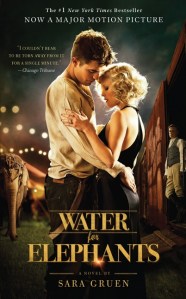

Water for Elephants, Sara Gruen #50BookPledge

I read Sara Gruen’s Water for Elephants mostly because the trailer for the movie looked very interesting, and I wanted to read the book before watching the movie. I wasn’t sure what to expect, having once tried Gruen’s other book Ape House, and finding so bored by it that I gave up halfway through. Elephants, however, was an utter delight to read, and I found myself zipping through it.

When he receives news of his parents’ death and having left him penniless, veterinary student Jacob Jankowski runs away and joins the circus. He falls in love with Marlena, who is the star of the horse act and wife of August, a cruel and abusive animal trainer. The story takes place in during the Great Depression, where circuses must struggle extra hard to survive. The circus Jacob joins has nowhere near the grandeur of the Ringling Brothers, yet has its own cast of characters. It has a clear class system, and when things get especially rough, only performers get paid and workers know better than to complain. As both the circus vet and friend of the performer-class Marlena, Jacob straddles the uneasy line dividing the classes, eating at the performers’ side of the cafeteria, but being classified as a worker on payday. Circus owner Uncle Al is a greedy swindler who has no compunction about “red lighting” (throwing off a moving train) workers to save costs.

The appeal of any circus story is the cast of characters, and Gruen certainly peppers this book with a colourful bunch. Jacob is the compassionate foil to August. While he starts off angry at his father (also a vet) for having healed animals in exchange, literally, for beans, Jacob soon comes to understand his father’s love for animals, and comes to care for the circus’ menagerie. As a love interest, Marlena is charming, and her love for her horses shows how perfect a match she is for Jacob. A dwarf, a drunk old man, and various other circus “freaks” provide a strong supporting cast — odd enough to keep us ever aware of the circus’ magic, yet human enough to keep it all believable.

The star, which anyone who has seen the movie trailer would know, is Rosie, the ten foot tall elephant who is introduced to August as being too dumb to train. It turns out she is actually quite intelligent, and her antics both add colour to the story (e.g. stealing lemonade) and make you cheer her on (her clear devotion to Marlena and hatred for August). The parts where Jacob gets to see a performance and is caught up in the magic are vividly described, and I at least wished I was there. Little details like “having a straw house,” which is when all the seats are sold out, so the circus puts straw on the ground so more people can still come in, are wonderful reminders of the level of excitement a circus performance can inspire.

Elephants moves from Jacob’s time in the circus to Jacob at ninety (or ninety-three, it’s hard for him to remember these days) at a senior’s home. A circus is setting up just outside the home, and he eagerly awaits his family to take him to the circus. This Jacob is just as lovable as his younger self. Nonagenarian Jacob is cantankerous, and almost offended by a fellow resident who claims to have carried water for elephants in a circus, which Jacob insists is impossible. He clearly misses the excitement and the magic of the circus, and by the end of this book, you will too.

Tiger, Tiger, Margaux Fragoso #50BookPledge

Wow. What an incredibly powerful book. Margaux Fragoso’s memoir Tiger, Tiger is not an easy read. There were moments where I literally had to stop reading, because I was just either getting too uncomfortable or too angry. A co-worker admitted to me that she was hesitant about starting Tiger, Tiger; having young children herself, she was afraid that she would find the book too disturbing. This same co-worker found Emma Donoghue’s Room difficult for that same reason. I did sympathize with Jack and his mother in Room, but I was fine reading it. I found it difficult to read Tiger, Tiger, and I mean that in the best way possible.

When Margaux was seven, she met fifty-one year old Peter at a swimming pool. Peter invites her and her mother to visit his house, ostensibly to meet his wife and hang out with his two sons. Margaux’s father is very verbally and physically abusive, especially to Margaux’s mother, who is on psychiatric medication, so the mother jumps at the chance to form a friendship with a seemingly nice man. Turns out Peter is really interested in Margaux, and the way he seduces and manipulates her is just disgusting. Without any of Humbert Humbert’s eloquence or, let’s face it, Jeremy Irons’ seductive voice in the Lolita audiobook, Peter’s pedophilia is just there, horrific and disturbing and outright disgusting.

Part of what makes this such an emotional read is that Fragoso writes each chapter solely from the point of view of the age she was when the events occurred. So, when Peter attempts to use guilt to make eight-year-old Margaux perform oral sex on him, we as readers don’t have the filter of present-day Margaux Fragoso in her twenties to distance us from the eight-year-old girl’s emotions. Her disgust at the request, mixed in with guilt because he had given her a treat earlier, is all too real, and Margaux’s descriptions are bitter reminders of her eight-year-old mind.

The vividness of Fragoso’s writing reveals her relationship with Peter in stark, unforgiving detail. We see the young Margaux confused and angered that her father would make fun of Peter’s false teeth; later on, we see the teen Margaux realizing how wrinkled Peter’s skin is, and how emotionally dependent he is becoming on her. We see the turmoil of her discomfort, then possessiveness and even love for Peter. We see her grow up, and as she becomes more aware – of the way in which Peter manipulates her and of how she can use her sexuality to turn the tables and regain power – we root for her, not just to gain power over Peter, but to become free of him. In a way, the latter half of the book, where Margaux has become a teenager, is easier to read, because while Margaux is still definitely being victimized by Peter, she is no longer just a victim. She is, albeit slowly, beginning to take back her life.

I’m not even sure if I can describe how I felt reading this book, and I’m just amazed that Fragoso was able to write such a compelling, cohesive account of such experiences. I was furious at the way Margaux’s father kept belittling her and her mother. I was disgusted at Peter’s actions, at his insistence that society just doesn’t understand that he and Margaux are in love, and at his attempts at emotionally manipulating Margaux into staying with him rather than building her own life. Margaux is never overtly furious in her depiction of Peter, and, in a way, such a straightforward, matter-of-fact account just makes the horror of his actions so much starker.

Tiger, Tiger is not an easy read, but it’s definitely well worth the effort. Highly recommended.