
Unknown's avatar

About Jaclyn

Reader, writer, bookaholic for life!

Hunger (Book 2 of Gone series), Michael Grant #50BookPledge

Michael Grant’s Gone series just keeps getting better. In the second installment, Hunger, the kids in the FAYZ have run out of food, some of the normal teens have drawn battle lines against the kids with powers, and the mysterious entity called the Darkness keeps sinking its claws even deeper into Lana and Caine. Sam and his crew have discovered fields with vegetables, but there are giant killer worms guarding their territory (sounds ridiculous, but they’re actually quite horrifying… and gross).

Worse, kids in the FAYZ don’t want to work. “I’m just a kid” becomes a common refrain, understandably frustrating Sam’s team, all of whom are kids themselves. My sister, who introduced me to this series in the first place, commented that she found it hard to believe that only Sam’s friends are stepping up, and the rest are content to whine about their hunger and play video games all day. She understood about the younger kids, but wouldn’t the tweens and teens at least band together and help organize something? My initial reaction had been that this situation seemed very realistic, but my sister raised a good point — is Michael Grant, and are readers like me, underestimating the potential for maturity in young adults?

Then again, it’s not just that it was only Sam’s friends stepping up; it was just that those who did step up naturally became part of Sam’s “government.” One of the characters also said something that struck me as logical: the kids have no incentive to do hard labour, because they know that even if they do nothing, Sam’s team will make sure they’re fed. One of my favourite secondary characters from Gone, Albert, comes up with what I consider a brilliant solution: he sets up a market economy, first a barter system, then eventually establishing a currency using McDonald’s Monopoly money. Astrid’s response to this disappoints me, considering how brilliant she is supposed to be: she tells Sam to shut Albert down, saying they now have the opportunity to establish a class-free society, where money doesn’t exist and therefore no one is richer than anyone else. Would socialism have worked in the FAYZ? Possibly, but only if established from the very beginning, before they ran out of supplies and most kids show no motivation to work “for the greater good.”

What I love most about Hunger is that we see the vulnerability in so many of these characters. Sam’s heading for a breakdown: “I’m not their parent,” he constantly tells Astrid, to which she reminds him, “They’re just kids,” who need parenting. Sam, of course, is a kid himself, and even adults would prefer to focus on the bigger issues like finding food or preparing for Caine’s next attack rather than have to deal with complaints of who pulled whose hair and who called whom stupid. Lana, as the Healer, feels a similar pressure. Kids come to her with everything from bloody noses to loose teeth to skinned knees. She’s like a celebrity hiding from paparazzi; everyone demands her attention, and all she wants is privacy. Astrid’s brilliance reveals its cracks. While Sam is the official leader, Astrid definitely holds the power, and a lot of her decisions (shutting down Albert’s enterprise, curtailing Quinn’s initiative in going fishing) reveal short-sightedness. I can understand why some of the kids in the FAYZ have grown resentful. I especially love the bigger role other characters play: Mary’s eating disorder grows much worse, Albert and Quinn reveal economic savvy, Edilio takes a much stronger leadership role, Brianna, Taylor and Dekka become essential to battle, and even Caine reveals his softer side.

Gone was thrilling and action-packed, with characters you grow to admire. Hunger is even more thrilling, and makes these characters even more real and tangible to us. Fantastic sequel, darker and more introspective than the first, Hunger takes the FAYZ kids from trying to survive a battle to taking the first steps in creating a long-term, sustainable society.

Big Girl Small, Rachel DeWoskin #50BookPledge

I read Rachel DeWoskin’s Big Girl Small mostly because of Shannon’s wonderful review of it in Savvy Reader. At 5’1”, I would never dare to imagine I can understand how a little person feels, but in other ways, I do know how it is to grow up feeling different. I imagine practically everyone has felt different in some way or another. High school is tough enough without being 3’9”, and DeWoskin’s protagonist, Judy Lohden, handles it with sarcasm and wit: “If you’re born saddled with a word like Achondroplasia, you learn to spell.”

In so many ways, the things Judy goes through are things practically every teenager experiences. She is the new kid at a performing arts high school, and worries about fitting in. She has a “teacher crush” on her inspirational AP English teacher and feels sympathetic for her dorky math teacher. She falls immediately for the handsome Kyle Malanack when she sees him at a party: “I think maybe the very not-realness of teenage love makes it the only real thing. […] what’s true about love isn’t a quantity thing — it’s a quality one. And the reason I know that is because I still feel like I’m actually going to die.”

We know from the first chapter that something big and bad is going to happen to her and cause her to run away. What happens to her isn’t much of a mystery for long (Judy drops a lot of hints along the way), but that didn’t impede my enjoyment of the book at all. It just made me feel utterly helpless, watching her moving towards her situation without being able to do anything to stop it: “If the first boy you dare love pulls the worst Stephen King Carrie prank in the history of dating, then you run and hide.” It is however the next part that really struck me as being absolutely true and heartfelt: “Because who can love you after that? Maybe your parents. But how can you face them, when you’ve all spent so much time convincing each other that you’re normal?”

In a way, her parents’ overcompensating for her dwarfism by pretending she’s normal makes things worse; Judy actually appreciates it when her friend Goth Sarah admits she admires Judy for having the guts to go to parties and face all the stares. Yet at times, when reading about Judy dressing up for a party or daydreaming about Kyle, even I forget she’s a little person. The advantage of reading her story is that I sometimes got so lost in the universality of her experiences (I had a crush like that too! I agonized over outfits like that too! I stressed over impressing a teacher too!) and only remembered Judy’s size when she makes a joke about it.

Judy jokes a lot about her size; she gets very defensive about it, yet in a way I can understand. It’s like how some comedians say they crack jokes about themselves because it’s better than having other people poke fun at them. Her jokes are actually also funny, designed to put the person she’s talking to at ease with her size so they can get on with an actual conversation. Her narration is often hilarious, her observations spot-on, and her descriptions vivid. Judy is an interesting, smart and relatable teenager.

She’s also lucky in so many ways. Unlike some other YA books, where the hero/heroine has to face obstacles alone, Judy has a very strong support system. Her parents, while completely clueless at times, clearly love her very much, and even Bill, a middle aged man Judy meets after she runs away, becomes a good friend, being her sounding board and recipient of her story. Judy’s friends Molly and Meghan are both wonderful, supportive friends, and Goth Sarah is simply a standout — quirky and loyal, the best friend a teenage girl could want. I winced whenever Judy would shun Goth Sarah in favour of the more popular Ginger, who while definitely nice and friendly, was clearly (to my twenty-eight year old brain anyway) nowhere near as interesting.

Big Girl Small is a wonderful story, with relatable characters. I would have loved to be as independent and confident as Molly or Goth Sarah when I was in high school. I was probably a lot like Judy — I knew I was good at some things (not singing, which is Judy’s big talent), I was shy and insecure about other things, and I too have had crushes where I thought I would never again feel that way about anything else. I can only hope that I’d handled it with as much wit and aplomb as Judy has.

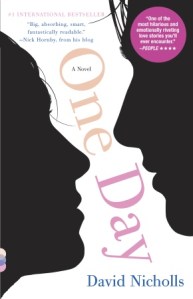
One Day, David Nicholls #50BookPledge

I read One Day on the recommendation of a fellow bookworm who thought it was a good book but hated the ending. My boss at the bookstore loves this book, has recommended it a lot of times, and is looking forward to the movie with Anne Hathaway and Jim Sturgess. So it’s been on my TBR list for a while, and when my bookworm friend lent me her copy, I was excited to read it.

One Day follows the relationship between Emma Morley and Dexter Mayhew over the course of twenty years, depicting snapshots of their lives on the same day (July 15th) each year. They meet in 1988, have sex, and set off to pursue different lives after graduation — Emma as an aspiring writer and Dexter as someone who wants to travel the world and become famous somehow. Their relationship shifts from romance to best friendship, and their lives turn out very different from how they’d imagined it in university. Taking a yearly snapshot is an interesting concept, allowing Nicholls to show gradual character development and long-lasting effects of decisions that characters make. Nicholls is a talented writer, and his characters are complex, interesting people you can imagine being friends with.

That being said, it took me a long time to get into One Day. I found myself bored for the first half of the book. Nothing to do with Nicholls’ writing, and I have to admit, the behaviour of characters and development of Emma and Dexter’s relationship felt realistic. It actually took me a while to figure out why I wasn’t enjoying the book, and I realized that while the yearly snapshot approach is an interesting idea, it made me find the story meandering. I just wanted something to happen already. While I acknowledged the Emma-Dexter chemistry, I found the single day narrative too abrupt — I’d just be getting invested in a plot thread when the day ends, I flip the page and I have to hear about the results through flashback. It didn’t help that I found the young, politically active Emma annoying. Dexter accuses her of being condescending and a know-it-all, and I had to agree. That made me a bit wary about the upcoming movie — I can imagine finding it more annoying on screen.

As Emma and Dexter grow older, however, and become a bit more settled in their respective lives, I found myself becoming more interested in the story. Secondary characters started to become more significant, and Emma and Dexter’s desire to be with each other (not just romantically, but also to connect more deeply as friends) becomes more urgent. That’s what I love most about Emma and Dexter’s relationship: it’s based on a deep friendship; they’re soul mates in a similar (though much less melodramatic) way as Cathy and Heathcliff. It’s a wonderful, touching love story, and Nicholls depicts their connection well.

Like my friend, I hated the ending. Without giving away any spoilers, I just have to say I found it unnecessary. Fortunately, Nicholls is a gifted writer and he handles it much better than I imagine others would have. I also think the one day snapshot format helped him pull off this ending well.

Would I recommend this book? Sure. I can see why so many readers like this book. Despite the movie poster image, One Day is more than just a romance. It’s a well-written look at how two individuals grow up, and, more importantly, grow up together.