Unknown's avatar

About Jaclyn

Reader, writer, bookaholic for life!

Review | A Monster Calls, Patrick Ness

I read A Monster Calls by Patrick Ness because of this blog review. I enjoyed Ness’s Knife of Never Letting Go, but as I wrote in my comment to that post, I thought of Monster as just a children’s horror story. The jacket cover just said the monster “wanted the truth,” which I thought could mean practically anything. So, while I admired the art, I had no interest in reading it.

Then I find out it’s about a boy  whose mom is dying of cancer and whose dad has another family in a different country. Far from being a simple haunted house (monster-infested house?) story, Monster is about a monster who forces the boy to face the truth of his situation. What is that truth? You’ll have to read the book to find out. But it’s a truth that definitely, painfully, hit home for me.

I was an emotional mess reading Monster, and I mean that in a good way. It was cathartic, and in a way, I almost wished I’d had a monster like Conor’s, who told me such stories. A bit of personal background: my mother died of cancer last year. Conor’s pain, his anger, his denial — his experiences just felt very immediate. To be honest, I don’t know how this book will affect you. I won’t say anything as pat as that we’ve all experience loss in some form or other, because if there’s one thing I’ve learned this year, the experience of loss is never generic. The book jacket calls the story “darkly mischievous and painfully funny.” I didn’t see the humour, but perhaps, in a few years, I will. My point isn’t that the book isn’t funny, but that it’s so intensely personal that I think it will touch each of us differently. That’s not something I can say for many books.

I was immediately struck by Conor’s first encounter with the monster:

Then the monster paused again.

You really aren’t afraid, are you?

“No,” Conor said. “Not of you, anyway.”

Of course not. Conor has something much more horrible to fear, something much more difficult to fight. There’s a focus that comes with tragedy, a loss of anxiety that isn’t so much courage as it is the realization that, when all is said and done, some monsters are really very minor.

The monster says that he will tell Conor three stories, after which Conor must tell him a fourth: the truth about the nightmare that has haunted Conor for months and that scares him much more than this monster could. I loved the monster’s stories. They had a fairy tale quality, but they also touched on specific aspects of Conor’s life. Like Conor, I wanted to control the way the stories went, and like Conor, I was shocked or thrilled or dismayed at the twists. I’m over twice Conor’s age, yet I had very similar reactions to the monster’s tales. Some situations are just too big, too frightening to handle, and the reality that, even in fantasy, we don’t always get what we want, is painful regardless of age.

Monster goes far beyond the monster’s tales. The scenes of Conor’s real life are even more powerful. As he faces bullies, as he shuts himself away from a former friend, as he repeatedly insists his mom will be cured by her treatments — everything is just raw and immediate and all too relatable. Even Conor’s fear of talking about his nightmare struck home. How often do we cling to denial because admitting something might make it true? The scene where the monster, gently yet insistently, forces him to acknowledge the truth… Amazing.

Monster is gut-wrenching, emotional, even painful. It’s also beautiful, tender, and moving. I don’t mean to make it sound like a heavy, depressing book. Nor do I want to sound cheesy, but it is uplifting. Ness never gets maudlin. The writing is masterfully subtle, and therefore connects even more deeply. Whatever your experience with loss, this book will connect with that part of you.

After one of the monster’s stories, Conor demands to know what he was supposed to learn from it.

You think I tell you stories to teach you lessons? the monster said. You think I have come walking out of time and earth itself to teach you a lesson in niceness?

It laughed louder and louder again, until the ground was shaking and it felt like the sky itself might tumble down…

“I don’t understand. Who’s the good guy here?”

There is not always a good guy. Nor is there always a bad one. Most people are somewhere in between.

Conor shook his head. “That’s a terrible story. And a cheat.”

It is a true story, the monster said. Many things that are true feel like a cheat.

Indeed.
Review | 77 Shadow Street, Dean Koontz

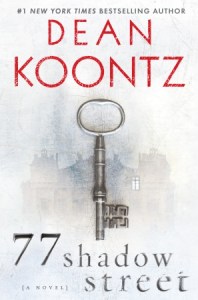
I like haunted house stories. Andrew Pyper’s The Guardians literally kept me up all night, and I identified with Joey Tribbiani when he had to keep Stephen King’s The Shining in the freezer. Still, Dean Koontz’s 77 Shadow Street, about an apartment complex with a history of its inhabitants mysteriously disappearing, mostly left me unmoved. In fairness to Koontz, 77 Shadow Street is a solid, well-written horror/thriller. I haven’t read Koontz in years, and remember only being seriously freaked out by Tick Tock. So I can’t really say how much avid Koontz fans will enjoy 77 Shadow Street.

The books that really creep me out are those where the threat is left intangible. You can sense the malevolence, but you have no idea where it’s coming from, or what its source wants. So when Koontz introduces his antagonist in the first thirty pages as a sinuous “black form,” I was disappointed. The creature is certainly menacing enough, and at parts, downright disgusting, but I was more grossed out than creeped out. We are introduced to the One fairly early, an amorphous evil entity who announces it will kill most of the residents, and presumably as many humans as it can. Scary, yes, but its grandiose tone and generic aim lacked menace for me, more like a cartoon villain’s evil master plan than like Hannibal Lecter’s far more chilling plots.

There are chilling moments, like when a woman tries to call the concierge only to be connected to a telephone operator from the 1930s, which has a Twilight Zone-like inexplicability that I love. There are also scenes where humour enhances the horror, like when the concierge is attacked: “Until now she hadn’t realized that in her right hand she still held the fork with which she had been eating Mausi Anupama’s delicious uttapam. […] She thrust with the fork and stopped her assailant […]” The idea of using a fork to stop a supernatural creature is absurd, yet when it’s the only viable weapon on hand, you can almost cheer when it works.

The potential victims are sympathetic enough, especially the children. I don’t usually like child characters, but Winny’s desire to be a hero is charming. I also really liked the pair of sisters; they added a nice touch of eccentricity and humour. Still, there were so many characters that it got confusing at times, and while I was generally sympathetic for all of them, I didn’t really feel invested in any of them.

The story picks up a bit for me near the end, with characters coming up  with possible scientific explanations. I also liked the story behind the origin of the One, and the moral dilemma it presented some of the characters. I thought the One’s motivation was fairly standard and therefore unexciting, but I did enjoy the twist in the origin story.  Still, overall, 77 Shadow Street didn’t really grab me. To be honest, I might have enjoyed it more as a movie. It would’ve been a gory, entertaining scream-fest and I would’ve left the theatre with no problems turning the light off that night. But as a book, it didn’t even make me scream.

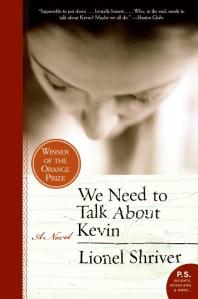
Review | We Need to Talk About Kevin, Lionel Shriver

Lionel Shriver’s We Need to Talk About Kevin is far from the celebratory type of book that I suppose would be more appropriate a way to ring in the New Year, but it’s definitely a must read. I first read it a few years ago, when it was getting a lot of buzz. I didn’t remember a lot of the details, but I do remember thinking it was a very emotionally powerful book.

Confession: I re-read it because of the movie. My sister and I saw the trailer, and my sister was so intrigued by it that we immediately bought a copy of the book. That night, she asked me if she could read it before sleeping: “It’s not too creepy, is it? Because the trailer looked very creepy.” I assured her that I remember it being very emotional, but not quite as horror-movie as the movie trailer suggested. Much later that night, she woke me up: “I thought you said it wasn’t creepy?!” Oops. She devoured it overnight, and the next day was still so disturbed that she wanted to talk about it. I finally had to admit that it’s been years since I’d read it, so I was fuzzy on some of the details. Still, her enthusiasm so intrigued me that I decided to read it again.

My last book of 2011, and my first of 2012, We Need to Talk About Kevin is even more powerful than I remembered. Fair warning: it is creepy. It’s chilling and disturbing, and you won’t want to put the book down. Kevin is about the family of a teenager who kills his classmates and a teacher. But unlike many of the school shooters in the news, many of whom seem to have led tragic lives as social outcasts, Kevin appears more like a psychopath than a troubled victim. From the moment he is born and rejects his mother’s breasts, his mother Eva senses there’s something wrong. Kevin grows up a very creepy boy, scaring away his playgroup and a series of baby sitters. While Eva is increasingly disturbed by what she sees as a power struggle between her and her son, her husband Franklin is wilfully blind to Kevin’s faults, and is determined to maintain a Happy Days family image.

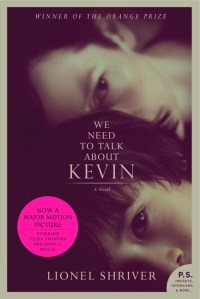
Movie tie-in edition

Kevin, as real-life school shootings do, raises the question of nature vs nurture. Could Eva and Franklin, as Kevin’s parents, have prevented his act? Also, as in real-life, Kevin provides no easy answers. Certainly, Eva admits she is far from blameless — she finds herself unable to form an attachment to her son, even though the mother-son bond is supposed to come naturally. Shriver is a very talented writer, and I love the scenes where she blurs the lines between mother and child, good and evil. For example, Eva once tells Kevin about her distaste for much of the American way of life, particularly how arrogant and materialistic she finds Americans. Kevin, quite rightly, points out that she is just as arrogant and materialistic as other Americans, particularly in the way she thinks herself superior to them. On one hand, it’s a distressing moment — Eva had thought that by being honest with her son, they were finally bonding, only to have her hopes shot down by Kevin. On the other hand, Kevin has a point in saying that the only thing that differentiates Eva from her image of Americans is that she isn’t overweight, and that perhaps he’d rather a mother who was a “cow” and yet not as condescending.

In another, particularly touching scene, Eva watches static on TV and wonders if this is how life is for Kevin. Does he feel as bored in his everyday existence as she does zoned out in front of a defective TV? It’s difficult to feel sympathy for a teenager who cold-bloodedly plans the execution of his classmates, but with that single image of a static-filled TV, I actually did feel for him. The last scene between mother and son in the novel is without a trace of sentimentality, yet I had to pause for a moment just to absorb all it contained.

I love how Shriver uses such subdued, matter of fact writing to deal with such emotional content. The no-nonsense nature of Eva’s narration heightens all the horror and pain and, possibly, even a hint of love, in the story. The title comes from Eva’s plea to Franklin throughout most of the book that they deal with the reality of their son’s issues. However, the title will also definitely apply to the reader. Kevin is an amazing, powerful, chilling book that just blew me away.

I think it also helped that, reading it a second time, I was imagining Tilda Swinton and Ezra Miller as Eva and Kevin. I don’t remember how I imagined the characters to look when I first read it, but bravo to the casting director. Ezra Miller is even more chilling than I think I would’ve imagined Kevin to be, and I can’t wait for the movie. Amazing book, amazing trailer!