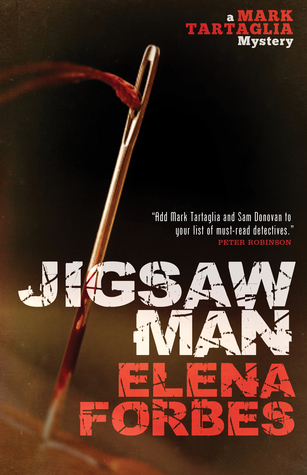
 The fourth in the DI Mark Tartaglia series, this book features a double mystery: a burned corpse turns out to be an assembly of parts from four different bodies and a young woman killed at a hotel turns out to be the sister of Tartaglia’s former partner Sam Donovan. I’d read and enjoyed the first book in this series a few years ago, where I commented that Tartaglia and Donovan clearly have some chemistry — from this book, I can see it had developed into something more and then ended badly, so there’s an interesting bit of tension from their shared history.
I was definitely intrigued by the plot of Jigsaw Man — in particular the stitched up bodies because how creepy and gruesome is that? There was also the interesting coincidence of Tartaglia having been in the hotel on the night of the murder, and I could just imagine a detective like Hercule Poirot having his ego completely bruised at not having noticed anything amiss. For Tartaglia, because he knew the victim, his response was more guilt than a bruised ego, and made the crime personal.
Unlike the first book Die with Me, Tartaglia’s personal life is brought front and centre in this novel, with the investigation taking somewhat of a back seat. As a result, I felt like there was so much of a backstory that I missed, and while Forbes does a good job of cluing new readers in, I wondered if the case would have meant more to me if I’d known the victim as well, or at least remembered more of Donovan’s character. As it was, it read as a fairly standard police procedural.
I mentioned in my review of Die with Me that nothing in particular about Tartaglia stood out to me, and I think that was a part of why I couldn’t really get into this book. When the story is so contingent on a mystery’s effect on the main character’s personal life, you have to care about the main character, and in this case, I just didn’t find Tartaglia compelling enough.
Again, as with Die with Me, I found Donovan to be a more interesting character. She is no longer a police officer in this novel, yet her background naturally makes her want to be involved in tracking down her sister’s murderer. I found it annoying at first, mostly because I was no longer familiar with her background within the series and I thought she was just interfering in other people’s jobs. Later on, she then hides key information from Tartaglia because she wanted to take her own revenge, and while it’s an understandable impulse, it’s also a trope that annoys me in detective or superhero fiction, mostly because that kind of storyline always progresses predictably.
The mystery of the stitched up body parts didn’t make much of an impact on me — it mostly felt tacked on and while we follow the police procedural to solve that case, it felt more a background subplot to the actual mystery involving Sam’s sister.
Overall, I wonder if having read the other books in the series, or even having read the first book more recently, would have made me enjoy this book more. As it was, the book was okay. I found myself mostly bored by it, until Donovan’s perspective kinda takes over near the end. I may give the Tartaglia series another shot, but also wonder if Forbes may have plans of doing a Donovan stand-alone. That one, I’d definitely read.
+
Thank you to House of Anansi for an advance reading copy in exchange for an honest review.


 This is such a good book! Unfinished Business is an intelligent and well-balanced discussion on work/life balance. I love how Slaughter eschews a one-size-fits-all solution and instead talks about how this could work given a range of circumstances.