Unknown's avatar

About Jaclyn

Reader, writer, bookaholic for life!

TV Preview and Giveaway | Childhood’s End Premieres on Showcase Canada Dec 14 at 8 pm

Childhood's End - Season 1

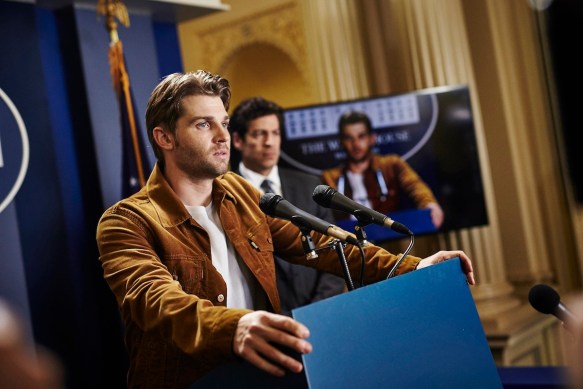
CHILDHOOD’S END — “The Overlords” Episode 101 — Pictured: Mike Vogel as Ricky Stormgren — (Photo by: Ben King/Syfy)

Calling all fellow Canadian science fiction geeks! Arthur C. Clarke’s classic novel Childhood’s End is being adapted for the small screen and will premiere next week on Showcase! The three-night, six-hour miniseries follows the peaceful invasion of the mysterious Overlords, which begins decades of apparent utopia. The Overlords eliminate poverty, war and sickness from the world… but at what cost?

I’m also geeking out over the cast for this show. Charles Dance (Tywin Lannister from Game of Thrones!) is the ambassador of the Overlords, and likely about as trustworthy here as he was in Westeros. Julian McMahon is the founder of a research station, and while he’s probably best known for Nip/Tuck, I will forever know him as Phoebe Halliwell’s demonic boyfriend Cole in Charmed. Yael Stone, who is the utterly lovable but creepily stalkerish Lorna Morello in Orange is the New Black, plays a woman determined to find out the truth about the Overlords. Finally, Colm Meaney is in the cast as well, playing someone named Wainwright, and his name is certainly familiar to many Trekkies as Chief O’Brien.

Childhood’s End will be broadcast on Showcase in a three-night, six-hour miniseries event on December 14, 15 and 16 from 8 – 10 pm ET / 9 – 11 pm PT. 

GIVEAWAY (Canada only)

Childhood'sEndPrize

Want to win a Childhood’s End prize pack from Showcase?

Enter here for a chance to win!

Contest runs from midnight on Dec 10 – midnight on Dec 14 and is open to Canada only. Good luck!

TRAILER

Blog Tour | Just a Little Bit of Love, Ines Bautista-Yao

just a little bit of loveOne of Ines Bautista-Yao’s greatest strengths as a romance writer is that she is able to tap into the romantic fantasies of our high school selves. You know the type. That moment in life when it does seem conceivable that a pop star can find you in the midst of a crowd of screaming girls and fall madly in love, or that the hot captain of the sports team harbours a secret crush on the nerdy math geek.

Bautista-Yao takes these fantasies, and repackages them into sweet vignettes that actually feel real, and more to the point, realistic. Rather than Nick Carter swooning as he catches your eye at a Backstreet Boys concert (ahem), perhaps it’s a cute, shy man at the coffee shop where you work. Or the (actually cuter) teammate of that athlete you’re crushing on. Or perhaps it’s the random cute guy you encounter once at a work event and fear you may never see again.

These stories make up Bautista-Yao’s newest book Just a Little Bit of Love, a collection of short stories that are tangentially related to the main characters in her most recent novel Only a Kiss. As the blurb says, these are just small doses of romance, but they do serve up a whole lot of feels.

Q&A WITH INES BAUTISTA-YAO:

1. These stories revisit the world of Kate and Chris from your novel Only a Kiss. What inspired you to return to that world and flesh out these characters?

I wish I could give you a more creative answer but the truth is, I started writing the story blog posts to promote Only A Kiss. Then my husband asked how many stories I had and suggested putting them all together in a collection. The problem was I wasn’t done with one of my stories and no matter what I did, I couldn’t seem to finish it. So I stopped writing it and just started a new one which I fell in love with in an instant!

2. Two of the stories may be familiar to avid readers of your blog, where they were originally published. What was the reader response to those stories and what made you decide to include them in this collection?

Whenever I would announce the stories, I’d get readers and friends messaging me asking for more. So this is it! But of course, I’m still getting requests for more haha! But that’s always a good thing.

3. In “On the Sidelines,” the romance begins with tension — Ina finds John annoying. What about this type of beginning interests you as a writer?

I like complications because I want to see how my characters figure them out and come out better, stronger, and happier in the end. Also, it makes my characters and their relationships more intriguing.

4. I love Ina’s friend Robert, who cheers on her romance while being too afraid to pursue his own. His fear is compounded by his being gay, and unsure how his crushes will respond. What inspired Robert’s character, and do you think you’ll ever write a romance between characters of the same sex?

I have no idea. I didn’t plan for Robert to be gay, he just was. When I start writing, I have a very general idea in mind and everything comes together when I start putting the words down. So I don’t know if I will write a same sex romance. Who knows? I just might one day 🙂 As for inspiration, that’s a secret because I think it’s still a secret, if you know what I mean 🙂

5. John tries to woo Ina with cheese rolls and in “Sticky Notes”, Jacob charms Carla with a sticky note. What was the sweetest thing a guy has done for you, and what made it so special?

I believe there’s a fine line between sweet and creepy. The difference lies in your feelings for the boy. If Ina didn’t like John, his persistence would have been creepy. If Carla didn’t like Jacob, she would have been grossed out by the sticky note. So given that, I’ve had boys serenade me, draw me islands, write me poetry, give me bouquets of flowers, but the sweetest thing a boy has ever done for me was something I only found out about after it happened. Before my husband and I got together, he was praying a novena to St. Joseph that I would finally come to my senses and realize I was in love with him too 🙂

+

Thanks to the author for inviting me to be a part of this blog tour!

Just a Little Bit of Love is available on Amazon.

 

Review | The Gap of Time, Jeanette Winterson

GapofTimeThe Gap of Time is such a beautiful book. Winterson is a master of language, and she plays with Shakespeare’s tale in such clever ways that it feels both homage and update, Shakespeare’s original not so much retold as teased out and turned inside out. There’s a playfulness to Winterson’s tone, a lilt to her cadence that hints that she doesn’t take all of this too seriously, yet there is also such lyricism in the language that she manages to evoke depths of emotion all the same. It’s a linguistic feat worthy of Shakespeare himself, and thus such a fitting “cover” of his work.

Take for example the beginning, where a man named Shep finds a baby “light as a star” abandoned near a hospital, and decides to adopt her as his own:

I played the song and I taught it to her. She was singing before she could talk.

I am learning to be a father and a mother to her. She asks about her mother and I say we don’t know. I have always told her the truth — or enough of it. And she is white and we are black so she knows she was found.

The story has to start somewhere. (page 23)

The words are simple and straightforward, yet the rhythm almost feels musical. Contrast that with the harsh momentum in the story of Leo, a man whose irrational jealousy ends up destroying his family:

Leo swivelled round to the window. He hated his friend for fucking his wife. Weren’t there enough women out there? Everywhere he went, bars, clubs, hotels, boats, there were identical-looking women searching for men. Long hair, long legs, big sunglasses, moulded tits, vast handbag, killer heels. You could rent them for the weekend except that it wasn’t called renting, but both parties knew who paid and who put out. (page 39)

You could just feel his anger bubble up and about to burst through. Winterson’s story isn’t meant for stage, but there’s a stage-like quality to her writing, a sense that you’re watching the action unfold rather than just reading about it.

Gap of Time is a cover version of Shakespeare’s The Winter’s Tale. You don’t need to know the original to appreciate this story; the novel begins with a handy recap of the play. One of Shakespeare’s later plays, it was never one of my favourites, mostly because I felt Leontes (Leo in Winterson’s version) got off too easily with his own happy ending despite all the havoc he wreaked on other people’s lives. Winterson’s version makes me appreciate the story more, and while I still can’t bring myself to feel sorry for Leo, I appreciated how Winterson’s book makes clear how much Leo’s darkness is within him and how much his suffering ends up self-inflicted.

I also love the other updates Winterson made to the story. She weaves in issues of race (a white girl adopted by a black man and his son) and sexuality (the tension between Leo and his best friend Xeno is partially due to them having once been lovers and there are hints that Leo’s homophobic comments to Xeno are actually rooted in fear of his own sexuality). She also ramps up the metaphor, but does this so beautifully that it feels natural rather than heavy-handed. Xeno invents a video game inspired by a story of an angel who is trapped in a courtyard, and as time passes in the game, Time itself eventually becomes a character in its own right. I’m not quite sure what it means, and there’s a moment where Winterson blurs the lines so I’m not sure if the characters are playing the video game or moving about in the real world. I didn’t like that ambiguity, but I think the metaphor of the game is beautiful overall.

Towards the end, Winterson breaks the fourth wall and deliberately steps back to let the story play out without her. Up until that point, she has moved the characters around, between London and New Bohemia, between the past and the present, and just before she breaks that fourth wall, she situates the characters just so. It’s masterfully done, a playwright/director creating a tableau just as they signal the curtain to fall. There’s an artifice to Winterson’s presentation, certainly, but it’s deliberate and, to my mind, done really well. We know, somewhat, how the story will end, because we know how Shakespeare’s original ended, and despite Winterson’s weaving in of new themes like race and sexuality, she consistently stayed true to the flow of the original. And yet we are still swept away. The emotions are still real, the characters still fleshed out, and the wordplay simply magnificent.

I loved this book, and I’d love to read more of Winterson’s works, to see how her magic with words can bring her own stories to life.

+

Thanks to Random House Canada for a copy of this book in exchange for an honest review.