
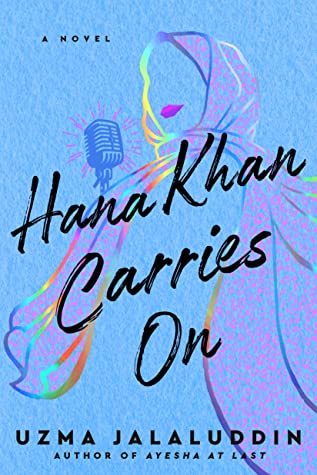
 If you read only one book this year, let it be Hana Khan Carries On. You’ve Got Mail set in two competing halal restaurants, Hana Khan is a sparkling, heartwarming, laugh-out-loud hilarious rom com that is an absolute pleasure to read. Hana is a podcaster and aspiring radio producer whose mom has run the Three Sisters Biryani Poutine in Golden Crescent, Scarborough for fifteen years. Aydin is an aspiring restauranteur with a wealthy, domineering father determined to make his mark with an upscale halal restaurant across the street.
Hana and Aydin’s banter is witty and clever — sparks practically fly off the page. From the very first page, where we meet them as anonymous podcaster AnaBGR and her first fan / avid commenter StanleyP, I was hooked, and I wanted more. Their enemies-to-lovers relationship stays prickly sweet throughout — you see how much they’re growing to care for each other, even as they can’t help their impulse to keep hurting each other’s business. Much like the equally prickly sweet rambutan, it’s a pleasure to see the sharp outer layers peel away, and reveal the soft squishy heart within.
Beyond the romance, Jalaluddin has created an entire world within Golden Crescent, populated by a cast of characters who have my heart. Foremost is Hana’s eighteen-year-old cousin Rashid, visiting from India and plunging headfirst into all the intrigues at Golden Crescent. A cheerful and mischievous Machiavelli whose family of accountants may or may not have ties to the New Delhi Mafia, Rashid stole the show when he joins Hana at the business owners’ association meeting, and enthusiastically joins in a drama confrontation, while of course cheekily confirming with his cousin that this was indeed the drama his cousin had warned him about. I love the way his story unfolded, and I would so very much love a spinoff novel all about him, please and thank you.
Then of course, there is Kawkab Khala, who is a force of nature, and just the badass mentor Hana needed. The story behind her being nicknamed after a cat is absolutely fantastic, and if Hana’s podcast were real, I would totally eat it all up. Both Hana and Aydin’s families are richly imagined, and revealed with so much depth and heart that I don’t know how Jalaluddin managed to keep it all contained within 300+ pages. I feel like I know these people, and feel very strongly about them and their futures, and all I can say is that I very much invite you to get to know them as well. Even the side characters are drawn with spare but vivid strokes; I would totally be down to reading more about Hana’s friends Yusuf and Lily, and Aydin’s friend Zulfa. And the imam, who barely appeared at all — I won’t say anything more, but a scene featuring a pink Hawaiian shirt with two flamingoes almost made me cry.
Being a hijab-wearing Muslim woman like Hana unfortunately comes with its share of racism. I am blown away by the breadth and depth of Jalaluddin’s handling of this aspect of Hana’s life. In Hana’s boss Marisa, we see how microaggressions operate in the workplace, from people who mean well but seem to not realize — and not care to realize — how their words and actions hurt. In Hana’s co-worker Thomas, we see how some Brown people attempt to assimilate, and how much they may need to sacrifice in order to do so.
And then there’s an incident of racist violence that leads into a whole series of even more racist hate crimes. There are so many ways an author can choose to handle this kind of content, and I should note that many of them are equally valid, but I am downright awestruck with the mastery and skill that Jalaluddin displayed in these chapters. She incorporates such depth of nuance, and such a broad diversity of responses within Hana’s community — from the combination of street smarts and naivete in Rashid’s response as someone who didn’t grow up in North America, to the combination of privileged outrage and weary apprehension in Hana and Aydin’s responses as young adults who did; from the more mature caution of Hana’s older sister and brother-in-law who carry more years of experience than Hana and Aydin do, to the completely different views of Hana’s mother, whose experiences of racism as an immigrant have shaped a completely different worldview.
Hana captures it well when she says that on one hand, her immigrant parents did experience racism to a much worse extent, but on the other, those experiences have conditioned them to accept less than what Hana and her sister are willing to live with. These chapters are just all so incredibly rich and textured, and yet handled with such a light and delicate touch that Jalaluddin manages to maintain the rom com feel. As a reader, all I can say is that I feel the need to sit with these chapters, perhaps read them again later on. I don’t know if I can ever fully absorb or express the thoughts and feelings they inspire, but all the kudos and admiration to Uzma Jalaluddin for her ability to put all of this on the page.
Hana Khan Carries On was just an absolute joy to read. It made me laugh, it made me cry, and by the end of the book, it filled me with joy. How much do I love that scene at the Golden Crescent festival? I love Hana, I love Aydin, and I love so many of the wonderful people Jalaluddin has brought to life. This book is by far the best one I have read all year, and I urge all of you: do yourself a favour and read it for yourself.
+
This book comes to me courtesy of Another Story Bookshop and a gift card from Penguin Random House Canada, which I won at an online contest to celebrate independent bookstores and the important work they do. In gratitude for this opportunity to read such a wonderful story as Hana Khan, I invite you to check out this map that Penguin Random House Canada has compiled of independent bookstores across Canada. Find your local indie and show it some love!
 Popular high school kid Griffin is dead, and Clara’s sister Emily has been arrested for murder. Only Clara knows why Emily may have hated Griffin enough to kill him, and it’s all because of something Clara told her.
 Literary Treats