
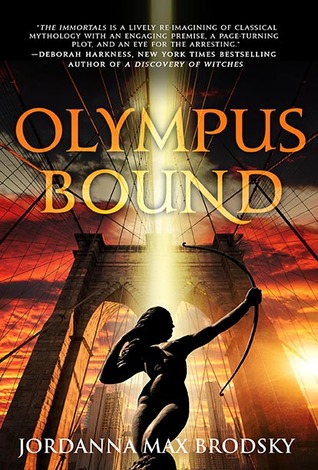
Review | Olympus Bound, Jordanna Max Brodsky

34328816I absolutely loved The Immortals and Winter of the Gods, so I was eager to see the next instalment in the story of Selene DiSilva, the Greek goddess Artemis living in present-day New York. Unfortunately, I found myself bored with Olympus BoundI gave it a few tries, because the first two books were so great, but I eventually gave up and marked it as DNF at 31%.

The story has a compelling premise: the culmination of Selene’s battle against mysterious forces with an apparent vendetta against the Olympian gods and goddesses. In Olympus Bound, Selene is after her grandfather Saturn, a titan deposed from power by his son / Selene’s father Zeus when Zeus took over Olympus. She suspects that Saturn is behind the recent attacks on the Olympian gods and goddesses and that he holds Zeus captive for a ritual sacrifice that will increase his power tremendously. He poses a major threat because, while the Olympian gods and goddesses have been steadily losing their power in the last few centuries, Saturn has been manipulating belief systems like Christianity to ensure his own power remains strong. In the meantime, classics professor Theo is mourning what he and while his friends try to help him move on, he is obsessed with plotting how to bring Selene back from the underworld.

It’s the perfect set up for an epic, emotional battle, but the execution fell flat. Grief-stricken Theo is just mopey, and the plan he comes up with to save Selene is certainly audacious, but he just came off kinda pathetic. I sympathize with his grief, but I also just wanted to join his friends in telling him to move on already. There was a colleague who stayed with him because she had a crush on him and was hoping to catch him on the rebound — I found her a compelling character and wanted her to find someone who would actually love her back.

Selene’s quest to find Saturn and save Zeus should have been epic, but instead felt mechanical. I like seeing more of Flint’s character and I thought Juno seemed interesting, but Selene fell flat. She was such a compelling character in the first book, and I think her relationship with Apollo made her more nuanced in the second book, but in this book, despite the emotions over missing Theo, worrying over her father, and wanting revenge on Saturn, she feels like little more than a device to advance the plot.

As I said, I gave up on this book at the 31% mark. Winter of the Gods started off somewhat slow as well, so it’s possible Olympus Bound would’ve gotten better if I’d stuck with it. I just no longer care enough to find out.

+

Thank you to Hachette Book Group Canada for an egalley of this book in exchange for an honest review.
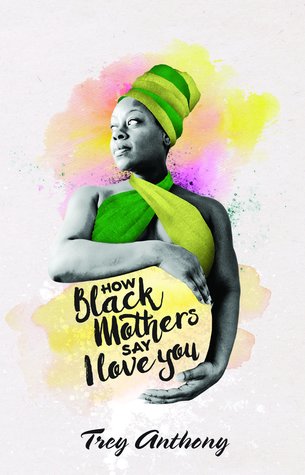
Review | How Black Mothers Say I Love You, Trey Anthony

36152816Claudette moves back in with her sister Valerie and mother Daphne when she learns that Daphne has terminal cancer. Claudette has never forgiven Daphne for moving to Canada and leaving her and Valerie with their grandmother for six years, nor for always seeming to care more for their younger half-sister Cloe, who died in childhood. In turn, Daphne has never come to terms with Claudette’s a tomboy and a lesbian, and constantly tries to get her to act more feminine. Valerie has been taking care of Daphne for years, and ends up in the unenviable role of peacekeeper as the three women are back in the same house for the first time in years.

I’ve heard great things about Trey Anthony’s How Black Mothers Say I Love You, and while I still would love to see it performed on stage, I can attest that the book version is incredibly strong. Anthony’s dialogue is sharp, and she’s great at switching between humour and tears within a single scene. Living together can often be a catalyst for long-buried issues and resentments to bubble to the surface, and Black Mothers does this beautifully. Anthony gives us beautifully brief moments of tenderness nestled between rapidly escalating confrontations, and as a result, there’s a tension within each quiet moment that reminds us how fragile peace can be. Conversely, the balance Anthony maintains between these types of scenes reminds us as well that there is a thread of love underscoring even the most emotionally fraught shouting matches.

Above all, the dialogue feels heartbreakingly real. Anthony does a great job with the relationship between the sisters and their mother. The way Claudette and Valerie tease each other, confront each other, and then defend each other all portray an incredibly fierce sisterly bond. I can just imagine them as children clutching to each other as they waited for their mother to bring them over to Canada, or perhaps as they prepare themselves for the possibility that she never would. And the way Daphne interacts with them is wonderfully familiar in the way only mothers can be, and yet there’s the sense of distance as well, that reminds us of how unfathomable adult daughters can be to their mothers.

I also really love this scene where Valerie tells Claudette that her husband, a wealthy white man, is having an affair with a white woman:

But when I found out about the affair I was right back in grade six. Hating this nose, hating this skin, hating this hair. Thinking I bet all along all he wanted was a white woman and maybe I just wasn’t enough?

[…]

And we’re in counselling. And we’re trying to work it out but it’s hard. He just doesn’t get it, you know. He keeps saying that colour has nothing to do with it! She could have been purple for all he cares! But it matters to me!

Beat.

It just wouldn’t hurt so much if she was black. And our counsellor, clueless! Telling me we need to look at what was going on IN the marriage that let David look outside. But I just can’t get past the fact that she was white. [p. 28-29]

Incredible writing, and I can only imagine how much more powerful it would be on stage.

+

Thank you to Playwrights Canada Press for a copy of this book in exchange for an honest review.

Review | Emergency Contact, Mary H.K. Choi

35297272The concept behind Emergency Contact is pretty cute: Sam and Penny meet at a coffee shop and after Sam has a bad night and Penny is the one who gets him home safely, they agree to be each other’s ’emergency contact,’ the person the other can text for help at any time. Over time, their texts become less about actual emergencies and more about flirting through emojis. The book isn’t a romcom, however, and Sam and Penny end up helping each other through some difficult times.

Mostly, Emergency Contact made me feel old. There was a time I may have been totally caught up in Sam and Penny’s drama, and may very well have found this a very deep and emotionally moving tale of friendship and love. As it was, I was mostly unmoved.

Part of it is that both characters felt quirky hipsterish in a way that reminded me of so many other main characters in teen dramas. Penny is an aspiring fiction writer who studies English at university. Sam is an aspiring documentary filmmaker who works at a coffee shop to make ends meet and doesn’t even have enough money to buy a laptop for making his films. Penny’s main project is a short story inspired by a news item from Korea, and a breakthrough about the perspective that tells the story elevates her work to brilliance in her teacher’s eyes. It was a good idea, and certainly unusual, but I thought the story ended up feeling pretty flat. Sam’s main project is a documentary about neighbourhood kids, which isn’t super groundbreaking in terms of documentary ideas, though I do like a decision he made about how best to respect the best interests of his subjects.

A lot of Penny’s problems also had to do with her mother. I liked the cultural aspect of it, where Penny’s non-Korean roommate complains that Penny’s mother is too involved in her life considering she’s now in university, and Penny explains that that’s just how their relationship is. I thought that felt very realistic, and I thought the roommate’s reaction was also very true-to-life. But overall, I felt bad for Penny’s mother, with Penny being so judgemental of her romantic life and her love for trendy, youthful clothes. I can understand where Penny is coming from, and perhaps if I had read this when I was Penny’s age, I may have even sympathized, but as it is, I felt sorrier for the mother.

Still, the story got better the further it developed, and I especially liked how the friendship between Sam and Penny evolved over time. I think younger readers or at least more angsty or less jaded ones, may enjoy this book more than I did, but this simply wasn’t for me. One thing I did absolutely love is the cover art: the illustrations and cover design are gorgeous!

+

Thank you to Simon and Schuster Canada for an e-galley of this book in exchange for an honest review.