According to Gretchen Rubin, we all fit into one of four tendencies: Upholder, Obliger, Questioner and Rebel. You may take the quiz on her website to find out your tendency, and in the nutshell, the four tendencies are as follows:
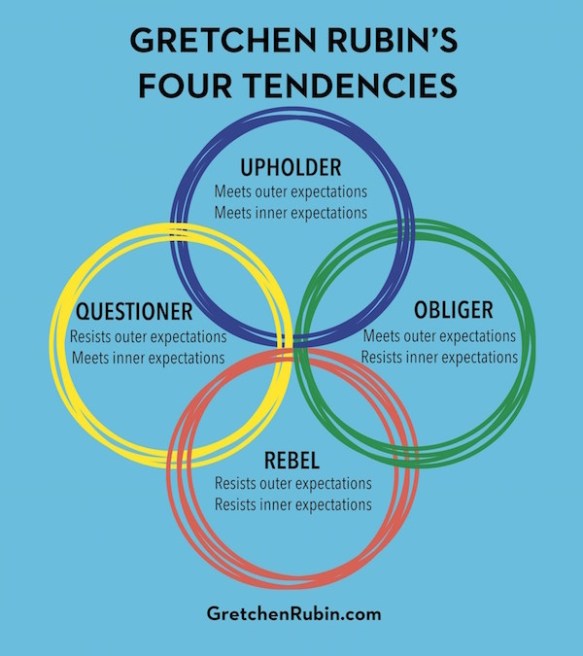
Some readers have commented that this categorization is reductive, and even Rubin herself admits that people often exhibit traits of more than one tendency (see: the overlap in the Venn diagram above). I don’t quite have that issue. I took the quiz when it first came out with Better than Before, I took it again with this book, and I’m very firmly an Obliger. Even when I read the various chapters, I recognized myself most strongly in the Obliger section. Which is probably why, while part of me questions the validity of the framework (a lot of it feels self-fulfilling, e.g. you answer X therefore you are an Obliger and you are an Obliger because all other Obligers answered X, and I wonder how the quiz was constructed and people grouped before these categories even existed), for the most part, I pretty much take the framework at face value.
 It’s fairly logical, and I like that the framework is pretty non-judgemental — it’s not that one tendency is better or worse than the others, it’s that we need a different approach to motivate people of various tendencies. The Obliger is pretty much the Hufflepuff of the four tendencies (we do stuff for other people, but struggle to do stuff for ourselves), so it’s a relief that this framework recognizes that any tendency has just as good a chance as any other at succeeding in various careers and leadership positions.
The book goes into some good tactics to deal with people with a different tendency than yours. For example, if you’re a manager of a Questioner, you need to give them a logical explanation for the tasks you assign. If you’re the spouse of a Rebel, you need to give them the freedom (or the illusion?) that the decisions they’re making are because they want to, and not because you told them to. There’s also a really good section on Obliger rebellion, where Obligers get fed up with doing things for others and then just stop without warning. I also like the insight that we often see our loved ones as extensions of ourselves, and so we treat our obligations to them the same way we treat our obligations to ourselves.
The book itself feels a bit thin, and a lot of the content felt repetitive. Once you get a grasp of the differences between the tendencies, a lot of what she advises feels like common sense, and not worth going into detail for over 250 pages. As an example, if you’re an Obliger and respond best to external motivations, it seems obvious that you need to create external accountability (e.g. workout buddy, mid-point deadlines enforced by your manager).
I also felt that while the book dealt in-depth with how to motivate and deal with people of other tendencies, it doesn’t at all tackle how we can manage our own behaviour given our own tendency. Rubin will likely say this is my Obliger self coming through, but I couldn’t help wondering — the chapter on Questioners explains all the ways in which we can provide endless logical explanations to make Questioners do what we want/need them to do, but that puts all the onus on the people the Questioner interacts with and none on the Questioner themself. How can a Questioner manage their own desire for rational explanations and make themselves just go to work when their manager or spouse no longer has time to justify the task? Similarly, how do Upholders manage their own behaviour so that they don’t seem self-righteous when loved ones don’t meet obligations as easily as they do?
The chapter on Obligers advises them to create artificial deadlines and people to call them out on missing their obligations, but nothing about managing their emotional need to please people. To address Obliger burnout, Rubin recommends coming up with a conflicting obligation that must be met (e.g. I can’t work overtime on X project because my family needs me home for dinner. So my family’s needs trump my boss’s needs), which may be effective, but may also simply turn Obliger burnout in another direction. I think a section on self-care and realizing the importance of your obligation to yourself is just as important.
I like the Four Tendencies framework in general. I just wish this book delved a bit deeper into how we can manage ourselves and our own tendency to work and live more smoothly with people of other tendencies.
+
Thank you to Penguin Random House Canada for a copy of this book in exchange for an honest review.

 I watched the Evening with George Smiley event at the movie theatre, where John Le Carre spoke to an auditorium in England about his history with his beloved character. In his talk, Le Carre spoke about the time of Smiley, the era Le Carre himself was in the British Secret Service, with a sort of nostalgic wistfulness. It wasn’t that spies were much nicer back then — Le Carre’s novels are rife with corruption and double dealing — but there was a simplicity to their work that Le Carre imagines is very different from spy work today.
 I was once tagged on a Facebook photo of an event I did not remember at all. After a moment, I realized that the friend who tagged me made a mistake, and the woman she thought was me was someone else completely. The woman’s features were somewhat obscured by sunglasses, but the resemblance otherwise was enough to confuse even me for a moment. I’ve had people before tell me they’ve seen my doppelganger around, but I’ve always dismissed those as exaggeration. The Facebook photo was the closest experience I’ve ever had of seeing a possible doppelganger for myself, and it was disquieting.
 Literary Treats