
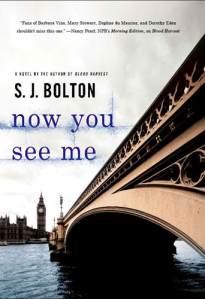
Now You See Me, S.J. Bolton #50BookPledge

Young detective constable Lacey Flint walks to her car after interviewing a witness and finds a woman bleeding to death draped over it. An anonymous letter to a reporter points out alarming similarities between the killer and Jack the Ripper, and mentions Lacey by name. Turns out Lacey is a lifelong Ripperologist, and has some dark secrets in her past, which slowly get revealed as the investigation progresses.

As a crime buff, I’ve always been fascinated by Jack the Ripper, and S.J. Bolton’s Now You See Me takes off from one of the lesser known theories about Jack the Ripper’s identity. This book kept me guessing throughout, and I love how Bolton put in all these twists that made me think that I knew what was going on, only to find out later on that I was wrong.

Ultimately, while the mystery began as being about Jack the Ripper, it soon became more about a contemporary crime and a secret from Lacey’s past. Lacey is an intelligent detective, and while I was afraid I’d be disappointed in whatever secrets she had (with so much build up, I would’ve hated to be let down), when the big reveal came, everything just made sense. Even the minor characters, Tulloch and Joesbury, were fascinating figures, and I could never tell what Joesbury thought about Lacey. I shared Lacey’s confusion about whether he was attracted to her or suspicious of her, and I loved that ambiguity.

Bolton effectively builds an atmosphere of creepiness, with killings taking place to the soundtrack of such an innocuous song as My Favourite Things from The Sound of Music. At first, I didn’t like the chapters from the killer’s point of view, because they began as mostly atmospheric and vague, and I felt they detracted from the primary story, which was already so exciting in itself. There were also times when I wondered if plot points were going anywhere or if they were just put in randomly (e.g. flashbacks, My Favourite Things, the case Lacey was originally investigating before getting sidetracked by the Ripper copycat). However, the killer’s chapters soon became more action-packed, revealing the thoughts of the victims, and all the minor plot points turned out to be very important for the ending and for understanding the killer’s character.

Finally, I love all the discussions on Ripper lore in Now You See Me. It’s never pedantic, always in the context of trying to understand the latest murder, but it gives crimes buffs like me interesting details about Jack the Ripper. There’s even an Author’s Note where Bolton explains some of the various theories about his identity. Now You See Me is an exciting murder mystery and an original take on the Jack the Ripper myth. Highly recommended for mystery buffs.
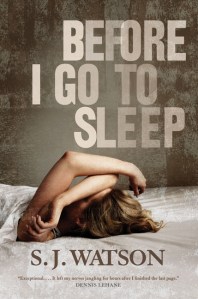
Before I Go to Sleep, S.J. Watson #50BookPledge

Oh. My. God. S.J. Watson’s Before I Go to Sleep is amazing. Read it, read it, read it. But first, and trust me on this one, make sure you have a few hours to spare. Sleep kept me awake till 2:30 am.

My tweets while reading:

May 18th, 4 pm: Engrossed in ARC of S.J. Watson’s Before I Go to Sleep. Out in June, watch for it. Incredible so far.

[I stopped reading for a few hours, then decided to read just a bit more when I went to bed around 11 pm…]

Midnight: OMG, the twists keep coming. S.J. Watson’s fault if I sleep super late tonight.

1 am: Literally gasped out loud while reading.

2 am: I knew it! I knew it!

2:05 am: Holy crap. I didn’t know anything after all. Chills.

That was when I realized I should just stop live tweeting my reading experience before I flooded my followers’ feeds with even more “Aha!” and “Oops.” moments.

How much do I love this book? And why do I love it so much? Check out my full review on Savvy Reader or read below.

S.J. Watson will be reading at Harbourfront Centre, Toronto, June 22nd.

Or check out this Vizme token to see an excerpt, a bit about the author and other cool stuff.

+

Full Review

[I just noticed that my review has been archived on the Savvy Reader site, so I’m republishing it here.]

Before I Go to Sleep is pure psychological thriller. Christine wakes up in a strange bedroom beside a middle aged married man she doesn’t recognize. It is only when she goes to the bathroom and sees her hand that she realizes that her skin is wrinkled, and that she too is wearing a wedding ring. She sees photos of herself, twenty years older than she thought she was, taped to the bathroom mirror. She also sees photos of the man from the bed, labelled “Ben, your husband.”

Ben explains that an accident eighteen years ago has destroyed her memory. While she can usually remember things that happen during the day, she will have forgotten them by the time she wakes up the next morning. She sometimes gets flashes of memories about her childhood, but most of her life is a complete blank. When Ben leaves for work, he says, “I love you, Christine. Never forget that.”

I thought Sleep was going to be an emotional, heart breaking tragedy, and in many ways it is. What if you lose your memories every time you went to sleep? There are events and people I remember vividly — sometimes, the most random of things, like riding the spinning teacup when I was three. Then there are events I remember, but am not too clear on the details. Memories are notoriously unreliable, and I love the security of looking at photos and knowing that that moment, at least, was real. To lose even the most tenuous hold on memory, to look at photos and have them evoke no sense of recognition, to have lost the last two decades of your life — I don’t even want to imagine how that would be like. In one scene, Christine is angered by Ben’s seeming indifference to a past event. Then she realizes that, for Ben, the emotions have already scabbed over, years before. Yet for her, emotions will always be raw, because she will always, every day, be experiencing them for the first time. So Christine’s condition is tragic; the last sentence in the book almost made me cry.

But Sleep isn’t just a beautifully crafted drama. Christine receives a call from Dr. Nash, who tells her she’s been his patient for a while now. He returns to her a journal she’s written, from which Christine reads about her past, but as disconnected from it as if the journal were a work of fiction. How much can we trust this journal, when Christine herself can’t remember writing it? More importantly, why does she have snippets of memories that don’t agree with what Ben has told her about her past? Are these real memories, or has Christine created them herself? Is Ben lying to her, and if so, is it just because he wants to spare her pain? Who are these people she remembers, who seem so familiar and yet whom she can’t identify?

Watson takes us right into Christine’s mind, and I, at least, was just as confused as she was. I’d think I knew who to trust, and what the truth is, only to find out later that I was wrong. As readers, we have a bit of an advantage over Christine — unlike her, we don’t have to begin from scratch with every new day in her story. Yet, even with that advantage, I found myself frustrated, dying to know more, wishing I knew the truth. Watson depicts very vividly how much more frustrating it must be for Christine.

Before I Go to Sleep is a powerful, gripping, and yes, tragic, psychological thriller. I didn’t want to go to sleep when I was reading it; I just kept wanting to find out more. I also found myself getting caught up in Christine’s fear and paranoia; I certainly didn’t want to go to sleep with that kind of mindset.

More importantly, however, the title perfectly encapsulates Christine’s own, much more urgent, desire not to fall asleep yet. Each slumber is a kind of death. We expand our life by building on our memories; Christine must live as full a life as she can each day, because she starts completely from scratch again the next. And she must do this while dealing with potential half-truths and lies from people she has no choice but to trust.

Trust me: read this book.

A Visit from the Goon Squad, Jennifer Egan #50BookPledge

Jennifer Egan’s A Visit from the Goon Squad has got to be one of the most hyped books in the past few months. My co-worker had been recommending it since it first came out, but it wasn’t really on my list of books I have to read. I’m not too big a music fan, and to be honest, the idea of a chapter in powerpoint, while intriguing, also turned me off: I’m not too big on gimmicks. What eventually convinced me to read Goon Squad is the phrase “Time’s a goon.” I’d heard of it as a quote from the book, and the significance of that with the title touched me. So I read it.

True enough, when a character utters that line in the middle of the book, I got… well, not chills, but that ineffable pull you feel whenever something touches you deeply and makes you want to reach for something just beyond your grasp. “Time’s a goon” ties together all the seemingly disparate stories within Goon Squad, and makes you realize the breadth of Egan’s tale. Goon Squad begins with Sasha, who suffers from kleptomania, and her boss Bennie, an aging music executive and former rocker. The story then traipses through time, picking up one element in a character’s story and skipping with it into the past, often with a completely new set of characters and an altogether different perspective.

I’d say the story feels like a web, with threads stretching out in different directions and spinning everywhere till it returns to the centre, but it feels more like a hyperlinked cyberweb. You click on random elements, get taken to some other story that’s still somehow connected, and, in the end, return home. I may have been wary of the Powerpoint chapter, but Egan has changed my mind. The Powerpoint, with all its bullets and arrows and random phrases in bubbles, depicts the overall structure of Goon Squad perfectly. Because this chapter is narrated by a younger character, the next generation, so to speak, its form also wonderfully illustrates the drastic changes that come with the inevitable passage of time. And, quite frankly, the powerpoint form turns what could’ve been a maudlin, albeit emotionally significant, chapter into something zippier and more interesting.

So did I like Goon Squad? I liked portions of it, ended up feeling deeply about some of the characters, and I admire what Egan has accomplished. I didn’t completely love it, and that may just be because I couldn’t fit it all into a linear narrative. I found myself caring about a character and wanting to find out more about him/her, only in the next chapter to be taken to a completely new set of characters, or an event in the character’s past. There are a lot of characters, some of whom only appear for a chapter, and after a while, I just got confused about how a certain character knew another (which I knew was explained in an earlier chapter, but which I’d forgotten already).

I liked the Powerpoint chapter, but a couple of the other gimmicks just made me go “meh.” Egan uses footnotes in one chapter, which reminded me of David Foster Wallace, but overall, I found the actual events in the chapter much more compelling. The footnotes were okay, but just that: okay. The thing about text messaging at the end, where a young character gets tongue-tied when she speaks and needs to “T” her responses to someone right in front of her, is funny, kinda sad, and actually reminds me a lot of what’s happening in real life. That being said, Egan then needed to continue with the conceit, and, especially with a little kid texting along, it just started to feel precious. Especially with a lot of phones now having QWERTY keyboards, text language phrases like “4 rEl??” and “no more Ar/lyt” just feels like it’s trying too hard to be hip.

Would I recommend it? Sure. It’s a Pulitzer winner, and there are points when the realization about time and aging, and seeing these characters age in ways they didn’t expect or particularly wish for, is poignant, and heart-tugging. At times, especially in the first chapter, it reminded me of Eleanor Henderson’s Ten Thousand Saints, probably because of the description of music, and the insights on time and aging. Egan does use some clever gimmicks, and for the most part, uses them well, or at least has a good reason for using them (not just gimmicks for gimmicks’ sake). I would’ve preferred a bit more focus, perhaps a more linear narrative or at least less characters. But that would’ve been a different book and not as ground-breaking.