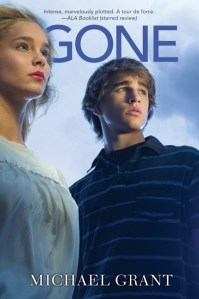
Gone, Michael Grant #50BookPledge

I read Michael Grant’s Gone on my sister’s recommendation, and I’m so glad I did. It’s brilliant and exciting, Lord of the Flies meets X-Men in a contemporary small town setting.

I was hooked by the very first paragraph: “One minute, the teacher was talking about the Civil War. And the next minute he was gone.” I can imagine lots of kids wish their teachers would just disappear, especially during really boring classes, but what if it really happens? What if all the adults in the world disappear? “No ‘poof.’ No flash of light. No explosion.” Just disappear. I actually appreciate how non-climactic the disappearances are, such that the kids the remain at first think they must have imagined  it.

The premise of Gone reminds me of a Star Trek episode where all the adults in an alien planet have died from a disease and the kids have formed a Lost Boys type society, basically being complete brats and driving the Enterprise crew insane. Thankfully, the children in Gone are more mature. Everyone 15 and older has disappeared. Main character Sam is a natural, albeit reluctant, leader. As scared as the other children, the only advice 14-year-old Sam can offer when the adults disappear and younger children look to him for guidance is eat a cookie. There’s almost a Peanuts-type wisdom in that advice, now that I think about it, but mostly it just reflects the children’s helplessness.

The adults disappearing isn’t the first weird thing to happen to Sam however. Something else has happened to him, which I won’t reveal here because part of the fun is finding it out, but basically it makes Sam worry that he has caused the adults’ disappearance. Later on, he finds out that he actually isn’t the only, um, unusual resident of the area, and the unusual nature of certain children may hold the key to what has happened to the adults.

In a world without adults, who’s in charge? As Sam’s best friend Quinn tells him, adults are no longer around to keep the bullies from imposing their rules. How can children who don’t know how to drive and barely know how to cook fend for themselves and care for the really young children? Even more urgent, what happens when they themselves turn fifteen?

Gone has an exciting premise and likable characters. I love seeing Sam’s growth from scared kid to hero, from avoiding the leadership role to embracing it and working to improve their situation. Quinn is an interesting character as well, a free spirited surfer unable to handle the pressure of responsibility, and I look forward to seeing him develop even further in the next book. I love that Astrid is such a strong female character. Nicknamed Astrid the Genius, she spouts random facts when she’s nervous. Her character however is given added nuance because of Little Pete, her autistic younger brother. When the adults disappear, she has no idea where he is, so she sets off to find him, taking Sam and Quinn with her. Mary, who takes responsibility for the day care centre, is forced to become remarkably mature, caring for babies and toddlers all wanting their mothers, and I love how she has her own personal demons to battle as well. Perhaps the most endearing character is Albert, who takes over the local McDonald’s. He takes his role so seriously he actually studies the McDonald’s manual cover to cover.

The bad guys range from bullies to an actual psychopath. Their leader is charming, intelligent and powerful, more than a match for Sam and his friends. I’ve always believed that amazing bad guys help make heroes amazing as well, and Gone has a match up I love reading about. The ending of their ultimate confrontation in this book was a bit frustrating, as my sister warned me, but good news is, there are several more books in this series.

One thing that surprised me is how religious some of the main characters are. It’s not a bad thing, just unusual in contemporary fiction. It’s not preachy in any way, which is good, and the events these kids face certainly merit some appeal to a higher power.

The book answers a lot of the questions it poses, even as it leaves a lot of other questions hanging. Gone is exciting, action-packed young adult fiction. I’ll definitely be checking out the next book in this series.
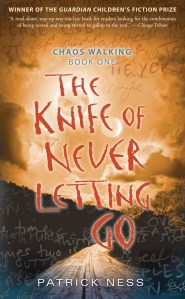
The Knife of Never Letting Go (Chaos Walking Book One), Patrick Ness #50BookPledge

Imagine a world where you can hear what everyone else is thinking, and they can hear everything you are thinking. You can’t shut it off, it’s an endless barrage of Noise, and most of what you hear are thoughts of pain and grief. That’s how it is in Prentisstown, where all the female settlers are dead and the Noise virus has left the males with the ability to hear each other’s thoughts and the thoughts of animals.

The only remaining boy in a town of men, Todd Hewitt is a month away from his thirteenth birthday and officially becoming an adult when he and his dog Manchee encounter an odd pocket of Quiet near a river. When Todd’s adoptive fathers Ben and Cillian find out about it, they pack Todd some food and his mother’s journal and order him to take Manchee and get as far from Prentisstown as possible. Turns out that a lot of what Todd believes is actually a lie, and Prentisstown has a terrible secret in its past, and the Mayor is pulling out all the stops to bring Todd back.

Knife is a powerful book, especially because we’re thrust right into Todd’s perspective. I especially love the scenes where the book describes the Noise – the overlapping lines of text in varying fonts are a veritable cacophony. I’m usually a big fan of e-reading, but the image of Noise contained within the mechanical boundaries of the e-reader screen just does not compare to the splash of words words words practically spilling over the edge of the page. Patrick Ness uses this sparingly – most of the time, he focuses on a particular character’s Noise, signified by a different font – and when he does, we are just sucked into the chaos that Todd must endure every day. Faced with the visual representation of this chaos, we can feel the desperation in Todd’s constant repetition of the mantra “I am Todd Hewitt.”

Todd speaks in a rough dialect, and Ness expresses this through his spelling. I normally don’t mind deliberate misspellings as long as the purpose is clear and consistent, and I was fine with a lot of it in Knife (e.g. “yer” instead of “your”). For some reason, “-tion” spelled “-shun” (e.g. “stayshun” instead of “station”) really bugged me, and I think it’s because I’d imagined this narrative to be primarily oral (Todd is literally telling his story) and I don’t hear enough of a difference to justify that particular misspell. That being said, about a third of the way through, I hardly even noticed it anymore, which I guess means the book really did suck me in completely. Interestingly, Todd later meets a character whose pronunciation is more conventional, and when that character tries to correct Todd’s grammar, Todd gets very defensive. I liked that; Todd’s dialect then became not just a writing gimmick, but more of a cultural stance. A friend told me he saw the unconventional spelling and grammar in Knife to mean that the old rules, what we thought of as rules in our world, just no longer applied.

Minor comment, I love how Manchee’s speech is limited mostly to “Poo” and “Squirrel.” So many books with talking animals treat them mostly as humans in animal form. I have no problem with animals able to speak intelligently (I love Snoopy, for example), but limiting Manchee’s language makes him just a creature of such boundless joy and friendship, a welcome Noise of innocence and happiness in such a confusing, dangerous world.

Ultimately, Knife works because it dares to ask the questions: how far are you willing to go to survive, and how far can you go without losing yourself? Faced with the opportunity to kill a man who wants to kill him, Todd says “But a knife ain’t just a thing, is it? It’s a choice, it’s something you do. A knife says yes or no, cut or not, die or don’t. A knife takes a decision out of your hand and puts it in the world and it never goes back again.” The decision of whether or not to kill has even more significance than Todd can begin to imagine, and he faces this decision over and over as he struggles for survival. Having a knife becomes a moral dilemma, one that haunts Todd and forces him to reflect on what makes a boy into a man.

It’s a fantastic book, first in the Chaos Walking trilogy. It felt a bit long at some points, but just when my attention drifted, something major happened that snapped me right back in. Knife ends on a cliff-hanger, with a very interesting, unexpected development that promises an exciting beginning to Book Two.

Wonder, Robert J. Sawyer #50BookPledge

Wonder by Robert J. Sawyer makes you think without offering any easy answers. Sawyer talks about everything from artificial intelligence to abortion, and while the book usually takes a clear stand on these issues, Sawyer sets his arguments up as long, intelligent dialogues between characters, which challenges the reader to come up with his/her own views rather than simply accept the character’s. Holden Caulfield says a mark of a good writer is that readers want to hang out with him, and I’d certainly want to hang out with Sawyer, if only to pick his brain about all sorts of topics he talks about in his books.

Wonder is also thrilling science fiction. It’s the final book in the WWW trilogy, and Webmind, the artificial intelligence born from the Internet, is in danger of being shut down by the Chinese government and the American military, who are afraid of Webmind’s Big Brother-type abilities. The reason the book is so exciting, and Sawyer’s best argument in favour of artificial intelligence, is the character of Webmind himself. Friendly, witty and compassionate (he still feels guilt over witnessing a suicide via webcam), Webmind is just plain likable. Caitlin says about Webmind’s online interactions, “Webmind did know everyone who was online. He wasn’t a celebrity; he was more like the whole planet’s Facebook friend.” That’s certainly the impression I got, and I did feel like shutting him down would be like murdering a person rather than just shutting off my laptop.

So am I 100% on Team Webmind? Not quite; I felt some sympathy for the view of chief bad guy military officer Peyton Hume, who wants to destroy Webmind before he becomes too powerful. Not that I agree with his fear that Webmind will want to take over the world or destroy humanity; Webmind has made some logical arguments why he has a personal stake in humanity’s continued existence. But Webmind doesn’t follow a Star Trek-type Prime Directive; he meddles. Using his sense of morality (which is admittedly comprehensive, being the result of studying all the philosophies and moral debates on the Internet), he acts as an Internet-based superhero, bringing down “bad guys” and furthering the cause of justice and tolerance. On one hand, this can be a good thing; he foils terrorist plots and corrupt politicians. On the other hand, this is someone who knows everything about you – so much information is readily available on the Internet, and Webmind has access even to the information you try to keep secure with passwords – do you really want any individual with that much power impose his beliefs on the world? I acknowledge Webmind’s benevolent intentions, but I grew up in a country with far too much experience with colonizers who have benevolent intentions, and I’m definitely wary. As I’ve said, Wonder offers no easy answers, and I like that about it.

That being said, I think Wonder, and the WWW trilogy in general, could have been much tighter. Some of the speeches and debates on social issues were unnecessary to further the plot, and seemed tacked on just because Sawyer wanted to state his views on it. They added to the overall theme of tolerance – just because Webmind is different, doesn’t mean he should be feared or discriminated against – but it sometimes felt like Sawyer wanted to include a mention of as many similar social issues as he could. Key words: a mention. They were in the story just for the sake of being mentioned. I would have preferred that Sawyer wove them into the plot more subtly; that would’ve made more emotional impact, I think.

Minor spoiler alert, skip to the next paragraph if you want: I also didn’t like the evil Webmind subplot. It turned out to have some significance in the eventual resolution of the novel, but since that side of Webmind was given a very flimsy set-up, I felt like that subplot came out of nowhere, and was tacked on just as an exciting little plot twist.

Overall, I really enjoyed Wonder. It raises interesting questions on artificial intelligence, and it’s a fun read. I especially loved all the geeky pop culture references – Big Bang Theory, William Gibson (a character says he needs “a hacker—a genuine Gibsonian cyberpunk”), and Roomba (I had to Google it; now I want one). And something I just found very cool – at one point in the novel, Webmind tweets a bit.ly link. I got the Kindle e-book version, and I was thrilled to find that the link actually worked! It’s the little things. (By the way, I heard the Kobo version has special features. If any of you have it, I’d love to know what other bells and whistles it had.) Then of course, I felt disappointed whenever I saw an underlined “link” that didn’t go anywhere. I get spoiled fairly easily.

Note to publishers: I like even the little bells and whistles on e-books, and I hope to see more of it in the future.