Review | Dr. Brinkley’s Tower, Robert Hough

Dr. Brinkley’s Tower is a lush, beautiful novel about Mexico in the 1930s. The tiny town of Corazon de la Fuente has just survived a long, bloody revolution, the scars of which are beautifully illustrated in the condition of a mirror in the opening scene. A century of the Ramirez family’s use has created “undulations” in the glass and “a spidery hairline crack near the bottom,” but the “real dissolution” is the faint, sour smell that still lingered from the time Francisco Ramirez’s father hid the mirror under fermenting wheat to keep it away from government soldiers during the revolution.

It is easy to lose oneself in Corazon de la Fuente. Hough’s writing portrays the flavour of the small town beautifully. We are overwhelmed with the sights and sounds of the town coming together for a lucha wrestling match, our ear quickly becomes attuned to a natural blend of Spanish and English, and we are absolutely captivated by the fragility of this town’s innocence. At times, Hough gets heavy-handed with his symbolism. For example, a character describes tequila as “the taste of Mexico, captured in a glass.” What an apt, beautiful and evocative metaphor! Unfortunately, I found its impact diminished by the almost overbearing two pages of description that preceded it. That being said, I enjoyed the language overall. The publisher’s description compares Brinkley to Gabriel Garcia Marquez, and while the novel isn’t magical realism at all, there is a strong sense of nostalgia, and the potential for magic, throughout.

Central to the story is the romance between Francisco Ramirez and Violeta Cruz. I love, absolutely love, this love story. Francisco’s Quixotic devotion to Violeta is simply endearing, and I hated Dr. Brinkley before he even appeared, simply because I knew from the publisher description that Dr. Brinkley will catch Violeta’s eye. Violeta is torn between the wild animal passion she feels for Francisco, and the escape from Mexico offered by a relationship with Dr. Brinkley, so while I was rooting for Francisco all the way, I did understand her dilemma. Hough does a fantastic job portraying the town in its socio-economic context. Because Corazon de la Fuente is poor, and poorer still for the effects of the revolution, Dr. Brinkley’s radio tower does appear as a god-send, providing jobs and enticing foreigners with deep pockets to spend money in the town.

I grew up in the Philippines, where many live below the poverty line and, unlike in Canada, there is no social safety net to ensure everyone has food, housing and education. I was struck by how relevant this tale of 1930s Mexico can still be relevant today. After an incident where a contest literally leads to a riot over gumballs, Violeta realizes how much she longs “to live in a place where a simple contest didn’t turn into a showcase for violent degeneracy.” It’s a sad state, yet I remember an incident years ago where people were trampled while trying to enter a contest for money. Poverty leads to desperation.

Also striking is a scene where the Corazon de la Fuente mayor encounters racism in his own town:

– No speeky the Spanish, said a large gringo at the front of the line. – Go back to Mexico…

– I am in Mexico, said the mayor in English. – And you’re in my country, pendejo.

My ARC has that passage underlined and, in the margin, a scribbled “Yay mayor!” It’s an odd form of racism, yet it’s all too prevalent. Growing up in the Philippines, I remember how many skin whitening products are advertised, and also how much more intimidating it is to be berated in English rather than the local Tagalog, simply because the use of the English language is viewed as intellectually superior. I remember a story my aunt once told me, about a sales clerk who signalled for a tourist to jump the queue simply because he was Caucasian. The tourist was embarrassed and refused to do it, but it bothers me that it was the Filipino sales clerk who slighted other Filipinos in the first place. So when I see the mayor of this tiny (albeit fictional) town stand up for himself, I raise my glass to him. One of my favourite passages in the book.

The radio tower Dr Brinkley introduces to Corazon de la Fuente brings progress and prosperity, but it also creates problems. Other than the racism and the increase in homelessness, the radio waves also cause sound to come from metallic objects. It’s the classic debate between progress and purity — does the town sell its soul for a few pesos? — and Hough’s prose has a wonderful, nostalgic, rather regretful tone that makes his stance clear. The cast of characters is colourful. I already mentioned how much I love the mayor and the young couple in love. Also memorable is the cantina owner who goes for Dr. Brinkley’s infertility treatment (extracted from goats!) so he can make love to his wife again — such a charming man! Finally, there is the aging molinero and Laura Velasquez, a plain woman who nevertheless is the heart of the town:

In the workings of a small town, the satisfaction of a person like Laura Velasquez functioned as a sort of inspiration for those who were far luckier but who nevertheless considered themselves to be having a bad day. Her inner peacefulness… functioned as a source of illumination, particularly in difficult times…

I love that a plain woman has such a vital role in the town, and precisely because of her plainness! I also love that the molinero, a Don Juan all his life, sees her beauty, and falls in love with her. It’s a beautiful romance, and one that made me cheer.

Hough makes you cheer for the characters, and for their town, as they struggle against the compromises imposed by “progress.” I especially love how relevant this story feels, even as I felt transported into the past. Above all, I fell in love with Corazon de la Fuente and with Francisco, Violeta, the mayor, at all their neighbours.

AUTHOR Q&A

Stay tuned to my blog tomorrow for a Q&A with author Robert Hough!

WIN A COPY OF DR. BRINKLEY’S TOWER!

Would you like to be transported to 1930s Mexico? Win a copy of Dr. Brinkley’s Tower, courtesy of House of Anansi!

To win, simply comment on this post, and answer this question:

If you could re-visit any place from your past,
where would you go and why?

Contest ends March 22, 2012. (Canada only)

Review | The Scrapbook of Frankie Pratt: a novel in pictures, Caroline Preston

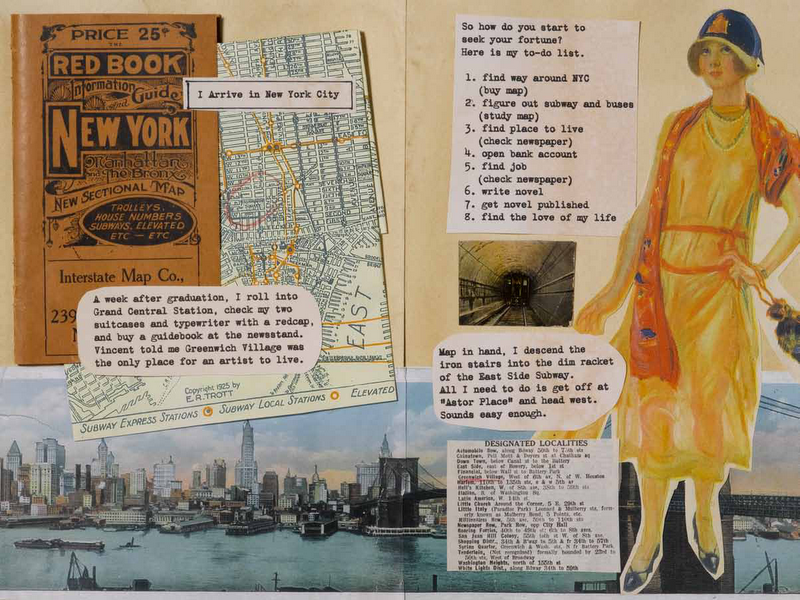
I love the concept behind Caroline Preston’s The Scrapbook of Frankie Pratt! The “first-ever scrapbook novel,” the novel takes the form of a scrapbook Frankie keeps from her high school graduation in 1920, through her days at Vassar, her struggle to be a writer in Greenwich Village and in Paris, and finally her return home in 1927. Somewhat similar in form to Griffin and Sabine, Scrapbook contains vintage memorabilia, designed as if they had been glued to the page. Pages include amusement park tickets, graduation invitations, photos cut from fashion magazine, even a magazine ad for Palmolive soap. Unlike in Griffin and Sabine, the memorabilia in Scrapbook are only images on the page, and therefore cannot be removed, but the entire look of the page is almost three dimensional.

Have you ever kept a scrapbook? Back in 2005, right before I moved to Canada, my sister gave me a scrapbook so that I would always have a piece of the Philippines with me. I turned that book into a record of my entire life — as many pictures and memorabilia as I could cram in. My scrapbook ended up looking nowhere near as artistic as Frankie Pratt’s, but it’s definitely one of my most treasured possessions. I flip through it every once in a while, and the book transports me instantly to my past, to people and memories that mean something to me.

Scrapbook transports us to the 1920s, a fascinating era in history. Frankie, voted the “smartest girl” of her graduating class, dreams of becoming a writer and finding the love of her life. Because of her ambition to be a writer, she gets to meet some of the literary luminaries of her time, such as Edna St. Vincent Millay and James Joyce. Including such significant historical figures, especially when they aren’t the subject of your story, is usually a delicate task, and it sometimes comes off as name-dropping. Preston, however pulls it off and it feels plausible. The scrapbook format also works really well, because giving each writer encounter a page or two of beautifully laid out snapshots, letters and typed lines acknowledges each encounter’s significance without either overwhelming us or trying too hard to be casual about it. Frankie’s scrapbook gives the impression that meeting James Joyce for work is as important to her as a letter she receives from a beau. I also love that Frankie is a reader. I love vintage book covers, and seeing 1920s cover art for This Side of Paradise and To the Lighthouse was just amazing. I especially love the feeling that while, for me, viewing these book covers was a trip to the past, for Frankie, these were contemporary titles, and she would have no way of knowing how significant they’d be over time.

Reading Scrapbook made me want to travel back in time to the 1920s. Well-written novels can certainly transport my imagination to the past, but the beauty of Scrapbook’s unique format is that it puts me as a reader into an interesting dual position. On one hand, I feel like a 21st century woman who happened upon an old scrapbook in an attic or a garage sale, and am viewing the significant moments in the life of someone from the past. On the other hand, I am also Frankie Pratt, viewing these things for the first time and being so excited by Beau Brummel with Mary Astor and John Barrymore that I simply must include the theatre program in my scrapbook. When I think of James Joyce’s Ulysses, I picture a heavy tome of classic literature that, because of its narrative style, is going to be a difficult read. In contrast, Frankie knows Ulysses as “the notorious banned novel!” Ulysses is the controversial novel that everyone talks about, but that is practically impossible to find. She reads it not because she wants to tackle a classic, but because it has for her the thrill of the illicit. The vintage memorabilia in the pages creates an atmosphere of magic, of passion and possibility, and I at least wished I could have been there with Frankie, experiencing all these adventures with her.

Scrapbook is also such a romantic novel! The question of whom Frankie will end up with isn’t too difficult to guess, but the relationships she forms are all so fascinating. Again, the scrapbook format enhances the romance. Images of dapper men in suits, of love letters, movie tickets and telegrams all work together to create a lush, evocative world, where a gentleman can come knocking at your door or a rogue can invite you for a spin in his brand new automobile. The scrapbook format also softens the edges of emotion. When a man breaks Frankie’s heart, we know this because of a couple of photographs and a few typed lines, over a two-page spread. Frankie has a great sense of humour, and so another painful experience is countered by a lighthearted image from a magazine ad. It is almost too easy to miss the pain behind these images, and the book forces us to stop at moments and discern all the layers of emotions revealed by Frankie’s choice of memorabilia.

I can keep going on about all the things that fascinated me in this novel, but Scrapbook is definitely better seen in person than read about. The book trailer is a bit too long, in my opinion, but it does give you an idea of how the pages in the novel look:

Scrapbook of Frankie Pratt is a beautiful, beautiful book. Frankie is a charming, intelligent, utterly delightful woman, and her personality shines through on every page. I just fell in love with this book, and I hope you will too.

Review | Beautiful Creatures, Kami Garcia & Margaret Stohl

To be honest, I’ve been feeling a bit of YA fatigue lately. I’m a huge fan of Harry Potter and The Hunger Games, I have read quite a few really good YA books, and to be honest, I wish we had this much variety available when I was younger. That being said, it feels like wherever I turn, there’s the Next Big YA Series coming out, the one perfect for fans of Hunger Games. After a while, even the well-written ones start to sound the same to me — yet another dystopian world, yet another kick-ass heroine, yet love triangle, and so on. Full respect to the writers who create these stories and to the readers who love them, but I, at least, need a break.

So when my sister brought home Kami Garcia and Margaret Stohl’s Beautiful Creatures, finished it (all 563 pages!) in a single day, and suggested I read it, I was hesitant. Beyond my YA fatigue, there’s also a movie version coming out, so I was expecting to soon be overwhelmed by online buzz. Still, I figured I might as well give it a try. And I am so glad I did.

Beautiful Creatures is a brilliant Southern gothic — atmospheric, romantic, and haunting. I love that Garcia and Stohl tell the story from the guy’s perspective, and that there is no love triangle. I especially love that, while the focus of the story is the romance, there is an entire world beyond the love story, and the characters’ actions have significance far beyond their relationship. From the first chapter, I felt myself drawn into this world, and I wanted to find out more. The book did strike me as long, but the story is fascinating. It’s also really scary — I can definitely imagine it playing out well on screen, and I can just picture myself covering my eyes in the theatre.

When Lena Duchannes moves into the mysterious Ravenwood house in the small Southern town of Gatlin, Ethan Wate recognizes her from his dreams and is immediately drawn to her. Her family is cursed. They are Casters (they can cast spells), and while other Casters can choose their destiny, each Duchannes is Claimed at the age of 16 by either Light or Dark. As a powerful Natural Caster, Lena is a prize to both the Light and the Dark, and a prophecy later in the book reveals exactly how significant she is. Ethan is an ordinary boy, but he’s determined to protect Lena from the Dark as much as he can. At the very least, he fights to protect her from the other kids in school who have labelled Lena a witch simply because her uncle is the town recluse.

Beautiful Creatures has romance, but more than that, it has curses, ghosts, mystery, and, well, very real emotions. I love how, even though Lena has to deal with Dark Casters and curses, one of her major concerns is how to have a normal teenaged life before she is Claimed. Like an ordinary teenager, she just wants to have a good time at the school dance and to face a school day without being teased. In one particularly heartbreaking scene, she is invited to a party by the popular girls in her class. Lena knows they are under a spell by another Caster, but she pleads with her uncle to let her go anyway: “I want to go to a party I’m invited to. I mean, I know it’s all Ridley [casting a spell], but is it wrong if I don’t care?” As Ethan notes, “She wants to be part of all this, even if it wasn’t real.” How sad is that, and how much can we all relate to it?

Speaking of Ridley, I found myself very fascinated by her character. A childhood friend of Lena’s, she was Claimed by Dark at 16 and is now no longer welcome to her own family. She seems genuinely pained by this rejection, which makes me wonder if being Claimed as a Dark Caster makes one as absolutely evil as everyone seems to think. I love that Garcia and Stohl made her character a bit ambiguous; in her own way, she appears just as vulnerable as Lena, and I’d love to find out more of her thoughts.

The secondary characters in this book were also fascinating. I love Amma and Macon, both mentor figures who seem to have exciting pasts of their own. I also love Ethan’s best friend Link, the comic relief who I hope may be able to get through to Ridley. Finally, I love how much of this book revolves around a library — the town librarian works at a Caster library on bank holidays, and that just seems like such a magical, fascinating place.

Beautiful Creatures is such a fascinating book, and I can only begin to imagine where Garcia and Stohl will take the rest of the series!