
Review | Second Night Stand, by Karelia and Fay Stetz-Waters

SecondNightStandKarelia Stetz-Waters’ Satisfaction Guaranteed was one of my favourite books in 2021, so when I saw she had a new romance coming out this year, this time co-written with her life partner Fay Stetz-Waters, I immediately wanted to read it.

Second Night Stand is a sexy-sweet romance between two dancers competing on a reality show with a $1M cash prize. Lillian Jackson is a super talented ballet dancer and head of an all-Black ballet company. The company is losing their sponsorship, so she needs to win in order to keep the company going. Izzy “Blue Lenox” Wells is a curvy burlesque dancer who leads a group of gender-diverse and body-diverse performers. She’s purchased a fixer-upper theatre to use as a community gathering and performance space, and needs the cash prize to make necessary repairs.

The romance between Lillian and Izzy is sweet, and just as with Satisfaction Guaranteed, consent and mutual respect play prominent roles in their relationship. I like that they both shared a strong sense of responsibility for the welfare of their respective chosen families, and how they both had to deal with complex relationships with their families of origin. And I especially like how their relationship with each other helped them learn valuable things about other aspects of their lives, and grow both as individuals and as a couple.

Where the book fell flat for me was in the set-up itself: the dance competition. I get a strong sense of why Lillian’s group is a contender at the competition, but I was never quite convinced about how Izzy’s group stayed on for so long. The depiction of their first performance was just messy. The whole point of their group is to provide a space to belong for all peoples, regardless of identities and performance interests, and while that’s a wonderful goal from a community-building aspect, it doesn’t make for a cohesive performance.

The book tries to explain this away by saying that the producers put them on as an amateur sacrificial lamb, so to speak, destined to be knocked off in the first round. Even Lillian, watching the group members perform one after the other, is certain that they’re about to be eliminated. The book, and Lillian, then try to make us believe that Izzy’s performance is so charismatic and captivating that she single-handedly convinces the audience to vote them in to stay. Unfortunately, as likeable as Izzy the person is, whatever magic she worked on-stage to get her group past Round One does not translate well on page. I was unconvinced, and the longer they stayed on, the more convenient it felt, as there was often one competitor or another who messed up so badly they had to be sent home. With a $1M prize at stake? Puh-lease.

I also tend to not be a huge fan of overly detailed descriptions, especially of background characters, so this is a rare instance when I actually wanted to see more of the dance competition. The front runner for the prize is a hip hop group that pretty much all the competitors agree is amazing and tough to beat, but we never actually get to see them dance. I don’t even remember meeting the dancers in this group at all, even though we meet a random assortment of other dancers. For a book centred on a dance competition, there isn’t much of it.

Speaking of competition, there’s also a chapter where the producers try to provoke Lillian, Izzy, and their dancers to trash talk each other, and both groups flat-out refuse to do so. Lillian and Izzy’s attempt quickly turns flirty, so the producer swaps them out with other performers on their respective teams, but then those performers seem incapable of doing anything but compliment each other. And I get it. Manufactured competition is silly, the producer was pushy, and kudos to the characters who refused to call their competitors the B-word, because it’s such a gendered insult.

But honestly, as over-the-top and sometimes mean as those scenes can sometimes play out, not engaging in it at all just feels very killjoy-ish. And however much the performers may respect their competitors’ talents, there is very little sense at all that any of them consider this competition important. Part of that is on Lillian and Izzy for not being open with their respective groups about their real motivations to win the competition. (It’s not just for funsies! It’s to save the ballet company / community theatre!) But even when the truth comes out, the competition takes second place to the characters’ morals and values. Which, okay, good for them. But if the characters themselves don’t care about winning the competition, how am I, as a reader, supposed to care about either of them winning? Despite the real futures at stake, the story takes a very gentle approach to the competition driving the story forward, and that in turn blunts much of what gives the story edge.

Overall, this is a sweet and feel-good romance, with lots of body positivity and love within found families. It’s a bit of a let-down for me after the brilliance that was Satisfaction Guaranteed, but it’s a good story nonetheless, and a fun way to spend a weekend.

+

Thank you to Forever for an e-galley of this book in exchange for an honest review.

Review | Don’t Want You Like a Best Friend, by Emma R Alban

DontWantYouParent Trap meets Bridgerton, and make it sapphic. Don’t Want You Like a Best Friend has a heckuva fun hook, and the story definitely lives up to the hype! It’s charming, heartwarming, and absolutely delightful.
It’s Beth’s first season, and she has just this one shot to snag a wealthy husband or else she and her newly-widowed mother, Lady Cordelia Demeroven, will be out on the streets. This is also Gwen’s fourth season; she’s pretty sure she’s destined for a ‘most seasons without a match’ medal, and mostly amuses herself at parties by challenging friends and cousins to ‘spot the heir and the spare’ games.

When Gwen rescues Beth from an over-eager old man, both young women realize they’d much rather hang out together than deal with all the tediousness and stress of the season’s endless social events. They also realize that their parents seem to be attracted to each other, and scheme to help them along towards their own happily ever after.

Beth and Gwen’s relationship is really sweet. Even more than the physical attraction and the fun sexytime scenes, their friendship and desire for each other’s happiness really shines through. These are characters who genuinely enjoy spending time together, and my favourite parts are when they’re just having fun hanging out together and laughing at silly things going on around them.

For me, though, the main highlight of the book isn’t the main romance, but rather the second-chance romance brewing between Beth’s mother, Lady Cordelia Demeroven, and Gwen’s father, Lord Dashiell Havenfort. When both were in their own seasons, they fell in love, but Lady Demeroven was in a similar situation as Beth, where she needed to marry rich to secure her family’s financial stability. Lord Havenfort was heartbroken, and even though he went on to marry Gwen’s mother, when his wife died, he never bothered finding a new one, and instead chose to remain a perpetual bachelor and lady charmer for the rest of his life.

Their meet-cute at the same ball where Beth and Gwen meet was just sparking with unresolved sexual tension, and their will they/won’t they dance running parallel to Beth and Gwen’s romance just stole the show for me. I absolutely felt for Lady Demeroven’s desire to reunite with Lord Havenfort yet also secure her daughter’s future with a wealthy match to another family. The man who eventually began courting Beth seems sweet enough, but his father is a total ass. Seeing through Beth’s eyes the parallels between this potential future father-in-law and her own abusive father is heartbreaking, especially when she notices how much her mom makes herself small to feed this man’s ego, just so she can secure Beth’s future. I love how Beth pushes her mom to consider how their happiness (Beth’s and her mom’s) is more important than financial security, but I also understand why her mom would be afraid to make that leap.

Lord Havenfort seems like a good man, and I sympathize for how much Lady Demeroven’s fears keep happiness away from both of them. A member of the House of Lords, he’s championing a bill to give women the right to divorce their husbands. This objectively makes him a hero, but on a more visceral level, it also makes him a personal knight in shining armour to Lady Demeroven and women like her, because if such a law had existed earlier, she may not have had to put up with an abusive marriage for so long.

Honestly, their romance just stole the show for me, and the big climactic moment between them just made my heart swell. I am so absolutely fantastically proud of Lady Demeroven, and so happy for them both.

I also really like how the novel explores the ways in which social conventions determine the options available to Beth and Gwen. It’s illegal for two women to marry, and most couples in their situation make do with being friends who visit each other’s estates and steal whatever moments they can for romantic encounters. Both Beth and Gwen struggle to come to terms with that restriction, yet as women, they couldn’t really have careers on their own, and so need husbands for financial stability. This is especially true for Beth who doesn’t have the security of Gwen’s father’s wealth.

The book highlights this theme with the two women servants who both work in the same household under different married surnames, but are actually a couple. Social snobbery works to their advantage, because most members of society don’t bother paying enough attention to the servants to even notice they’re romantically involved. One of them tells Gwen that this is the one time she’ll admit that Gwen’s wealth and social status puts her at a disadvantage, and I like how the story explores these kinds of nuances about privilege.

Overall, this is a fun, lighthearted, and feel-good book. The sequel, You’re the Problem, It’s You, featuring Beth and Gwen’s cousins, also seems like fun. Both cousins’ meet-cute at the end of Don’t Want You Like a Best Friend showed a lot of promise for their chemistry together.

+

Thanks to Harper Collins Canada for an e-galley of this book in exchange for an honest review.

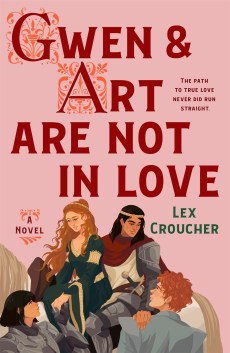
Review | Gwen and Art Are Not in Love, by Lex Croucher

GwenAndArtThis book takes a cute spin on the traditional forced marriage (forced betrothal?) + fake dating premise. Gwen and Art are betrothed, but they’re very much not in love. Such a set-up usually promises an enemies-to-lovers romance, but in this case, both main characters are gay, and so they actually do find their happily-ever-afters with other people. Gwen harbours a years-long crush on Bridget, a badass knight and only female knight in the kingdom; Arthur starts off kissing a stable boy, but eventually develops feelings for Gwen’s studious brother Gabriel. When both main characters find out about each other’s romantic secrets, they agree to fake-date to get their parents off their backs.

It’s a cute premise, and one I’d expect to love. Unfortunately, the book started off slooooooow for me. The first couple of chapters failed to hook me at all, mostly because it took so long for the main characters to win me over and make me care about them. Gwen just seemed like a miserable person to spend time with, and while I can kinda see why she wouldn’t want to marry someone as irresponsible and unreliable as Arthur, the specific incidents she complained about just made her seem bratty and petulant.

Arthur won me over more quickly, partly because his struggles with alcoholism and a power hungry father made him a more nuanced and textured character from the get-go. But what really made Arthur’s scenes shine almost from the start is his side kick (body guard? man servant?), Sidney. To me, Sidney stole the show. I found him witty and compelling, and I would totally read a whole book about his misadventures and his eventual romance with Gwen’s maid.

In fact, Gwen and Arthur owe a lot to the secondary characters. Despite Gwen and Arthur eventually going through full character arcs (Gwen needs to learn to get over her cowardice, and Arthur needs to learn to step up to his responsibilities), it’s the secondary characters, specifically Sidney and Bridget, who drive the momentum of most of the plot. It isn’t until later in the book that Gwen and Arthur actually start taking matters into their own hands. When they do, the story definitely picks up, but it takes a while to get there.

The final third or so takes a sharp turn from lighthearted romance to inter-kingdom politics and battle. The seeds were planted throughout, and the climactic battle is certainly a powerful section. Both Gwen and Arthur have their respective moments to shine, and demonstrate their character growth.

But the eventual happy ending does come at a cost, and a rather surprising tonal shift that unfortunately felt rushed. And while the denouement makes sense, it also feels oddly flat. Not quite rushed and not quite perfunctory, but not quite satisfying either. There’s a rather momentous point in the battle that adds so many layers of complexity to what comes next, yet it feels like the ending glosses over all that and focuses only on the happily-ever-afters of the central romances. Don’t get me wrong: I love genre romance and I love happily-ever-afters. Yet in this case, it doesn’t quite hit its emotional mark.

+

Thank you to Raincoast Books for an e-galley of this book in exchange for an honest review.