
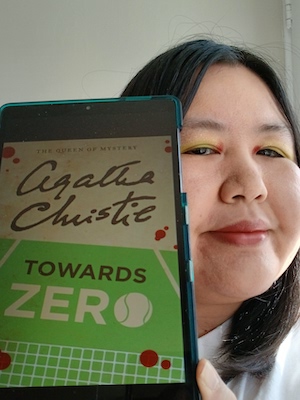
I Try to Solve an Agatha Christie Mystery | Towards Zero (Superintendent Battle)

Okay, I admit it, I’m completely lost. I decided to try solving this mystery because the BBC adaptation was coming to Canada via Britbox this month, and I wanted to try my hand at it before watching the show. I also haven’t written a blog post in a while, and figured that going head-to-head with the Queen of Crime was the perfect way to kick off my blogging year.

Now here I am, 87% in and right before the chapter with the big reveal, and I’m absolutely at a loss. So I’m afraid my 2025 series of Agatha Christie challenges will very much likely kick off with a loss, but on the bright side, I’ve really been enjoying this book, and highly recommend it to any fan of Christie or mysteries in general.

First, it has the elements I love most in Christie’s mysteries: it features a fairly small cast of characters, all of whom have complex relationships with each other, and enough drama amongst them to fuel whatever the motive for murder will turn out to be. At its heart is tennis player Neville Strange, his ex-wife Audrey, and his current, younger wife Kay. From the start, it seems clear that Neville isn’t fully happy with the divorce; he speaks highly of Audrey’s character, expresses guilt over causing her heartbreak, and seems impatient whenever Kay complains about something. The love triangle comes to a head when Neville decides that he and Kay will visit his elderly relative Lady Tressilian (Anjelica Huston in the adaptation!), at the same time as Audrey visits her every year. Instant drama!

Added to the mix are two other men who turn the love triangle into a much more complex polygon: Thomas Royde, a childhood friend of Audrey’s who has been secretly in love with her for years, and Ted Latimer, a dashing young man who is friendly and rather flirty with Kay. Then there’s Mary Aldin, companion and distant cousin to Lady Tressilian, and of course, Lady Tressilian herself, a formidable woman (Anjelica Huston!) who stays in her bed full-time and uses a rope bell to call her maid.

One evening, a visitor, Mr Treves, tells the story about a child he knows who got away with murder (literal, cold-blooded murder) many years ago. That child would now be an adult, and Mr. Treves said they had such a distinctive physical feature that he would surely recognize them even now. Mr. Treves later returns to his hotel, finds a sign saying the lift is broken, and so climbs the stairs to his top floor room. He dies of a heart attack from the climb.

Fast forward a few days (?), and Lady Tressilian is also found dead in her bed, struck in the head with an unknown blunt object. All the evidence points to one of the characters, but of course, the case is never that simple.

I had a vague suspicion of one of the characters from the beginning, honestly for no good reason other than they made the most sense to me for the big reveal. But then they later did something that made me realize they’re actually likely innocent. And then came a flurry of new clues and mini-reveals that seem to make everything clearer to Superintendent Battle, but honestly only made me even more confused than ever. I don’t think that re-reading past chapters, or even my notes and highlights will make anything any clearer for me, mostly because I already did that and I’m still confused, LOL! So, without further ado, I’m going to lock in my answer, and see how I do!

Was I right?

Ahahahaha! No, absolutely not, not even close. I named my choice of murderer below, and a bunch of other suspects I’d discarded as suspects for various reasons. Then I make a joke about how, at this point, I wouldn’t be surprised if it was this one character I never suspected, and of course, that’s who it turned out to be. And of course, their motive makes total sense; I just didn’t see it at all.

So, well played, Dame Agatha Christie. The Queen of Crime has fooled me again. My ego would like to give myself partial credit for at least guessing the motive; I’d just assigned it to the wrong person. But, ultimately, no, I did not figure out whodunnit. So 2025 begins with Agatha Christie 1, Literary Treats 0, and a fun little mystery to kick off spring.

*** SPOILERS BELOW ***

My Verdict

Continue reading

Review | The Cat Who Solved Three Murders, by LT Shearer

Murder! Cats! Art theft! Seriously, take a look at that adorable cover. How could I not fall in love with this book?!

The Cat Who Solved Three Murders is a cozy mystery starring a retired detective, Lulu Lewis, and her talking calico, Conrad. He talks only to Lulu; to everyone else, he simply says “meow.” It’s a unique concept, but one that, I’m afraid, turned me off somewhat. As a cat person, what I love most about cats in books is how the author manages to bring to life all the wonderful ways cats communicate without having to say a word. By giving Conrad human dialogue, I feared that LT Shearer simply created a regular human-like sidekick who just happened to have four legs and a tail.

That being said, Conrad does get his lovely moments of pure kitty cat. He comforts people by sitting on their laps and purring. He delights people by how skillfully he balances on Lulu’s shoulder. And in two delightful scenes, he turns action hero with claws and hisses. (My cats may, of course, argue that any self-respecting cat would’ve skillfully disappeared from sight in those scenes rather than put themselves in such danger, but, ehh, kudos to Conrad the action hero kitty.)

The mystery that Lulu and Conrad tackle is pretty good. The story begins when Lulu is invited to the mansion of a wealthy friend, Julia, for Julia’s husband Bernard’s 60th birthday party. But when Lulu and Conrad (her plus-one, which I thought was cute) arrive, they learn that Julia and Bernard’s home had been burgled. Julia was fortunately out of the house when it happened, but an insurance agent who’d been at the house to assess the value of some paintings had been killed, and Bernard injured. Some of the details around the burglary strike Lulu and Conrad as odd, and when someone is killed at the birthday party, they realize the need to dig deeper.

Like I said, the mystery aspect is pretty solid. The clues aren’t very subtle, so the big reveals are easy enough to figure out, but it’s still fun to see the story unfold. I like that Conrad is the one who discovers a significant clue by the pool, and there was a bit of fun in how Lulu had to come up with an elaborate story for why she’d noticed the clue herself but didn’t mention it till a day later.

Beyond that, as refreshing as I thought it was that this cozy mystery had a professional detective who was actually competent and receptive to the heroine’s contributions, I found it a stretch that Tracey included Lulu on so much of the investigation. It doesn’t matter that Lulu used to be a detective herself; surely, some of the things Tracey shared with her should have been confidential? Tracey treated her more like a partner than a civilian; she included Lulu in suspect interviews, allowed her to see the autopsy results, and just shared information like phone records without a single thought. Even though the author explained that Tracey was young and inexperienced, and even though it clearly worked for the best with this investigation, it still struck me as unprofessional on Tracey’s part, and I feel like that should have been addressed somehow.

And as much as I like Conrad, I do wish he’d been more cat-like. As affectionate and compassionate as he is in some scenes, his personality still came off as disappointingly flat. I do get that cats are often portrayed as jerks in books, so it’s kinda nice that this cat is portrayed as a nice character. But, well, Prozac in Laura Levine’s Jaine Austen mystery series shows more personality in a single scene than Conrad does over multiple chapters.

Conrad’s dialogue does often make him feel like a human stand-in. Even though he reminds Lulu about his cathood multiple times (like when he hears something that she doesn’t, and he reminds her it’s because cats have better hearing), it comes off as unnecessary. Worse, it’s a glaring reminder of how easy it is to forget that Conrad is a cat, not because he’s such a special creature for being able to speak, but because he isn’t quite as compelling as real kitties are. Also, as much as I love cats and appreciate how many characters seem delighted by Conrad’s presence, the whole “that’s a cat!” “he’s on your shoulder!” “he meows!” type of scene actually got old. Even for me, which says a lot, because normally, I love scenes of people gushing over cats. But here, it just happens so often, and in pretty much the same way each and every time, that the novelty and charm eventually wore off.

Still, overall, Conrad is still a pretty cool cat, and I like that he literally saves the day a couple of times. Lulu seems a good series lead, and the mystery itself was fun to read about. This may not have met my (admittedly ridiculous) high hopes of becoming my new favourite mystery series, but it’s a fun mystery nonetheless. And I’m all for more cat detectives in fiction, please and thank you!

+

Thank you to Publishers Group Canada for a copy of this book in exchange for an honest review.

I Try to Solve an Agatha Christie Mystery | Murder is Easy (Superindentent Battle)

There’s a BBC adaptation of Murder Is Easy coming to BritBox in March that looks pretty good, so I wanted to try my hand at solving the case myself before checking it out. The ebook was fortuitously available at the library, and its cover just as fortuitously matched with my recently-purchased ube keso Selecta ice cream. 

The set-up is fantastic: retired detective Luke Fitzwilliam meets fluffy elderly lady Miss Pinkerton on a train to London. Miss Pinkerton is from a sleepy little village, and she’s headed to Scotland Yard because she’s convinced one of her neighbours is a murderer. And not just any murderer, but one who has already killed several people, and seems to be on course to kill their next victim. 

Luke gives Miss Pinkerton a kindly smile, wishes her luck, and thinks nothing more of it, until he reads in the paper that shortly after their encounter, she is killed in a hit and run. He also learns of a death in her village: Dr Humbleby, the very person she’d identified as the murderer’s next victim. His curiosity piqued, Luke heads to the village himself, posing as the visiting cousin of a young woman his friend knows, and sets out to find the identity of the killer.

It’s a fantastic setup, and the puzzle aspect of the story is pretty well-constructed. Luke is a methodical investigator, and we meet each suspect and learn about each victim in turn. Yet for some reason, the story isn’t quite gripping me like Christie’s books usually do. I’ve enjoyed some Christie stand-alones, so it can’t just be the absence of my beloved Marple or Poirot. Possibly, it’s just my mood, and if I were to re-read this again another time, I may enjoy it more. As it is, I do really want to watch the BBC adaptation (Miss Pinkerton is played by the Dowager Countess’s best frenemy in Downtown Abbey!), so I’ve kept going on to figure out whodunnit.

There’s also a romantic subplot, which should come as no surprise to any long-time Christie fan the minute we meet Luke’s host Bridget. She is young, more arresting than beautiful, clever enough to see through Luke’s cover story almost immediately, and engaged to her wealthy and much older employer for purely pragmatic reasons. In a mystery by another writer, she would’ve been my immediate prime suspect, but I’d already made the mistake of forgetting Christie’s romantic streak in The Moving Finger, so I’m going to guess she’s innocent.

Since Bridget is not on my suspect list, there’s honestly only one person I think it can be. A case could be made for a secondary suspect, and more than likely, the murderer turns out to be one of the many other suspects I don’t think did it. But I feel pretty strongly about my first choice, so I’m going to lock it in at the 81% mark, and see how I do.

As an aside, I’m almost done with the book, and Superintendent Battle still has not appeared? Perhaps he’ll show up in the final chapter for the big reveal? And perhaps we’ll learn that Miss Pinkerton did manage to share her suspicions with him after all before she died. Perhaps the case would have been solved even without Luke’s involvement, but with a couple or so extra victims, because Battle had to deal with more pressing matters before getting to this one.

Did I Solve It?

Yes I did. I figured out whodunnit, and I kinda figured out the motive, even though I saw it all sideways. (I figured out the driving force behind the killings, but I got the emotions behind it all wrong.)

This isn’t quite as exciting for me as other Christies I’ve read. It was fine, and I’m not used to Christie’s books being just “fine.”

I do appreciate Christie’s commentary here about the importance of paying attention to women’s instincts. Other than Miss Pinkerton, there were two other women characters who had an inkling whodunnit, but because they lacked proof beyond a vague feeling, they kept quiet and doubted themselves. For at least one of the women, Luke’s certainty about a particular aspect of the killings made her decide her suspicions were totally off the mark. But as it turns out, as methodical as Luke’s investigative methods are, and as logical as his reasoning may be, he ultimately is a bit of a bumbler.

So, to learn from Dame Agatha: trust your gut, ladies. You do know things you don’t even realize you know.

***SPOILERS BELOW***

Continue reading