
Review: The Borrower, Rebecca Makkai

Young librarian Lucy Hull wants to help ten-year-old book lover Ian Drake, who has a lively imagination, but whose mother wants him to read only books “with the breath of God in them.” Mrs. Drake also enrols Ian in gay rehab classes with Pastor Bob. So when Lucy discovers Ian hiding in the library after hours and intending to run away, she goes with him. Lucy pretends to believe Ian’s story that he’s really just running away to his grandmother’s house in another state, but the truth is, Lucy just wants to show Ian a world beyond his mother’s rigid boundaries. Rebecca Makkai’s The Borrower is a funny, entertaining book, about the love of reading and the transformative potential of stories.

I love so many things about this book. Both Lucy and Ian are obsessed with reading, which is something to which I can totally relate. While it appears to be only Ian running away, it soon becomes clear that Lucy is also trying to escape something. I love Lucy’s parents; the father especially is such a colourful character, a member of the Russian mafia with so many stories about his childhood. Lucy has always accepted these stories as true, albeit exaggerated. Her realization that her father’s stories may not have been as based on reality as she believed when she was younger is a beautiful, poignant portrayal of our own growing up. I grew up reading a lot, and it kinda sucked realizing high school wasn’t anything like Sweet Valley or finding out Carolyn Keene (who was one of my favourite authors growing up) isn’t even a real person.

The Borrower is a tribute to children’s literature, with lots of references to wonderful books. For example, Lucy’s father ran a chocolate factory in Russia. (What avid reader would not immediately remember his/her experience reading Roald Dahl?) There’s also a chapter written in the style of Choose Your Own Adventure, another of my childhood favourites, and one chapter begins in the style of “This is the house that Jack built.” The story of The Borrower is interesting enough to read, but it’s these little winks to beloved children’s books that I loved the most.

I also love that Ian himself challenges Lucy’s perceptions of him. For example, Lucy sees a scar and immediately assumes Ian is being physically abused, but it turns out not to be the case. Ian glumly borrows some Bobbsey Twins books because Lucy assures him they’ll meet his mother’s “breath of God” requirements even though they’re horrible (as a Bobbsey Twins fan myself, I have to say I’m offended by that). So Lucy assumes Ian only likes to read the kinds of books she does (admittedly also a good list, including The Hobbit), only to be shocked that Ian also enjoys reading a Christian YA series. Lucy can’t understand how Ian can “fall” for that, which I think also shows her own limitations. I liked this because it shows that, although Lucy appears to be the hero, wanting to break Ian free to be himself, she also imposes her own preconceived notions on what he should be.

Not sure how I like the ending. The Borrower ended with a whimper, which felt like a let down after such building up through most of the book. Yet at the same time, the ending also felt very fitting. Like, how else could their adventure have ended, and how else would a book extolling the virtues of reading close its story? The Borrower is a fun, breezy read, and a wonderful homage to the magic of children’s literature. Love reading? This is worth checking out.
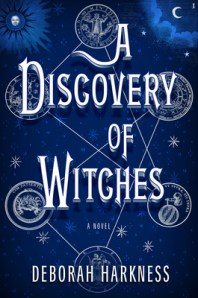
Review: A Discovery of Witches, Deborah Harkness

Deborah Harkness’ A Discovery of Witches begins with an interesting premise: reluctant witch Diana Bishop discovers an ancient book of great power in a library and sends it back. It turns out witches, vampires and daemons have been after that book for centuries, each with their own ideas about what the book contains. Together with tall, handsome vampire Matthew Clairmont, Diana tries to escape all the baddies after her (and the book) and find out more about this book. They fall in love, which unfortunately violates a centuries old treaty that vampires, witches and daemons must not mingle. Forbidden love, a mysterious ancient text and a reluctant witch who, it turns out, has the potential to be the most powerful witch in history — sounds exciting, eh? The beginning certainly was.

Unfortunately, the rest the book felt like the first six hundred pages of a three thousand page novel — full of minor threads that either get resolved or not yet, with no major story arc for the book itself. As a result, a lot of the major dramatic scenes didn’t have the impact it could have. Once, Diana is tortured by a baddie wanting to force her to reveal her powers. She survives and is praised for her bravery. Unfortunately, it comes too early in the novel to feel climactic, and as Diana herself didn’t know what her powers were at this point, her resistance seemed more unavoidable than heroic.

Several major baddies show up, all of whom are given only a few chapters before disappearing, ostensibly to reappear in a later book. The major baddie, who provided what I assumed was the climax, came almost literally out of nowhere. This could’ve been a wonderful surprise twist, if only this particular baddie had been present, even as a shadowy, unknown behind the scenes puppeteer, throughout, but that wasn’t the case. I can only assume Harkness is saving the actual climax for a later book.

Discovery is bogged down by minutiae. Harkness may have been so fascinated about vampire eating habits (they eat nuts!) that she wanted to devote practically an entire chapter to Diana serving Matthew a meal. Halfway through, when I realized the conversation was never going to move beyond Matthew praising Diana’s attention to detail and Diana’s fascination that Matthew can eat solid food, I stopped caring completely. So imagine my horror when only a few pages after this meal, Matthew decides it’s his turn to feed Diana, and to educate her about all the wines he serves. While it must be amazing to taste centuries old wine, by what felt like the tenth bottle described in loving detail, I wanted to swear off wine forever.

Minor quibble, but while I love having a heroine with a great appetite (finally!), Diana eats more toast in one book than Miss Marple drinks tea in all of Christie. That’s how it seemed anyway, from Matthew serving her tea and toast to Diana wondering if they had any more butter. I love foodie lit (Goldy Schulz! Guido Brunetti! Hannah Gruen!), but there’s a reason none of those authors spent this many pages on toast.

Diana spends a huge chunk of the novel in Matthew’s mother’s castle, where she waits around for Matthew and finds out lots about the vampires’ back stories. Way too many pages of nothing exciting happening, and way too much boring information, to the point when, after a few chapters of action, when a vampire I actually liked said “This is my tale to tell,” I had to turn off my Kindle (much less satisfying than slamming a book shut).

This book does have one of the most unintentionally hilarious scenes I’ve read in a while. When Matthew leaves Diana in the castle to go pursue baddies, Diana cries so hard she starts leaking water everywhere and creates a literal flood. Maybe it’s just because it’s such a lame reason to be that devastated, but that made me laugh. It was only afterward, when Matthew’s mother said Diana was the first witch in centuries powerful enough to command witchwater that way (Diana actually became water) and Diana admitted her fear that she’d disappear completely (think Wicked Witch of the West) that I realized the scene was meant to be solemn.

So why did I finish the book? Like I said, the premise was promising, and the parts where the characters talk about the book are interesting. There is also the possibility of a revolution and a war among the witches, vampires and daemons, which sounds exciting. So I do want to find out how this whole story ends.

The next book promises to be about Diana training to use her powers properly. Personally, I’d like to find out how many books Harkness plans to have in this series, so I can wait for the final one and read the last few chapters to see how the war turns out and what the ancient book actually contains. Till then, I leave the toast eating and vampire reminiscing to other readers.

Wonder, Robert J. Sawyer #50BookPledge

Wonder by Robert J. Sawyer makes you think without offering any easy answers. Sawyer talks about everything from artificial intelligence to abortion, and while the book usually takes a clear stand on these issues, Sawyer sets his arguments up as long, intelligent dialogues between characters, which challenges the reader to come up with his/her own views rather than simply accept the character’s. Holden Caulfield says a mark of a good writer is that readers want to hang out with him, and I’d certainly want to hang out with Sawyer, if only to pick his brain about all sorts of topics he talks about in his books.

Wonder is also thrilling science fiction. It’s the final book in the WWW trilogy, and Webmind, the artificial intelligence born from the Internet, is in danger of being shut down by the Chinese government and the American military, who are afraid of Webmind’s Big Brother-type abilities. The reason the book is so exciting, and Sawyer’s best argument in favour of artificial intelligence, is the character of Webmind himself. Friendly, witty and compassionate (he still feels guilt over witnessing a suicide via webcam), Webmind is just plain likable. Caitlin says about Webmind’s online interactions, “Webmind did know everyone who was online. He wasn’t a celebrity; he was more like the whole planet’s Facebook friend.” That’s certainly the impression I got, and I did feel like shutting him down would be like murdering a person rather than just shutting off my laptop.

So am I 100% on Team Webmind? Not quite; I felt some sympathy for the view of chief bad guy military officer Peyton Hume, who wants to destroy Webmind before he becomes too powerful. Not that I agree with his fear that Webmind will want to take over the world or destroy humanity; Webmind has made some logical arguments why he has a personal stake in humanity’s continued existence. But Webmind doesn’t follow a Star Trek-type Prime Directive; he meddles. Using his sense of morality (which is admittedly comprehensive, being the result of studying all the philosophies and moral debates on the Internet), he acts as an Internet-based superhero, bringing down “bad guys” and furthering the cause of justice and tolerance. On one hand, this can be a good thing; he foils terrorist plots and corrupt politicians. On the other hand, this is someone who knows everything about you – so much information is readily available on the Internet, and Webmind has access even to the information you try to keep secure with passwords – do you really want any individual with that much power impose his beliefs on the world? I acknowledge Webmind’s benevolent intentions, but I grew up in a country with far too much experience with colonizers who have benevolent intentions, and I’m definitely wary. As I’ve said, Wonder offers no easy answers, and I like that about it.

That being said, I think Wonder, and the WWW trilogy in general, could have been much tighter. Some of the speeches and debates on social issues were unnecessary to further the plot, and seemed tacked on just because Sawyer wanted to state his views on it. They added to the overall theme of tolerance – just because Webmind is different, doesn’t mean he should be feared or discriminated against – but it sometimes felt like Sawyer wanted to include a mention of as many similar social issues as he could. Key words: a mention. They were in the story just for the sake of being mentioned. I would have preferred that Sawyer wove them into the plot more subtly; that would’ve made more emotional impact, I think.

Minor spoiler alert, skip to the next paragraph if you want: I also didn’t like the evil Webmind subplot. It turned out to have some significance in the eventual resolution of the novel, but since that side of Webmind was given a very flimsy set-up, I felt like that subplot came out of nowhere, and was tacked on just as an exciting little plot twist.

Overall, I really enjoyed Wonder. It raises interesting questions on artificial intelligence, and it’s a fun read. I especially loved all the geeky pop culture references – Big Bang Theory, William Gibson (a character says he needs “a hacker—a genuine Gibsonian cyberpunk”), and Roomba (I had to Google it; now I want one). And something I just found very cool – at one point in the novel, Webmind tweets a bit.ly link. I got the Kindle e-book version, and I was thrilled to find that the link actually worked! It’s the little things. (By the way, I heard the Kobo version has special features. If any of you have it, I’d love to know what other bells and whistles it had.) Then of course, I felt disappointed whenever I saw an underlined “link” that didn’t go anywhere. I get spoiled fairly easily.

Note to publishers: I like even the little bells and whistles on e-books, and I hope to see more of it in the future.