

Tiger, Tiger, Margaux Fragoso #50BookPledge

Wow. What an incredibly powerful book. Margaux Fragoso’s memoir Tiger, Tiger is not an easy read. There were moments where I literally had to stop reading, because I was just either getting too uncomfortable or too angry. A co-worker admitted to me that she was hesitant about starting Tiger, Tiger; having young children herself, she was afraid that she would find the book too disturbing. This same co-worker found Emma Donoghue’s Room difficult for that same reason. I did sympathize with Jack and his mother in Room, but I was fine reading it. I found it difficult to read Tiger, Tiger, and I mean that in the best way possible.

When Margaux was seven, she met fifty-one year old Peter at a swimming pool. Peter invites her and her mother to visit his house, ostensibly to meet his wife and hang out with his two sons. Margaux’s father is very verbally and physically abusive, especially to Margaux’s mother, who is on psychiatric medication, so the mother jumps at the chance to form a friendship with a seemingly nice man. Turns out Peter is really interested in Margaux, and the way he seduces and manipulates her is just disgusting. Without any of Humbert Humbert’s eloquence or, let’s face it, Jeremy Irons’ seductive voice in the Lolita audiobook, Peter’s pedophilia is just there, horrific and disturbing and outright disgusting.

Part of what makes this such an emotional read is that Fragoso writes each chapter solely from the point of view of the age she was when the events occurred. So, when Peter attempts to use guilt to make eight-year-old Margaux perform oral sex on him, we as readers don’t have the filter of present-day Margaux Fragoso in her twenties to distance us from the eight-year-old girl’s emotions. Her disgust at the request, mixed in with guilt because he had given her a treat earlier, is all too real, and Margaux’s descriptions are bitter reminders of her eight-year-old mind.

The vividness of Fragoso’s writing reveals her relationship with Peter in stark, unforgiving detail. We see the young Margaux confused and angered that her father would make fun of Peter’s false teeth; later on, we see the teen Margaux realizing how wrinkled Peter’s skin is, and how emotionally dependent he is becoming on her. We see the turmoil of her discomfort, then possessiveness and even love for Peter. We see her grow up, and as she becomes more aware – of the way in which Peter manipulates her and of how she can use her sexuality to turn the tables and regain power – we root for her, not just to gain power over Peter, but to become free of him. In a way, the latter half of the book, where Margaux has become a teenager, is easier to read, because while Margaux is still definitely being victimized by Peter, she is no longer just a victim. She is, albeit slowly, beginning to take back her life.

I’m not even sure if I can describe how I felt reading this book, and I’m just amazed that Fragoso was able to write such a compelling, cohesive account of such experiences. I was furious at the way Margaux’s father kept belittling her and her mother. I was disgusted at Peter’s actions, at his insistence that society just doesn’t understand that he and Margaux are in love, and at his attempts at emotionally manipulating Margaux into staying with him rather than building her own life. Margaux is never overtly furious in her depiction of Peter, and, in a way, such a straightforward, matter-of-fact account just makes the horror of his actions so much starker.

Tiger, Tiger is not an easy read, but it’s definitely well worth the effort. Highly recommended.
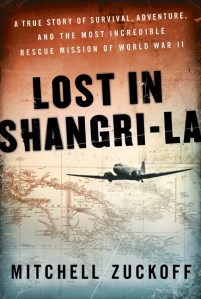
Lost in Shangri-La, Mitchell Zuckoff #50BookPledge

It began as an afternoon treat – an aerial tour of the hidden valley whimsically called Shangri-La. Stories about Shangri-La include tales of lush vegetation and a Stone Age civilization with people over seven feet tall. No outsider has ever set foot in Shangri-La, and very few have flown over it. The air space was just too treacherous. Yet on May 13, 1945, Colonel Peter Prossen decided to treat his staff to a sightseeing trip on a transport plane over Shangri-La.

Due to a number of factors, the plane crashed, and only three passengers survived — Corporal Margaret Hastings, Lieutenant John McCollom and Sergeant Kenneth Decker. They knew nothing about the terrain,

and have heard only terrifying stories about the natives. Mitchell Zuckoff chronicles their story in Lost in Shangri-La, and tells the tale of how a group of brave Filipino-American soldiers mounted a rescue operation that, by all accounts, offered little chance of survival, much less success.

I don’t read a lot of non-fiction, nor do I read a lot of history books, yet I couldn’t put this book down. It’s that thrilling. Zuckoff is an award winning journalist, and I can see why. He writes with journalistic detachment, and creates an exciting, moving narrative because of it. I love that Zuckoff doesn’t editorialize. Opinions expressed in the book are from interviews and personal documents like journals. While readers can generally guess at Zuckoff’s own slant on certain subjects (e.g. a certain comment showed frat boy humour), his language is detached, and he presents a balanced view: “Changes in a valley during the ensuing decades have been dramatic, but whether for better or worse is a matter of debate.” The picture he proceeds to paint is bleak, suggesting that the changes have been in fact for the worse, but Zuckoff uses facts (poverty levels), imagery (native elders now begging for change) and interviews (a quote from a documentary filmmaker) to make his case.

I also love Zuckoff’s attention to detail. Even the people who died in the crash were fully fleshed out because of the details Zuckoff mentions. About John McCollom’s twin Robert, who was on the plane as well, Zuckoff notes that the twins were “known to family and friends as ‘The Inseparables.’” When Robert got married, “both McColloms were in uniform [at the wedding photo]; the only way to tell them apart is by Adele’s winsome smile in Robert’s direction.” Private Eleanor Hanna, who was also on the plane “had a reputation…for singing wherever she went.” Sergeant Helen Kent, who’d lost her husband in a military plane crash, left behind her best friend Sergeant Ruth Coster, who was “swamped with paperwork” and couldn’t join the tour. These details made even these secondary characters real to me, which I appreciated.

Probably the most tense moment in the book was the account of the survivors’ first encounter with the natives. All they’ve heard was that these natives were war-like and cannibalistic. “We haven’t any weapon,” McCollom tells Margaret and Decker. “There is nothing to do but act friendly. Smile as you’ve never smiled before, and pray to God it works.” The survivors smiled and held out Charms hard candies as peace offerings.

Even better, Zuckoff has interviewed some natives who were children when the plane crash occurred, so he’s able to present their perspective on the events as well: “[Yaralok] saw creatures that resembled people, but they didn’t look like any people he’d ever seen. The skin on their faces was light, and they had straight hair. The skin on their bodies was strange. They had feet but no toes. Only later would he learn that coverings called clothing shielded their skin and that shoes encased their toes.” This, I think, was when it really struck me how alien these cultures were to each other. Yaralok and his tribe have never seen fair skin or Western clothing, much less Charms hard candies.

It’s hard to imagine in these days when we have such a global culture and meeting people with different clothing and skin colour is a daily occurrence. But what if we encounter someone who doesn’t meet any of our ideas of humanity? What if I meet a “creature” that looked like a person, but had, say, green skin, was covered in scales and was holding out to me brightly coloured balls of goo? How would I react? By telling the story from both perspectives, Zuckoff recounts cultural misunderstandings and ways in which humans adapt when faced with the unfamiliar.

Zuckoff also gives due credit to the Filipino American soldiers who mounted the rescue mission. From the always cheerful Corporal Camilo “Rammy” Ramirez to the shy, efficient Sergeant Benjamin “Doc” Bulatao, the Filipino Americans were heroes, parachuting into the valley on a potential suicide mission. It was courageous, especially in light of the discrimination Zuckoff shows these soldiers have faced as Filipinos. Part of this discrimination, which frustrated their captain, Earl Walter Jr, is the way the media coverage ignored their contribution. So I’m glad Zuckoff remedies this media oversight in his book. The courage of Walter and his team is balanced by their “Bahala na” (Come what may) attitude, which paints a portrait of the team as cheerful in the face of danger.

Filled with first-hand accounts, journal entries and personal observations, Mitchell Zuckoff’s Lost in Shangri-La is an exciting book, both hopeful and tragic. No wonder Zuckoff became a finalist for a Pulitzer in investigative reporting.

The Girl Who Was on Fire, Leah Wilson (ed) #50BookPledge

Couple things about me:

  • I love Suzanne Collins’ Hunger Games trilogy. I think it’s one of, if not the most intelligent, relevant YA series I’ve ever read.
  • I am a major nerd. I actually enjoy English classes where we dissect novels and discuss the significance of the character deciding to wear a red hat.

So Smart Pop BooksThe Girl Who Was on Fire, a collection of essays on the Hunger Games trilogy, definitely caught my eye. Most of the topics covered — reality TV, politics, Katniss’ character — may come as no surprise, but I found the essays all fascinating. Recommended reading for Hunger Games fans who enjoy debating with friends questions like: Team Gale or Team Peeta? Can jabberjays really exist? How can one teenage girl bring down a government?

Personal highlights:

(NOTE: Just to let you know, both the book and this blog post contain spoilers. If you haven’t read Hunger Games yet, I suggest you stop reading now, and read Hunger Games instead. 🙂 )

  • “Team Katniss” by Jennifer Lynn Barnes

When I read Hunger Games, I was always baffled by the Team Peeta/Team Gale debate. I really couldn’t see the romance in Hunger Games — for me, the trilogy was all about Katniss trying to take care of her younger sister. That probably says a lot more about me than about the trilogy, as will your view on what is important in Hunger Games. (For the record, I was firmly on Team Gale until Mockingjay, where I was torn between vulnerable Peeta and BFF Gale right up till Gale’s big confession at the end. Like Katniss, I wouldn’t have been able to get past that. For that, and many other reasons, I think Katniss made the right choice in the end.)

Barnes takes a similar position, that Katniss’ choice between Peeta and Gale is more about the kind of person she is than about the kind of guy she likes: “…sometimes, in books and in life, it’s not about the romance. Sometimes, it’s about the girl.” Two thumbs up, Ms. Barnes.

  • “Crime of Fashion” by Terry Clark

I love fashion, and Cinna is probably my favourite secondary character in Hunger Games. So I’m thrilled that Clark gives Cinna the props he deserves. Katniss “might be the flame,” Clark says, “but Cinna is the torch.” Using celebrities like Li’l Kim and political figures like Michelle Obama and Sarah Palin as examples, Clark discusses the power of clothing for either enhancing or debilitating a desired public image. The arts, and creativity in general, have always been powerful tools for social change, and Cinna performs this role in Hunger Games. His designs shape the public’s perceptions of Katniss, from the girl on fire to the blushing girl in love, and of course, to that magnificent bridal gown that transforms Katniss into the Mockingjay.

  • “The Politics of Mockingjay” by Sarah Darer Littman

A political columnist, Littman examines the parallels between Panem under President Snow and America under the Bush administration. This essay shows how relevant Hunger Games is, not just to our world in general, but to specific events in recent history. Littman turns the spotlight on us, the general public, who, disturbingly like the residents in the Capitol, spend more time discussing the latest elimination in Dancing with the Stars than the countless examples of human suffering around the world. It’s a very thought-provoking essay.

  • “Your Heart is a Weapon the Size of Your Fist” by Mary Borsellino

Borsellino argues, “Love when there isn’t supposed to be love is a hugely subversive political act. If it weren’t, there wouldn’t be protest marches in countries all over the world demanding same sex marriage.” Borsellino compares Hunger Games to George Orwell’s 1984 and shows how love is defeated in 1984 but is triumphant in Hunger Games.

Other topics include surveillance, genetic engineering, the illusion of authenticity in media, PTSD, and the power of community building. This book shows just how much Hunger Games can make us think about the world around us.