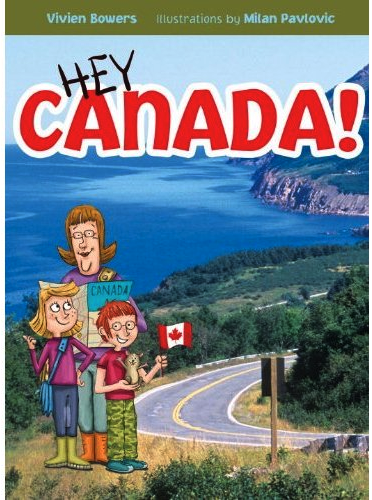
Blog Tour Review | Hey Canada! Vivien Bowers, illus. by Milan Pavlovic

Remember encyclopedias? Hardcover books with glossy, colourful pages. In my nerdiest moments, I had a great time flipping through them and learning random factoids about Elizabethan drama, far away places and whatever other topic catches my attention. Wikipedia is a much more efficient way to research, but there’s a certain charm in an encyclopedia’s glossy presentation of information.

Reading Vivien Bowers’ Hey Canada! reminded me of that experience. The story is simple: Gran takes nine-year-old Alice and eight-year-old Cal on a road trip across Canada. They visit all the provincial capitals, and learn about each one’s history and points of interests. It’s a fun, informative introduction to Canada for 7 – 10 year olds, a wonderful book for parents to read with their children to teach them about this country. As a recent immigrant myself, I would recommend this book to other immigrants, particularly those with children. Written in clear, easily accessible language and filled with photos of Canadian landmarks, Hey Canada! is a great way for a family to learn about the country together.
I enjoyed reading the facts and looking at the photos. I remember being in elementary school, and studying the dialects, cultural traditions and top industries of various regions in the Philippines. I imagine Canadian school children have studied the same about the various provinces. Hey Canada! is a great resource for this. I assume the plant and bird at each province’s chapter heading is the official plant or bird of the province (i.e. the osprey is the official bird of Nova Scotia and the mayflower the official plant), and I like that this was taught via a simple illustration in the chapter heading.

I liked the historical comic strips for a similar reason. Having not grown up studying Canadian history, it was fascinating to see small glimpses of each province’s history. For example in the chapter on Quebec, we see the British attack Quebec City in 1759, and the final panel shows the present-day Plains of Abraham as an idyllic park. I now want to visit the area, and perhaps read a bit more about this history.

The Find It! boxes are also particularly interesting as a teaching tool. It lists highlights in the chapter, and so, especially for parents reading with their children, it helps make the reading experience a bit more interactive. The only thing I didn’t like was that the list items sometimes referred to illustrations or text. Since they referred to highlights of the province, I would have preferred them to have referred to actual photographs. As well, and this admittedly is partly because I’m lazy, but I would have also liked the images to have labels, just so if I’m flipping through the book, I can immediately see what an image is, without having to search the entry.

Cal’s Tweets seemed designed to make the book seem more contemporary. Unfortunately, other than being labelled a tweet and, I’m assuming, consisting of less than 140 characters, it looked and sounded just like a regular Cal factoid rather than a tweet. I think using @ mentions, hash tags, and perhaps even formatting it to look like a tweet (with photos being labelled Twitpic or Instagram, and the Reply, Retweet etc buttons) would have helped these be more tweet-like. That being said, the primary appeal of Hey Canada! is its classic format, and the tweets just stand out as incongruous with everything else.

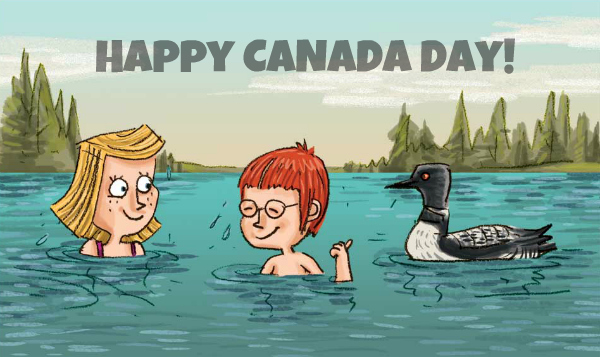
Hey Canada! is also very narrative in style, along with being informational. Gran and the kids joke around a lot, and there’s even a subplot about Cal’s hamster. The humour is very gentle, geared towards younger children and mostly about Gran’s singing and Alice’s snoring. It’s light family entertainment, and again, good for children or families reading together. With Canada Day coming up soon, it’s a great time to take an imaginary trip across the country with your whole family, and Hey Canada! is a fun way to do just that.
***

Thank you to Tundra Books for providing me with a copy of this book.

Review | Are You My Mother? Alison Bechdel

I loved the sneak peek I got of Alison Bechdel’s graphic memoir Are You My Mother? I was intrigued by the complex relationship between Alison and her mother, moreover, I was intrigued by Alison’s mother herself. A voracious reader and amateur stage actor, Alison’s mother had to deal with an unhappy marriage. Alison struggles to reconcile memories of her mother patiently writing down daily journal entries for her with memories of her mother being distant, no longer kissing her goodnight at a young age.

There are some genuinely touching moments in this book. The nights Alison and her mother spent, for example, writing down detailed accounts of the day in a journal. I also love the parts about Alison’s mother acting, moments of joy that stood in sharp contrast to her weary plea to a young Alison to let her have some private “me time.” The mother’s discomfort with Alison’s homosexuality, and with Alison revealing so much about their private lives in Fun Home struggle with the mother’s reticence in speaking about feelings.

Personally, I would have preferred more scenes of their interaction and a lot less intellectual reflection. This is more a matter of personal preference rather than a commentary on the quality of the book — what the author has set out to do, she does very well. It’s just too detached a treatment for me, and I got bored.

In struggling to understand her relationship with her mother, Bechdel examines the work of psychoanalytic analyst D.W. Winnicott, who studied the relationship between the child and its mother. Bechdel reflects on her relationship with her mother in terms of Winnicott’s work, for example, Winnicott’s play therapy is linked to her own memories of playing with her mother. At one point, she confesses to her therapist that she wishes Winnicott were her mother, which I guess is because she feels Winnicott understands children in a way her mother never did.

Bechdel also writes about Virginia Woolf, particularly about To the Lighthouse, and again, relates her reflections on her relationship with her mother to the Woolf novel. I like how, later on, Bechdel realizes that her mother must have read A Room of One’s Own, and how this is somewhat similar to Bechdel herself being influenced by the words of Adrienne Rich. However, as Bechdel ruminates on To the Lighthouse, I found myself tuning out again. Confession: I also couldn’t stand To the Lighthouse. I know it’s a classic work of literature and full of symbolism and so on, but I found it a boring, frustrating read. Like Woolf, Bechdel’s narrative loops, coming back to the same memories and offering a bit of new insight each time. Also like Woolf, Bechdel examines the tiniest details for significance, and then links it to psychoanalytic theory, or relates it to a dream that she recounts to her therapist. So, if you do like that style, perhaps Bechdel’s endless intellectual ruminations in Mother will also be more to your liking.

Are You My Mother? is a well-written book, and Bechdel’s illustrations are as good as ever. I liked the portrait Bechdel creates of her mother, and their scenes together are touching. I could have done with a lot less of the psychoanalysis and reflections on Woolf and Winnicott, but I can see how other readers may find that fascinating. Overall, well done, but not my kind of thing.

+

Thank you to Thomas Allen Ltd. for a finished copy of this book in exchange for an honest review.

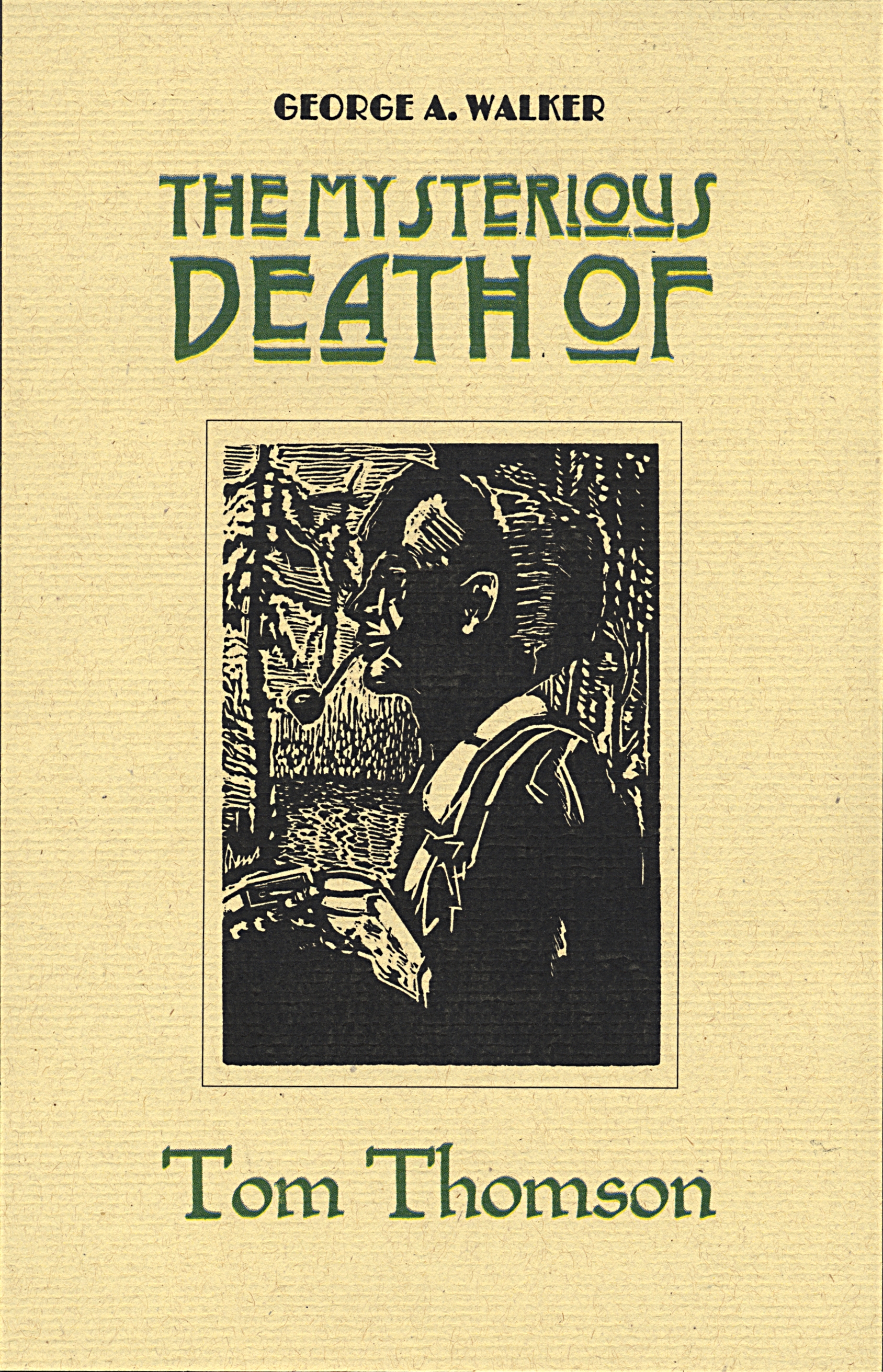
Review | The Mysterious Death of Tom Thomson, George A. Walker

Most Canadians know Tom Thomson as a famous Canadian artist affiliated with the Group of Seven. His disappearance during a canoe trip and the discovery of his body days later have remained a tragic, yet intriguing mystery. Official cause of death was accidental drowning, but clues suggest possible foul play. If you’re interested in knowing more about this story, here’s the Wikipedia entry, and I’d also highly recommend Roy MacGregor’s fascinating Northern Light.

George A. Walker’s The Mysterious Death of Tom Thomson is a beautiful addition to the list of books on Tom Thomson. Curator Tom Smart calls it a “visual elegy,” and I think that describes the book perfectly. Mysterious Death contains a hundred and nine woodblock engravings that cover Thomson’s life from his youth in the city to his death in Algonquin Park. I’m a fan of Porcupine’s Quill books in general — I love their textured pages, and think this is such a fitting format for the starkness of Walker’s medium. Mysterious Death is a wordless narrative, so all we have is a single black and white woodcut print at the centre of each page.

Certainly, it is possible to tell a story using only images, but I wouldn’t recommend reading Mysterious Death as a biographical resource on Tom Thomson. Rather, it is best to know a bit about Thomson’s life in order to understand the story. Because the images are so stylized, with faces either in shadow, or portrayed with few lines, and because there is no text, it can be difficult to recognize Thomson or other characters. Rather than give details about Thomson’s life, Walker gives impressions. This is especially true in the second half, about Thomson’s life at Algonquin. While the first half shows a more structured narrative, of Thomson as a professional artist, selling and exhibiting his work, the second half feels more like scenes plucked at random. Walker intersperses images of Thomson painting or fishing with images of the landscape, and creates an overall idyllic picture. Some of Walker’s images also give pleasant jolts of recognition, calling to mind, for example, Thomson’s famous The Jack Pine or West Wind.

The section on the fateful canoe trip is especially interesting because of the anger Walker conveys in his images. We may not understand the circumstances behind Thomson’s altercation with another man, but we can feel the menace, and the frustration. Walker’s account answers no questions about Thomson’s life; rather, it offers readers a sense of how that life must have felt — from the sense of purpose of getting his work exhibited, to the more relaxed, idyllic days painting in Algonquin Park, and finally, to the altercation that preceded his death.

Images from the book, from the Porcupine’s Quill website

A fact from the Author’s Note that I found especially interesting: The block used for the last image in the book is from branches believed to have fallen from the trees Thomson painted in Byng Inlet. That’s a fitting, rather haunting connection, eh?