
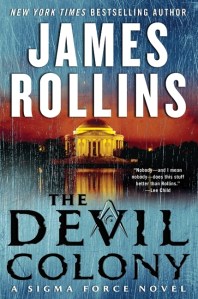
Review: The Devil Colony, James Rollins

Two things you can expect from any James Rollins book: non-stop thrills and really cool science that sounds like science fiction, but is really based on fact. The Devil Colony is no exception, and after two whole years, I’m just happy to spend a few hours again with the Sigma Force team. I love Sigma Force — secret agents with Sheldon Cooper IQs, they’re literally kick-ass nerds. That means that while they’re racing after bad guys action movie style, the problems they try to solve are just as much intellectual challenges as physical ones. It’s Michael Crichton on steroids, and a nerdy adrenaline rush all the way through.

The main plot of Devil Colony is one that, I admit, didn’t really draw me at first: the history of America is based on a lie perpetuated by the Founding Fathers and involving Mormonism. Rollins writes it well, with lots of clues to keep you guessing, and Da Vinci Code-style revelations that call into question commonly accepted beliefs about the history of America. Perhaps it’s just that I’m not American, nor am I that familiar with American history regarding the Founding Fathers. So the revelations didn’t really make gasp the way Dan Brown’s did in Da Vinci Code, where I contrasted it to everything I’d learned in Catholic school. Thankfully, however, Rollins isn’t as wordy as Brown was when discussing all the historical details. Plus, the action is vintage Rollins, and even I was swept along by the mystery and the action.

Call me a nerd, but the part that really interested me in Devil Colony was the bit about nanotechnology. I love how Rollins integrated such contemporary technology, and one I usually associate with futuristic thrillers, with the historical mystery. My main disappointment was that the scientists who were working with Sigma in exploring the impact of this nanotechnology weren’t given more scenes; I would’ve loved to read more about them, and perhaps find out what, if anything, the Founding Fathers thought of nanotechnology.

I also love how Rollins explored more of the Sigma members’ personal lives in Devil Colony. Monk is definitely one of my favourite characters, and I love seeing him in expectant father mode. Gray’s parent issues felt very real, and I love seeing Seichan’s softer, sympathetic side in dealing with him. The book ends with a bit of a surprise twist promising a future plot thread regarding Sigma and the Guild, which is exciting in itself, but honestly, I’m even more excited to see how Gray deals with what has happened in this book and what happens to Monk as a father.

Devil Colony isn’t my favourite Rollins book, but it’s definitely an exciting read. I love it, and I already can’t wait for the next Sigma adventure!
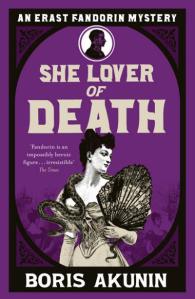
Review: She Lover of Death, Boris Akunin (Andrew Bromfield, trans.)

A huge thank you to my sister Jessica! She introduced me to John Rebus and Guido Brunetti (both detectives and mysteries I adore!), and now she’s introduced me to turn-of-the-century Russian detective Erast Fandorin. Thin and debonair with piercing blue eyes and (quite honestly, the coup de grace) a slight stammer, Fandorin is my latest discovery in the world of gentlemen detectives I love.

She Lover of Death is the eighth book in Boris Akunin’s Erast Fandorin series. There are intriguing hints of Fandorin’s back story (a past romantic tragedy, incredible luck), but since the story is told from the perspective of a young woman who has only met him in this mystery (and in fact only knows him under an alias), I learned just enough to make me want to read the previous mysteries and find out more. Again, since the narrator doesn’t really know Fandorin, I don’t even know if he’s a private detective (he appears to have some problems with the police, so he can’t be a cop), or a Lord Peter Wimsey type character, who solves mysteries as a hobby. All I know of him is that he’s a brilliant detective, a gentleman with a protective streak who gets flustered when he interviews an artist and is faced with a nude female model, and a bit of an adventurer (near the end of the novel, he mentions going off to break a record). A charming man similar to Brunetti and Lynley, but with an air of mystery that makes him even more intriguing.

The mystery in She Lover is fascinating. In Moscow, 1900, a young woman joins the Lovers of Death, a suicide club composed of bohemians. The head of the club is a charismatic man with a romanticized view of Death. Members read poetry at club meetings, and whoever is chosen for suicide has to compose a final poem first. The mystery appeared straightforward at first — we know all about the club fairly early on — and it seemed a well-written, creepy mystery, with the main problem being how to stop the suicide club. However, Akunin introduces plot twists that hint at an actual murderer, and figuring out the identity and motives of this killer is an exciting, convoluted puzzle, and a classic detective story.

I love this book, and am looking forward to checking out the others in the series. Fandorin is a likable character, and I love learning about him from a complete stranger’s perspective. I’m used to reading detective stories from the perspective of the detective or a sidekick figure, so Akunin’s style in this book is an interesting change. The ending is one of those so-obvious-can’t-believe-I-was-fooled type revelations that I love in mysteries. The language is a bit formal, which adds to the atmosphere of the turn of the century Russia setting. The romanticization of Death and naivete of the narrator could so easily have been overdone, but Akunin handles it well. I’m so glad my sister introduced me to this series, and I’m excited to read more about Fandorin.

Review: The Disciple of Las Vegas (Ava Lee Book 2), Ian Hamilton

The Disciple of Las Vegas, book 2 in Ian Hamilton’s Ava Lee series, is even better than the first. The mystery is tighter, with more emphasis on the actual mystery than on the exotic locales and cuisines. As a mystery lover and a woman, I also appreciated the additional focus on the mystery and the lessened attention on Ava’s beauty and effect on various men. There’s still the hot guy who is disappointed by Ava’s homosexuality, which if I remember correctly, also happened in the first book, and characters still comment on Ava’s looks, but there seems to be less emphasis on how people underestimate Ava because of her looks. This leaves more time to develop the mystery, which I actually found more exciting and easier to follow than the first book.

Chinese-Filipino billionaire Tommy Ordonez hires Uncle and Ava to track down $65 million stolen from his company in Canada, which his younger brother Philip manages. Ava’s investigation leads her to discover that the stolen money is linked to a gambling scam involving poker legend David “the Disciple” Douglas and his partner Jeremy Ashton. Hamilton again manages to make a financial crime as exciting as murder, and I loved reading the scenes where Ava uses bak mei to subdue bad guys.

As a Filipino, I am thrilled to have the Philippines featured in a Canadian book, especially a mystery, since the only Western fiction books I’ve seen that featured the Philippines and Filipinos are literary fiction, usually written by authors with Filipino roots themselves. (I’d love to be proven wrong, by the way. If you know of any well-written fiction books written by a Westerner, with a Filipino character or the Philippines as a setting, where the character/setting is as mainstream as a Chinese/Japanese character/setting, please let me know.) So I loved having aspects of the Philippines shown in Hamilton’s book, like the express line at the airport and balikbayan boxes (minor correction, Mr. Hamilton: balikbayans are Filipinos returning home; the boxes are called balikbayan boxes). I would’ve loved a scene with mouthwatering Filipino cuisine as well, but that’s just me.

One thing I would have liked changed, and this, again, is as a Filipino: When Ava asks Uncle about the long lines of Filipinas at the airport lugging balikbayan boxes, Uncle says they are all domestic workers flying home. Ava then remembers her own Filipina nanny and speculates that these domestic workers sending foreign currency home probably make up a large portion of the country’s GNP. Somewhat accurate — there are certainly lots of Filipinos working abroad and sending money home, and a lot are nannies and domestic workers.

However, there are also lots of Filipinos working abroad in all sorts of professions: nurses, doctors, English teachers, and businesspeople. Perhaps I’m sensitive because of an incident a few years ago where a dictionary in Europe defined a Filipino as a domestic worker. Perhaps I’ve just noticed how in books (not just this one), if a character is labelled Filipino, he/she is usually household help or part of the maintenance staff. Perhaps it’s just time writers go beyond the stereotype and show Filipinos in other lines of work, eh?

Overall, The Disciple of Las Vegas is a fast-paced, exciting financial mystery. There are some bloody scenes, so if that’s not your thing, be warned. I also thought the Jackie Leung subplot was unnecessary, given how action-packed the main mystery was already. Still, overall, a good book, better than the first.