
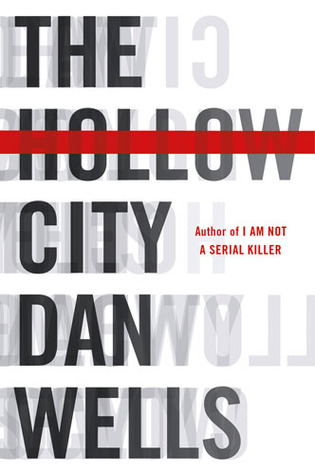
Review | The Hollow City, Dan Wells

Michael Shipman is crazy. A diagnosed paranoid schizophrenic, Michael sees Faceless Men and gets splitting migraines whenever a cellphone rings. So when we see the world through Michael’s eyes in Dan Wells’ The Hollow City, we know not to take it at face value.

It takes great talent for an author to get into the mind of someone who’s had a psychotic break from reality. Wells takes this to a whole different level by having readers mistrust his narrator from the beginning, yet slowly begin to question this mistrust. Some authors are able to make psychologically disturbed characters sympathetic and their views understandable, usually through eloquence (Lolita, A Clockwork Orange) or through comparison with a villainous “sane” world (One Flew Over the Cuckoo’s Nest). Wells however  offers actual clues and details that make us wonder if Michael is, in reality, seeing Faceless Men, and if there is some rational, physiological reason for his adverse reaction to electronic devices.

Hollow City begins as a tragic depiction of an unbalanced mind. Michael’s hallucinations are as real to him as reality is to us, and the intensity of his fear at things we view as ordinary (cellphones, TVs, hot water faucets) inspires sympathy. His condition, particularly his obsession with Faceless Men, makes him a prime suspect in the investigation of serial murderer The Red Line Killer, whose trademark is slicing his victims’ faces off. Worse, Michael has lost two weeks’ worth of memory and is himself unsure if he is the Red Line Killer. I can’t even begin to imagine how difficult it must be not to be able to trust yourself, and when Michael begins to doubt the reality of people around him, some of whom he loves and depends on, he becomes even more isolated.

Then the story takes a completely different turn when Michael’s hallucinations start making more sense. We’re never quite sure if Michael’s perceptions are turning out to be real or if we too have been sucked into his mind. But this does open up a science fiction/horror story angle to the plot. It’s a thrilling ride to the end, and I was as desperate as Michael to find out what, exactly, is going on. Wells never gets as complex as China Mieville or as seductive as Vladimir Nabokov, which he could have done given his premise, and this is perhaps the reason Hollow City didn’t blow me away. The murder mystery that drove the plot started out compelling, but wasn’t really developed, and the big reveal regarding the murderer was fairly obvious and anti-climactic. That being said, I was definitely taken by surprise by the other big reveal, the reason behind Michael’s hallucinations. I love that Wells took a big, unexpected leap with that, and while the ending seemed a bit rushed, given the build up, it made sense. After all the uncertainty, and all the wondering about where Wells could possibly be taking this story, the ending satisfies. A good, solid, fast-paced read.
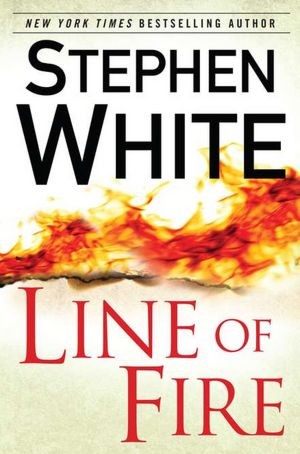
Review | Line of Fire, Stephen White

About a year ago, Stephen White announced that he would be ending the Alan Gregory series. He told fans that Line of Fire would be the penultimate book in the series, and that the series would end with book 20. He explains his decision on his website, under the book description for Line of Fire. My first thought? That sucks. I’ve been a long-time fan of the series, mysteries featuring clinical psychologist Alan Gregory. I enjoy reading psychological mysteries in general, and this series, more Jonathan Kellerman than Val McDermid, had a nice guy protagonist who made you feel comfortable even as you were reading about disturbed individuals. I also like White’s cast of characters — like Alan’s DA wife Lauren who has MS, and detective Sam Purdy — all with their quirks yet all so well-rounded and fleshed out over the past eighteen books. So it kinda sucks that the series was coming to an end.

That being said, if the series does have to end, what a way to end it! Line of Fire is such a fitting book to begin the end — White ratchets up the tension, brings together a lot of series characters, and fearlessly takes his beloved characters to dark, unpredictable places. If this book is any indication, the Alan Gregory series will end with a flourish. Well done, Mr. White.

Line of Fire begins with an idyllic scene — Alan Gregory at a Sunday night family dinner — yet, even there, White gives us an undercurrent of tension with a conversation about Boulder’s Red Flag Warning, which basically cautions residents about the possibility of a major fire. Alan’s life then proceeds to become even more complicated. His close friend Diane fears her marriage is falling apart and seems on the verge of emotional collapse. He has a couple of new patients who seem linked in some way to his life beyond work. Finally, a secret he and Sam have kept is in danger of being exposed, which could mean the end of their respective careers and both their families being taken away from them.

The stakes are high, and the twists keep coming. At times I thought Alan Gregory’s investigating was just making things worse — I wanted to tell him to listen to Sam and leave it alone — but that often happens in books like this to keep the protagonist involved and the story going. Alan had to deal with a whole lot of knotty problems, and I like how a lot of seemingly disparate plot points came together.

The ending, I admit, shocked me, as did the actions of a series character. White has never been one to hold back on how he treats his major characters (I still remember how I felt about what he did to Adrienne), but what he did here was just balls to the wall, nothing left to lose, let’s end this. I thought the twist was a bit contrived — too convenient, too orchestrated — but it still did have its desired effect. I have no desire to see the Alan Gregory series end, but after this book, I definitely want to see what White has planned for book 20.

+

Thank you to the author’s website manager for an ARC of this book in exchange for an honest review.

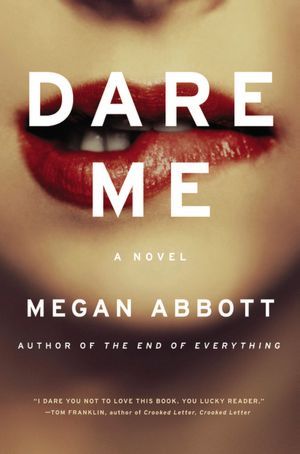
Review | Dare Me, Megan Abbott

Megan Abbott’s Dare Me was much more chilling than I’d expected. Remember high school? Friendship is important no matter how old you are, but somehow, in high school, the status of friend took on an almost do or die quality. Friendship was a status symbol, as was the ever elusive BFF tag. This is not to diminish high school friendships — many of the deepest, most lasting friendships I have were forged in high school. Still, the thrill of having a popular classmate, the Queen Bee of whatever social group, notice you, even validate you, seems to have been strongest in high school.

Dare Me is a cheerleading novel, depicting a world Bring It On and Sweet Valley never revealed. Cheerleading in Dare Me is like ballet in Center Stage: tough, competitive, borderline physically abusive. Yet unlike Center Stage or any similar sports movie, Dare Me uses cheerleading as the backdrop for an exploration of female teenage friendship and its entrenched social hierarchy. We have passages about cheerleading, poetic descriptions of bodies knifing through the air in death defying stunts, yet these descriptions never feel romantic like, say, Chris Cleave’s depiction of cycling in Gold felt romantic. There’s anger and defiance in Abbott’s descriptions of cheerleading stunts — in the parlance of her characters, a big fuck you, bitches, watch me fly.

The story is narrated by Addy, lifelong lieutenant of cheerleading captain Beth, until Coach French takes over the cheerleading squad, and wins Addy over. In some ways, Coach French is the kind of inspirational leader/mentor young people long for — she believes in the squad’s competitive potential, and has the ability to make the members exceed their limitations. She also takes her role too far, demanding both athletic excellence and eating disorder level diets from her squad.

What makes Coach French truly creepy however, is that she is a Mean Girl that never grew up. She clashes immediately with Beth, mostly because there can be only one Queen Bee, and the whole idea of a woman in her late twenties waging war against a high schooler for clique supremacy shows just how lonely and messed up Coach French is. She tells Addy that Beth’s scheming is amateur, yet ironically, her own tactics are very high school. For example, to cut Beth down to size, she fires her as cheerleading captain (even removes the role completely) and assigns Flyer (the star in squad routines) to a girl Beth always picks on. This could have been an empowering move by an adult, but Coach French’s glee in seeing Beth’s frustration keeps her just as immature as her adversary.

Beth is hardly a character that evokes sympathy — she’s bitchy and manipulative, and she tears down other girls just to win the battle against Coach French. Yet, buried deep inside is a touching vulnerability, most clearly seen in her friendship with Addy. At several points in the story, she calls Addy stone cold, tough, a fox. “It was always you,” she says. Addy may have been Beth’s second-in-command, but we see how much the power dynamic is really reversed from Beth’s point of view. Even though Addy doesn’t realize it, Beth really craves her approval, her validation, above all, her friendship. So when Addy, like the rest of the squad, becomes enthralled with Coach French, Beth’s battle against the coach becomes personal — much more than supremacy over a cheerleading squad, it’s a battle to be Addy’s BFF. Dare Me dares to explore just how far some girls will go to win such a battle, and kudos to Abbott for not holding back.

Dare Me is ultimately Addy’s story, however. At the centre of Coach French and Beth’s power struggle, Addy is embroiled in a lot of seriously messed up events, and when everything seems to be about power dynamics, she is unsure who she can trust. Addy is in a state of flux, both uninterested in going above her lieutenant role and secretly yearning to be the Flyer on the squad, the Queen Bee as it were. Well, why not me? she asks. Why not, indeed?

Dare Me didn’t blow me away. It started off slow for me, possibly because Abbott’s language sometimes slipped into Virgin Suicides-style philosophizing and navel gazing, e.g. an early rumination on how long it takes to wash off the glitter after a game. The whole cheerleading-as-metaphor angle also seemed overdone at times — at one point, a former squad member comments that being a spectator rather than a participant for the first time made her realize that the cheerleaders looked like they were killing themselves, literally. The comment was just overly dramatic, and the message far too hammered home.

However, Dare Me definitely exceeded my expectations. A dark and twisted take on friendship and cheerleading as blood sport, Dare Me thrills and disturbs.

+

Thank you to Hachette Book Group Canada for a finished copy of this book in exchange for an honest review.