
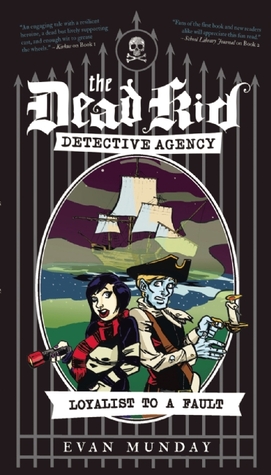
Review | Loyalist to a Fault (Dead Kid Detective Agency 3), Evan Munday

DeadKidLoyalistI’m a huge fan of Evan Munday’s Dead Kid Detective Agency series, so I was thrilled to hear that book 3 was coming out this Fall. Loyalist to a Fault has all the trademarks that make Munday’s writing such a treat — 1980s/90s pop culture references, middle school hijinks (school dance!) and a historical mystery. Throw in a ghost pirate who breaks into the town’s museum, and my little museum nerdy heart was all a-twitter.

The unifying thread behind the Dead Kid series is a mix of Scooby Doo meets Nancy Drew goes goth — October Schwartz befriends some tween ghosts in her neighbourhood cemetery, discovers that they’ve all died under mysterious circumstances, and vows to solve each of their murders in turn. The ghost whose death is investigated here is 18th century British settler Cyril Cooper, whose story involves spies, pirates and some mysterious historical documents involving his family.

Munday ratchets up the antics in this instalment, which wasn’t a huge draw for me, but which I admit may appeal to the kids this book was actually written for. Among the ghosts’ superpowers is the ability to detach and reattach body parts, and all the tossing about of heads and limbs was just a bit much for me.

I did enjoy the middle grade romances in this book’s subplot, in particular a couple of romantic possibilities for October herself and a potential match between a couple of the dead kids. The scene at the school dance was hilarious and fun, and shows just how perfect a battleground a school gym can be. I did wish the subplot involving October’s living friends was explored a bit more (the resolution felt a bit of a letdown), but I’m glad there are several more books in the series for this to play out.

I’m a total museum geek, and I especially geek out over historical archives, so I was glad that Munday made the Sticksville Museum such a huge part of this story. As a fan of British cozy mysteries in small towns, I have to admit being disappointed that the Sticksville historical celebration wasn’t quite given as much focus as I’d hoped, but to be fair, I can imagine that most other readers would have chosen to focus on ghostly pirate battles as well.

The mystery behind Cyril’s death is solved, somewhat, but a whole lot of other questions remain. We end the book knowing who the murderer is, but unless I missed it completely, still completely in the dark on the motive behind the killing. Instead, Munday teases us with some big revelations about the overarching mystery of the series, hinting at a major series-end reveal that would explain everything. More significantly, he also hints at a link to October, which ties her in even more with the ghost kids and possibly explains the mysterious phone calls she’s been receiving.

Munday is as witty and full of pop culture references as ever, but none of the lines quite struck me as much as the witticisms in his earlier books. I’d also be curious to know how his middle grade readers respond to the humour — I geek out over it because I understand the references to 80s cartoons and 90s TV shows, but I’d love to know how it connects with kids born after 2000.

Overall, this is a solid instalment in the series, one that seems stronger as an instalment in a larger story than as a stand alone title. I’m intrigued by all the various plot threads Munday has in the air, and am curious to see how they all tie together in the end. And if you’re looking for a fun book to read this Halloween, you just can’t go wrong with a ghost pirate mystery.
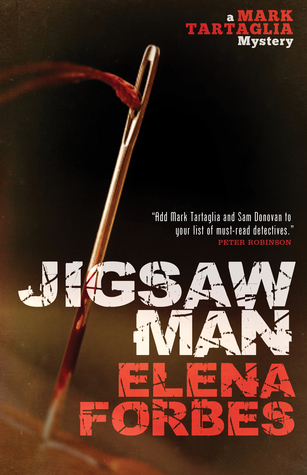
Review | Jigsaw Man (A Mark Tartaglia Mystery), Elena Forbes

JigsawThe fourth in the DI Mark Tartaglia series, this book features a double mystery: a burned corpse turns out to be an assembly of parts from four different bodies and a young woman killed at a hotel turns out to be the sister of Tartaglia’s former partner Sam Donovan. I’d read and enjoyed the first book in this series a few years ago, where I commented that Tartaglia and Donovan clearly have some chemistry — from this book, I can see it had developed into something more and then ended badly, so there’s an interesting bit of tension from their shared history.

I was definitely intrigued by the plot of Jigsaw Man — in particular the stitched up bodies because how creepy and gruesome is that? There was also the interesting coincidence of Tartaglia having been in the hotel on the night of the murder, and I could just imagine a detective like Hercule Poirot having his ego completely bruised at not having noticed anything amiss. For Tartaglia, because he knew the victim, his response was more guilt than a bruised ego, and made the crime personal.

Unlike the first book Die with Me, Tartaglia’s personal life is brought front and centre in this novel, with the investigation taking somewhat of a back seat. As a result, I felt like there was so much of a backstory that I missed, and while Forbes does a good job of cluing new readers in, I wondered if the case would have meant more to me if I’d known the victim as well, or at least remembered more of Donovan’s character. As it was, it read as a fairly standard police procedural.

I mentioned in my review of Die with Me that nothing in particular about Tartaglia stood out to me, and I think that was a part of why I couldn’t really get into this book. When the story is so contingent on a mystery’s effect on the main character’s personal life, you have to care about the main character, and in this case, I just didn’t find Tartaglia compelling enough.

Again, as with Die with Me, I found Donovan to be a more interesting character. She is no longer a police officer in this novel, yet her background naturally makes her want to be involved in tracking down her sister’s murderer.  I found it annoying at first, mostly because I was no longer familiar with her background within the series and I thought she was just interfering in other people’s jobs. Later on, she then hides key information from Tartaglia because she wanted to take her own revenge, and while it’s an understandable impulse, it’s also a trope that annoys me in detective or superhero fiction, mostly because that kind of storyline always progresses predictably.

The mystery of the stitched up body parts didn’t make much of an impact on me — it mostly felt tacked on and while we follow the police procedural to solve that case, it felt more a background subplot to the actual mystery involving Sam’s sister.

Overall, I wonder if having read the other books in the series, or even having read the first book more recently, would have made me enjoy this book more. As it was, the book was okay. I found myself mostly bored by it, until Donovan’s perspective kinda takes over near the end. I may give the Tartaglia series another shot, but also wonder if Forbes may have plans of doing a Donovan stand-alone. That one, I’d definitely read.

+

Thank you to House of Anansi for an advance reading copy in exchange for an honest review.

Review | Hungry Ghosts, Peggy Blair

HungryGhostsI’m a fan of Peggy Blair’s Inspector Ramirez series, as well as a fan of art mysteries, so when I learned that the third instalment in the series involved an art world crime (the marketing campaign included an art exhibition inspired by passages from the book), well, colour me intrigued!

Hungry Ghosts was more about a series of murders of prostitutes than about the art world crime, but it still definitely did not disappoint. Having established her world building in the first two titles, Blair now seemed freed up to focus on the intricacies of her mysteries. The characters fit in more naturally with each other than before, and the dual mysteries investigated by Ramirez and Canadian First Nations detective Charlie Pike seemed more seamlessly integrated than before.

That being said, the strength of Blair’s mysteries has rarely been about the actual case so much as it was about the political commentary these cases brought forth, both about Cuba and Canada. I particularly love how Charlie Pike was invited on a case, literally as a token First Nations representative — his experience as a detective was less valuable to his colleagues in this case than his background. This to me highlights the tense relations that still exist between the Canadian government and First Nation tribes, and while Ramirez and his Cuban mysteries are presumably the focal point of this series, Blair’s interest in and passion for First Nations issues in Canada comes through loud and clear, particularly in this story. Part of me wonders if she’ll ever do a spinoff story just on Charlie Pike, a full novel to explore the intricacies of Canadian First Nations politics.

I also love how Ramirez’s gift for speaking to the dead has become almost second nature in this story — it is still mentioned as a plot device, but much like it must be for Ramirez, it becomes here simply another tool in his arsenal rather than a defining characteristic. I love how his concerns over it tie in to his family history — bits like this flesh him out even more as a character, and make him more real.

Finally, I absolutely love the character of Hector Apiro. He is a wisecracking pathologist with dwarfism who, when asked what he’d want people to say at his funeral, quipped, “I’d like someone to lean over my casket and shout, ‘Oh my God, he’s alive!'” The mystery in this book is personal for Apiro, because of his relationship with a prostitute named Maria. Their love and affection for each other shines through, and they have some wonderful scenes of tenderness that belie the usual tough shell Apiro presents at his autopsies.

The mysteries themselves were resolved fairly neatly, and while part of me wished the art mystery was given a bit more prominence, I was mostly just glad to spend time once again with Blair’s characters.

+

Thank you to Simon and Schuster Canada for a copy of this book in exchange for an honest review.