
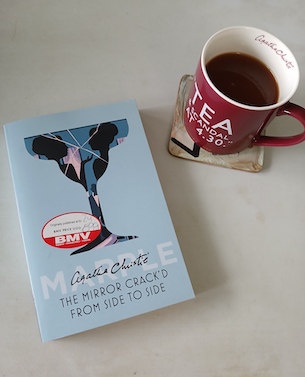
I Try to Solve an Agatha Christie Mystery | The Mirror Crack’d from Side to Side (Miss Marple)

Trying to solve The Mirror Crack’d from Side to Side is a bit of a bittersweet experience. It’s the final Miss Marple novel I haven’t yet read or tried to solve. After a staunch almost life-long preference for Poirot, I’ve grown to prefer Miss Marple in recent years. I mean, really, how awesome is it for a little old lady with white hair and pink cheeks to be the most brilliant crime-solving mind around? And while Agatha Christie mysteries are always a pleasure to re-read, I admit I’ll miss matching wits with dear old Aunt Jane, and trying to solve the mystery before she does.

Still, as the very pragmatic Jane Marple herself would say, the end will have to come at some time, and all one can do is face it when it does. (Except of course, she would say it much more eloquently. Because my goodness, Agatha Christie, the writer you are!)

Mirror features one of my favourite elements in a murder mystery: the glamour of a movie being made! A famous film star, Marina Gregg, moves to St Mary Mead (Gossington Hall, to be exact, where Mrs. Bantry from The Body in the Library used to live!). She and her husband, Jason Rudd, throw a fete for the neighbourhood, and invite a select group of 30 or 40 local luminaries into their home for drinks.

Among the guests is Heather Badcock, a kindly, if rather thoughtless and self-centred, woman, who is totally starstruck by Marina. At the party, she excitedly tells Marina about how kind the actress was when they first met years ago. Marina is super polite and gracious until something over Heather’s shoulder catches her attention, and she gets a terrible look on her face that reminds Mrs. Bantry of The Lady of Shalott (where the book’s title comes from).

Later in the party, Heather dies from a poisoned daiquiri. Except it turns out that, due to a spilled drink, it was actually Marina’s daiquiri she drank. We also learn that Marina has received threatening letters, and that there are many people in her life with reasons to hold grudges. Whodunnit? Why? And can Miss Marple solve the case before the killer strikes again?

I have a really strong gut feel about the answer to this mystery, and I’m going to go ahead and lock it in.

Did I Solve It?

I did! I actually did!

Also, my goodness, those last couple of chapters were filled with other twists I DID NOT see coming. So, brava, Dame Agatha Christie! The title Queen of Crime is very much well-earned.

That’s it for me and Miss Marple on this blog then. Fortunately, I believe I still have quite a few Poirot mysteries as well as non-series mysteries that I can try to solve!

***SPOILERS BELOW***

Continue reading

I Try to Solve an Agatha Christie Mystery | Nemesis (Miss Marple)

Mr. Rafiel from A Caribbean Mystery is back, this time with a posthumous mission for Miss Marple: “investigate a certain crime” and after a year, she will be entitled to GBP 20,000 from his estate. “Our code word, my dear lady, is Nemesis,” he writes in his letter. It’s a reference to something she tells him in A Caribbean Mystery and Miss Marple understands it to mean that he’d like her to correct a miscarriage of justice.

Nemesis is only the second-to-the-last Miss Marple novel, but to me, it feels more like her grand finale than Sleeping Murder does. Partly because Miss Marple feels older here. Nemesis has a larger cast of characters than Sleeping Murder, and also involves a physically strenuous walking tour, so there are more people here commenting on Miss Marple’s age and frailty. She plays along with it, as she does to help gather clues, but I also can’t help feeling that she is a bit more physically frail here than usual.

But more importantly, the mystery in Nemesis also feels more grandiose and more of a magnum opus, so to speak, than the one in Sleeping Murder. There are more references to other aspects of Miss Marple’s life: Mr. Rafiel, of course, but also references to her nephew Raymond and her old friend Sir Henry Clithering. And the mystery itself is also such a Mystery. Not just whodunnit and why, but also, what evern was done in the first place?

The journey to get to these answers is wonderfully twisty and complex. And the more I read, the more I realized that the reveal is likely to be really sad, with the kind of insights into human relationships that Agatha Christie is so good at.

First, the cast of suspects is huge. Mr. Rafiel sends Miss Marple on a tour that has fifteen other people on it. Presumably, at least one of those people is involved in the crime Mr. Rafiel wants Miss Marple to solve. Also possibly, could this turn into a Murder on the Orient Express situation, and all of them turn out to be involved?

Just as I was turning over that possibility in my mind (and getting cross-eyed staring at the list of suspects), Christie throws in another twist: Mr. Rafiel has also asked some old friends (a trio of sisters) along the tour route to invite Miss Marple to their home. The official reason is that he wants to give Miss Marple a break from one of the more strenuous days on the tour, but of course, we all know that it’s likely one or more of these sisters is actually involved in the crime.

Gradually, we learn that Mr. Rafiel’s son, Michael, was in prison for murdering a young woman. There were other young women who’d also gone missing and were presumed dead around the same time period, so even though Michael was convicted of one murder, it’s possible he was also responsible for others.

Important context is that Michael was known as a bad guy; he’d also previously been accused of raping another woman. I’ll flag here that characters in this novel express some outdated attitudes around sexual assault and false accusations from victims, which is very much a product of Christie’s time and thankfully no longer widely acceptable. But the basic thrust is that, however spotty Michael’s sexual history is, is he actually guilty of murder? And if he didn’t kill the young woman, who did and why?

And then, while Miss Marple is with the sisters, a member of the tour group is struck by a boulder and sent to hospital in critical condition. Who’s responsible, and is it in any way connected to the young woman’s murder?

Yes! Or at least I mostly did. I thought a second character was involved in the crimes, who turned out to be innocent. But I guessed the killer for the most important crime, and I also picked up on pretty much all the important clues! So I’m going to clock this as practically a win, and laugh at the fact that I actually tried to complicate matters more than Christie herself intended.

Continue reading

I Try to Solve an Agatha Christie Mystery | A Pocket Full of Rye (Miss Marple)

20231203_154648

Okay, first of all, I’m 86% into this novel, and absolutely LOVING it! One of my favourite scenes in an Agatha Christie, bar none, is Miss Marple’s entrance about 40% through. First, she swans onto the Fortescue estate in a taxi:

So charming, so innocent, such a fluffy and pink and white old lady was Miss Marple that she gained admittance to what was now practically a fortress in a state of siege far more easily that could have been believed possible. Though an army of reporters and photographers were being kept at bay by the police, Miss Marple was allowed to drive in without question, so impossible would it have been to believe that she was anyone but an elderly relative of the family. [41%]

And then she reveals that she’s there not to investigate the suspicious deaths of the wealthy Mr and Mrs Fortescue, but rather that of their nervous, “rabbity” maid, Gladys, whom it turns out Miss Marple herself trained for the service.

“It was the clothes-peg that really worried me,” said Miss Marple in her gentle voice.

“The clothes-peg?”

“Yes. I read about it in the papers. I suppose it is true? That when she was found there was a clothes-peg clipped onto her nose?”

Pat nodded. The colour rose to Miss Marple’s pink cheeks

“That’s what made me so very angry, if you can understand, my dear. It was such a cruel, contemptuous gesture. It gave me a kind of picture of the murderer. To do a thing like that! It’s very wicked, you know, to affront human dignity. Particularly if you’ve already killed.” [42%]

I just LOVE this image of an elderly woman managing to get past police barricades because of her fluffy pink and whiteness. And then, to have all that fluff pull back to reveal an avenging angel set to get justice for a dearly cared for servant girl. How wonderful it is that the main victims for this killer are presumably the super wealthy husband and wife, and yet it is the naive and innocent maid whose death will bring about their downfall! These passages are Christie’s masterful pen at work, and I loved every second of it.

Now for the case:

The wealthy Rex Fortescue dies at work after drinking a cup of tea. Yet the poison, taxine, is slow-acting, indicating he must have ingested it while still at home. Oddly, his pocket is full of cereal, rye to be exact.

At first, Inspector Neele suspects Rex’s much younger second wife, Adele, who is beautiful and glamorous, and also having an affair. Yet she’s the next to turn up dead, of cyanide poisoning in her tea. Then finally, Gladys’ body is found; she may have witnessed something about Rex’s murder.

Tying all three together is the nursery rhyme “Sing a Song of Sixpence,” which includes a pocket full of rye, a queen dead after eating bread and honey, and a maid whose nose is pecked off by a bird. The nursery rhyme also features blackbirds, which may provide a clue to the killer’s motive.

As for suspects, there’s a whole household full of them. There are Rex’s three children with his first wife: eldest son Percival, main heir to his father’s business; black sheep son Lancelot, who was summoned back home after Rex and Percival had a falling out, and daughter Elaine, who was in love with a man her father disapproved of. There are also the respective romantic partners: Percival’s quiet and lonely wife Jennifer; Lancelot’s independently wealthy wife Pat; and Gerald, Elaine’s communist ex-lover who left when Rex threatened to disinherit her, and returned after Rex was killed. And of course, the servants: cool and efficient head maid Mary Dove, whom Inspector Neele describes as almost performing her name; grouchy butler Mr Crump, and his grouchy wife, whose talent as a chef keeps them both employed. There’s also Vivian Dubois, the man Adele was having an affair with, and possibly the women working at Rex’s office.

Upon much reflection, I’ve narrowed down my suspect list to two key players. Per usual, I’ll type it out below, and check back in to see how I did!

Did I Solve It?

Kinda? I figured out the mastermind behind the murders, and I figured out their motive. But I got the method wrong, and my guess on an accomplice was totally off-base. There were a couple of clues that I skimmed past that turned out to be significant (or rather, I figured they may be important, but couldn’t figure out how, so I forgot about them); and at least one major clue I thought was significant but turned out to be nothing.

So, technically, this is a win, because I did figure out whodunnit and why. But I missed so many of the details that I feel only semi-victorious.

And, honestly, I’m happy about it. Because the big reveal I did not guess made me gasp out loud, and question everything I thought I knew about this case. And that, to me, is the hallmark of the most satisfying Christie mysteries.

Plus, of course, Miss Marple as a fluffy and pink and white avenging angel = sheer perfection!

*** SPOILERS BELOW ***

Continue reading