
I Try to Solve a Dorothy L Sayers Mystery | The Nine Tailors

Hoping Sherlock Holmes tea will help me solve this case!

Ahh… I tried solving this for my blog, but gave up halfway through.

The Nine Tailors is beautifully written. The “tailors” in the title refers not to suit-makers, but rather to the nine bells in a small village church. The story begins with Lord Peter and his trusty valet Bunter getting stranded at a small village on New Year’s Eve, and taken in by the local priest. The church has planned an overnight performance of its bells to ring in the New Year, one of the bellringers has called in sick, and Lord Peter gets a chance to join in the bellringing himself. As the hours pass, he also gets to know more about the people in the village, and all the little bits of local gossip.

Fast forward a few months, and Lord Peter receives a call from the parish: a body has just been discovered in another person’s grave. Could he come over and help them figure out who it is, and how it got there? Lord Peter of course agrees immediately, and I was equally intrigued.

I also have a soft spot for my copy: I found it in a thrift shop, and there’s a lovely handwritten line pencilled in cursive, “from my mother, 2010”, plus an embossed snowflake name, “Natalie Neill.” So I like thinking about Natalie Neill, and her mother, and how they may have shared a love for old British mysteries and maybe even Dorothy Sayers in particular.

But as a mystery for me to solve, it was a bit too dense for me to really sink my teeth into. Who was the dead body in the churchyard? How did they die? Why were they tied up, and why were their hands taken? Parallel to this, and somewhat linked, is the mystery around a jewelry theft at a wealthy woman’s home years ago. How were the jewels actually stolen? Were the right persons charged with the crime? Where did the jewels go? Added to the mix is a whole cast of characters who may or may not be involved, a stranger who visited during New Years and also may or may not be involved, and a potentially coded message whose key may lie amongst the parish bells.

Lord Peter Wimsey does his best to solve the case, in his methodical way, but it seems each new answer only gives rise to more questions. There are also too many characters for me to keep straight, and as much as I tried to stay interested in the whole history behind the jewel theft, I just ended up making my head hurt. Probably around the halfway point, I decided to stop trying to figure things out, and just enjoy the ride.

My enjoyment of the story did increase after that, because then I could just enjoy how wonderfully Sayers crafts the atmosphere for her story. I loved imagining myself in this small village, and hearing the beautiful church bells for myself. Sayers describes the bells’ songs beautifully; I honestly had no idea how much music and harmony were involved in bellringing.

It turns out that letting go of the need to solve the mystery did in fact actually lead me to solving a key component of the case. I managed to guess the cause of death, and I honestly think I was only able to do so because I’d stopped worrying so much about tracking all the little details involved.

The rest of the big reveals were a surprise to me. I thought the story of how the victim ended up dead made sense, and I thought Sayers did such a great job at humanizing the people involved, so that the reveal evoked more of an emotional response beyond just an “aha!” moment. I actually felt for those involved in the death, and for how things turned out in the end.

Overall, a beautifully told story, and like I said, the mother-daughter connection gave me a soft spot for my copy. As a mystery, it wasn’t among my successes, nor, quite frankly, was it all that much fun to try. Possibly others will have more luck / enjoy the attempt more, but for me, I recommend simply sitting back with this, and letting yourself enjoy seeing the story unfold.

I Try to Solve a Dorothy L Sayers Mystery | Gaudy Night (Lord Peter Wimsey and Harriet Vane)

gaudynight

Case number two for 2024 is by Dame Agatha’s contemporary. A blog commenter convinced me to give Lord Peter Wimsey another shot (I found Whose Body? well-written, but underwhelming), and they recommended the Harriet Vane starrer Gaudy Night.

The Story: A Book Review

I’m maybe two-thirds of the way through this book, and I’m absolutely adoring it! As someone who studied at an all girls Catholic school all the way from kindergarten to high school, and as an adult (ahem) woman close to a milestone (ahem ahem) high school reunion, Sayers’ descriptions of Shrewsury College at Oxford and their Gaudy Night reunion weekend gave me lots and lots of nostalgic feels. (I went to a co-ed university, so the associations aren’t quite the same.) My high school reunion, called a velada, is also colloquially known as Old Girls Day. I can’t find the specific line anymore (downside of print!), but there’s a reference to Gaudy Night being for the old gals or some similar phrasing, and it warmed my heart to see it.

I also very much enjoyed seeing Harriet experiencing the old campus after a decade or so away. I too haven’t been back to my alma mater’s campus in years, but I can imagine walking through it very much as Harriet does. I can imagine noticing both the familiar and the differences in sights, scents, and sensations. And while I still keep in touch regularly with my closest high school friends (thank you, pandemic Zooms!), I feel Harriet’s sensations of dismay and/or admiration as she meets old classmates for the first time in years, and realizes how little or much they’ve changed.

There are moments when Harriet does come off rather judgey, but well, that’s what naturally happens at these kinds of reunions, isn’t it? I’m sure, and Harriet is also aware, that her old classmates are judging her in turn, whether for her success as a mystery writer, or for her previously being suspected of murder. In a wonderfully mundane but real throwaway line, an old friend calls Harriet “successful,” and Harriet reflects that she knows the friend really meant “hardened.”

Beyond the nostalgia factor, Gaudy Night is also a wonderful exploration of women’s lives in the 1930s, when this was published. Sayers is fantastic at creating characters who breathe. In this novel, women from a diverse range of social classes, backgrounds, and lifestyles give voice to the societal tensions between pursuing academic accolades versus domestic bliss. All of this gets mixed in with Harriet’s own dilemma between wanting to remain independent and intellectual, and falling in love (despite herself) with aristocrat Lord Peter Wimsey. There are many fascinating conversations throughout this story, and I can imagine present-day university students geeking out in lively discussion about this novel and the societal contexts within which it was written. It’s fantastic!

The Mystery: What Actually Happens?

The incidents begin at Gaudy Night, when Harriet receives a couple of poison pen letters, of the O.G. cut-out letters from newspapers type. Even when she returns to London, she continues to receive mean notes. Yet she isn’t the sole target; students and faculty at Shrewsbury College also receive these notes, and all-in-all, the story spans an entire school year or more.

Some notes are petty (one accuses a student of stealing another’s boyfriend); some are mean (the ones to Harriet remind her of her previous murder charge). And one particularly vicious set of notes tells a student she is mentally ill and needs to die by suicide.

Beyond the notes are acts of mischief attributed to a ‘poltergeist,’ and like the notes, they form a spectrum of intensity. Some are mostly nuisance: the school library is turned topsy-turvy, a pile of scholars’ gowns is set on fire, and a book is burned. One is threatening: a dummy wearing a scholar’s gown is hung from the ceiling with a knife through its belly. And one seems particularly cruel: the manuscript that kind-hearted and naive scholar Miss Lydgate has been working on forever is defaced and destroyed, so that she has to start all over again. In an utterly chaotic and confusing chapter, the poltergeist targets several campus buildings in one evening; they cut the power, commit random acts of vandalism, and run off to the next building while Harriet, the Dean, and random assortments of residents give merry chase.

The Mystery: My Spoiler-Free Thoughts

As a case to solve, this mystery is rather baffling. The incidents (too benign to be actual crimes; too malicious to be merely pranks) strike me as without rhyme nor reason, and the targets too spread out to make the motive clear. Unlike Christie who provides us with a fairly manageable list of potential whodunnits, Sayers is unfortunately accurate in showing how challenging it is to narrow down a list of an entire campus-full of suspects. And each potential suspect has tons of opinions on the topic of women in academia. There are so many potentially important details that, for the first time, I used two pens to keep my notes straight; blue ink for suspects, and black ink for important events and clues.

In fact, the sheer volume of incidents even makes me consider if there could be a whole team of perpetrators. Could one person seriously commit all these acts by themselves? Yet there doesn’t seem to be a unifying motive strong enough to make several of them team up. On the other hand, amongst the twenty or thirty potential suspects I’ve met, which of them actually has a strong enough motive to do all these things? When Lord Peter Wimsey arrives to help solve the case, he tells Harriet, “There’s a method in it.” Harriet replies, “Isn’t the motive only too painfully obvious?” [p 358] I’m glad they think so, because alas for my poor ego, I don’t.

At this point, there is only one person whom I think makes sense as the perpetrator, and really, one particular scene that finally gave me a foothold to confidently name a suspect. Yet Peter and Harriet seem to be focusing on a different character, someone whom I suspected at first, yet eventually discarded in favour of my current prime suspect. I’m not gonna lie; their suspicions are shaking my confidence. Whereas I’m used to Christie throwing around red herrings galore, my (very limited) experience with Sayers is that she’s much more straightforward.

Most worrisome for my verdict is a scene where Peter is doing his sly best to pick up clues, and Harriet is noticing how productive his tactics seem to be. Alas for my ego, my suspect isn’t doing nor saying anything at all noteworthy! What on Earth are Peter and Harriet picking up on, that I’m missing?

Part of me wonders if my challenge stems from applying too modern a perspective on this case. Sayers steeps her mystery so much within the social milieu of her characters that I feel like the key lies in something that women of that era find incredibly important, but perhaps may not be as obvious to women in 2024. Or perhaps I’m just trying to make excuses.

Regardless, the suspect Peter and Harriet seem to be focusing on truly does not make sense to me. So I’m going to go with my gut, hope that Sayers is doing a last-minute red herring, and lock in my verdict.

Did I Solve It?

Yes I did! Boo-yah for going with my gut, and boo-yah for not letting Dorothy L Sayers lead me astray with her tricksy little red herrings along the way!

*** SPOILERS BELOW ***

Continue reading

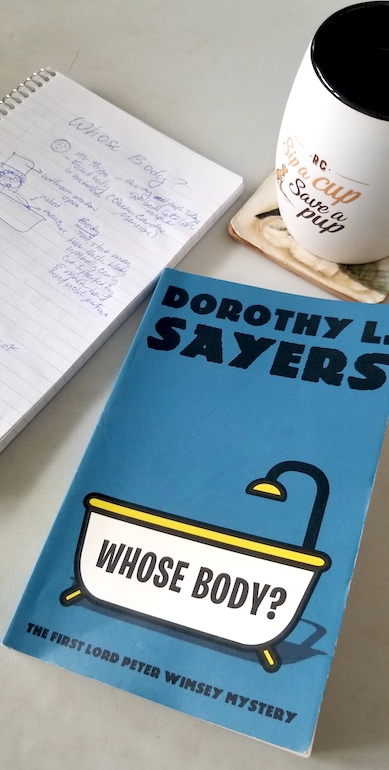
I Try to Solve a Dorothy L. Sayers Mystery | Whose Body? (Lord Peter Wimsey)

WhoseBody

Fresh off my recent victories with Dame Agatha’s work (woohoo!), I decided to give her contemporaries a try. First up: Dorothy L. Sayers, a founder and early president of the Detection Club, to which Christie also belonged, and which set up the whole “fair play” rules for detective fiction in the first place.

Sayers’ best-known mysteries are the Lord Peter Wimsey series. I tried reading the first book Whose Body? over a decade ago, and found it too boring to finish, but I decided to give it a go again this year, and see if perhaps pitting my wits against her sleuth made the story more compelling.

And… it did. It still took me over three months to finish the book — an especially long time considering it’s only 197 pages long. I’m afraid that as great a writer as Sayers is — and there are some sections in the book that are just *chef’s kiss* stylistically — I’m never going to devour her mysteries like I do Christie’s. And I’m not sure why either. Her writing is a bit like Agatha Christie meets PG Wodehouse, and those are two of my favourite authors, but for some reason, I struggled with Sayers’ writing.

Regardless, Whose Body? has an incredible hook for a mystery: a man discovers a dead body in his bathtub. The body of the dead man is naked, except for a pair of pince nez (a kind of eyeglasses) on his face. He bears a remarkable resemblance to Reuben Levy, a wealthy Jewish financier who went missing the night before, yet there are enough differences that the body clearly is not the financier’s. Detectives check the local hospital, and there are no bodies missing from their morgue. Whose body is it, and where is Reuben Levy?

Did I Solve It? (No Spoilers)

Well, yes, but I don’t think it’s as big a cause for celebration as solving an Agatha Christie mystery is. Unlike Hercule Poirot or Miss Marple, Lord Peter Wimsey is pretty open about his thought processes, so the killer’s identity was easy to figure out.

The couple of red herrings that came up were revealed as such fairly quickly, often with Wimsey pointing out how they didn’t fit the physical evidence. Now, with an Agatha Christie book, that wouldn’t necessarily mean the characters are definitely innocent, so I continued to keep them on my suspect list.

But then emerged a suspect who knew Levy, had a motive for getting him out of the way, and had a connection to the man in the tub. At first I thought it couldn’t be this person; they were too obvious a suspect, especially given that the relevant information was revealed only about halfway through the book. But then I flipped back to earlier chapters to see earlier scenes with them, and what I found only confirmed they had the opportunity to carry out the crimes.

And sure enough, it wasn’t long before Lord Peter confirmed my suspicions. I suppose I can feel proud that technically, Lord Peter took an extra chapter or two after I figured it out to reach the same conclusion. But again, I don’t think Sayers was being particularly sneaky about her reveal to the reader, so I think I figured it out precisely when the author intended me to.

My Verdict on Dorothy L. Sayers and Lord Peter Wimsey

She’s an incredibly skilled writer. There’s a wonderful passage late in the book:

When lovers embrace, there seems no sound in the world but their own breathing. So the two men breathed face to face. (page 174)

It’s so masterfully written; you can practically feel the charge in the air as Lord Peter Wimsey makes eye contact with the murderer.

Through Lord Peter’s dialogue, Sayers also shares some gems about detective fiction:

“That’s just what happened, as a matter of fact,” said Lord Peter. “You see Lady Swaffham, if ever you want to commit a murder, the thing you’ve got to do is to prevent people from associatin’ their ideas. Most people don’t associate anythin’ — their ideas just roll about like so may dry peas on a tray, makin’ a lot of noise and goin’ nowhere, but once you begin lettin’ ’em string their peas into a necklace, it’s goin’ to be strong enough to hang you, what?”

“Dear me! said Mrs. Tommy Frayle, with a little scream, “what a blessing it is none of my friends have any ideas at all!”

“Y’see,” said Lord Peter, balancing a piece of duck on his fork and frowning, “it’s only in Sherlock Holmes and stories like that, that people think things out logically. Or’nar’ly, if somebody tells you somethin’ out of the way, you just say, ‘By Jove!’ or ‘how sad!’ an’ leave it at that, an’ half the time you forget about it, ‘unless somethin’ turns up afterwards to drive it home.” (page 117)

It’s a brilliant piece of writing. Light, funny, and with nice comic touches like the part about Lord Peter frowning at the duck on his fork (I love how she phrased that!). It’s also sharp and incisive commentary about some of the conventions of detective fiction and how unnatural it is to have the important clues and evidence laid out so neatly for the reader.

As someone trying to solve this mystery with Lord Peter, it’s also a sly invitation to look more closely at information I may have easily overlooked earlier on, because they may be important. And indeed, when I re-read sections from earlier in the book to confirm details about my suspect, I had to applaud Sayers for how masterfully she sprinkled relevant details into the narrative. There’s good reason I didn’t suspect this person until Sayers meant to reveal them as suspicious, and kudos to the author for that. She also later mentions a highly telling clue that I missed altogether, so that was a nice new bit for me to realize after the fact.

Ultimately, despite my admiration for her writing skill, I don’t think I’ll continue with Dorothy L. Sayers’ Lord Peter Wimsey novels. Her style just isn’t a page turner for me, and the mystery element isn’t enough of a puzzle that I’ll want to keep trying to solve them. Still, I’m glad I read this. Her approach is so different from Agatha Christie’s that this gives me a better idea of what golden age detective fiction was like, and this book in particular gave me a better appreciation for how a mystery like The Honjin Murders is structured.

***SPOILERS BELOW***

Continue reading