

Review | The Far Side of the Sky, Daniel Kalla

Kristallnacht. Crystal Night. Such a beautiful name for such a horrific event. Daniel Kalla’s The Far Side of the Sky begins right in the middle of this Nazi attack on Jews in Austria, and the pace never lets up. Surgeon Franz Adler is a secular Austrian Jew who just wants to stay under the radar. Unfortunately, as the “incriminating large red J” stamped on his passport proves, his very ancestry already puts him in the Nazi crosshairs, no matter what he does or doesn’t do.

So Franz takes his family (daughter Hannah and sister-in-law Esther) to Shanghai, a major refugee base for European Jews because visas aren’t required to enter. Thing is, Shanghai at that time was occupied by Japan, so it really wasn’t so much of an escape as it was a movement to a different atmosphere of fear. In Shanghai, Franz meets a Chinese-American nurse, Soon Yi “Sunny” Mah, who works with him at the Jewish refugee hospital and who is prevented from becoming a doctor only by her gender. Far Side is about people who want only to live a simple life, and yet are prevented from doing so by circumstances and their heritage. It’s tragic, yet made somewhat more bearable by their relationships with people around them.

A lot of books have been written about World War II and the years before and after it, yet most of the ones I’ve seen are about either the West or the East. Far Side stands out to me because it shows how Europe and Asia connected during this period, and how the situation in Asia was just as horrific as the one in Europe.

I love that Franz isn’t really a hero — all he wants to do is to live as normal a life as possible — and yet circumstances force him to do heroic things. I also love that both Franz and Sunny have complex backgrounds — Sunny, for example, is Chinese-American, so she faces discrimination both from the Japanese soldiers who look down on the Chinese and the Chinese who look down on those who aren’t full-blooded Chinese. In Franz’s case, his being a non-practicing Jew makes his troubles with the Nazis even more tragic; he is ostracized for a belief system to which he doesn’t even subscribe and for a race he has himself rejected.

The supporting characters are just as fascinating. The American Simon Lehrer, for example, is delightful, almost relentlessly cheerful and a welcome respite from the darkness of the material. Ernst Muhler, who wages war through his art, is a charismatic, engaging figure. Ernst is the most defiant, political figure in Franz’s community, and his fear at the realization of what he might have to sacrifice on a personal level makes him an absolutely sympathetic character. Like the victims whose unjust deaths he depicts in his art, I cheer Ernst on in his crusade; yet like Franz and other friends in Ernst’s life, I also want him to stop, and perhaps find some measure of happiness and peace.

In war, it’s far too easy to see different factions as either all good or all evil. So I love how Kalla portrays Hermann Schwartzmann and Colonel Kubota. A senior attache with the German High Commission, Hermann has no ill will towards Jews and even tries to befriend Franz. He chooses to compartmentalize, to not speak out against the Nazis so that he and his wife can have a stable life. I can understand why Franz finds Hermann’s silent complicity cowardly, even reprehensible, yet I can’t help but feel sorry for Hermann. Like Franz, Hermann also just wants to live as normal a life as possible; only difference is, Hermann is better placed to benefit from compliance. With Hermann, Kalla presents the other side of the story, the moral difficulties faced by non-Jew Germans and Austrians.

Colonel Kubota, head of the Japanese contingent in Shanghai, acts with honour and compassion. Kubota’s admiration of Ernst’s work and Ernst’s refusal to have Kubota own his art provides a kind of tension that I love. Kubota and Ernst are figures from opposite sides of two different wars, and their desire to connect or repel through art is just beautifully portrayed.

One thing I really did not like happened near the end, where Sunny does something that has a dramatic impact on a historical figure’s actions. In a novel that focuses on the struggle to live an ordinary life, that explores mundane human relationships to evince emotion, Sunny’s dramatic act rings false. It made me question, “Since this is based on history, and this character doesn’t exist in real life, then what really happened?” That part disconnected me from the story, which is a shame because of the major emotional impact already created by all the smaller scale heroic actions in the story.

Also, we are told several times that Franz’s daughter, Hannah, is handicapped. This is significant because Franz worries about how she’ll survive if he is killed or arrested. However, I see no symptoms from descriptions of Hannah herself and her actions, and so have to keep turning back to be reminded of the cerebral palsy that has other characters so worried. A small detail that shows Hannah’s “spastic weakness of left arm and leg” would have helped me picture her and better understand why Franz is especially concerned about how she would adjust in a foreign country.

Overall, Far Side is a wonderful, emotional book. Highly recommended for fans of historical fiction, romance, and David Mitchell’s Thousand Autumns of Jacob de Zoet.
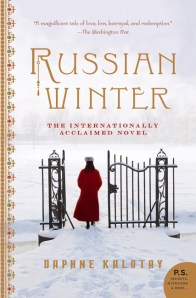
Review: Russian Winter, Daphne Kalotay

Daphne Kalotay’s Russian Winter is a beautifully written book. The pacing is a bit slow, but that somehow fits with the book’s reflective, nostalgic nature. And once in a while, Kalotay injects a cheeky line or two into an otherwise serious scene. Take for example a character whose ex-fiance’s new woman had “all her ducks in a row.” The character’s mother “let slip” that the ex-fiance was moving to Seattle with “the woman with the ducks.” It’s a toss away phrase, but one that turns a cliche into an opportunity to giggle. Later, a solemn TV interview scene includes a nurse who sneaks into camera view, waves, and scurries back off screen. It’s farcical, and definitely welcome, keeping the book from taking its heavy subject matter too seriously.

Nina Revskaya is an elderly former dancer from the Bolshoi ballet. Now living in Boston, she has decided to auction off her jewelry. This dredges up memories she would rather forget, of her life in Stalinist Russia. The auction also reveals a mystery in the present — why is Nina so reluctant to meet Grigori Solodin, a Russian professor with an amber necklace so apparently part of a set Nina owns?

The Russian scenes are beautiful and captivating. I loved reading about Nina’s rise to principal dancer. Kalotay describes ballet with a storyteller’s eye. We are drawn into Nina’s dancing because Kalotay goes into such detail that we can almost imagine we’re watching the ballet and feeling the magic of live theatre. Take for example:

Nina revels in the leaps and kicks and high jumps her body loves. […] She greets her Spanish girlfriends in mime and flirts with some of the young men, all the while aware that Stalin is watching–yet even as she makes her sequence of leaps around the square, slapping the ground firmly with her fan, Nina feels fully in control. When she dances her first variation, clicking her castanets defiantly, her sissonnes are fully split, so that as she arches her back in midair, her head points back parallel to her leg and her arm behind her almost touches her outstretched back foot.

We can practically see Nina happily flirting with men onstage. Her joy is marred by the presence of Stalin in the audience, the man responsible for her friend Gersh’s fall from grace and eventual arrest. Yet, with that final pose, Kalotay presents us with such a beautiful image of triumph. It may not mean anything in practical terms, but, reading that passage, we can believe that Nina has defeated Stalin, that she is free from his regime’s control. And we realize, isn’t that the power of art? Doesn’t art provide us with a sense of freedom, of transcendence? It’s idealistic, and as Nina’s story reveals, only temporary. But in passages like that one, we not only believe in this power; Kalotay makes us feel it.

I was drawn into Nina’s story: her romance with the poet Victor Elsin, the complexities of her friendship with Vera, and, in the present day, her overwhelming desire to both confront her past and forget it. I loved reading about her friends in Russia. Set against the backdrop of the Stalin regime, yet full as well of personal drama, their stories drew me in.

Less compelling are the scenes in the present. Kalotay does a good job fleshing out the other two main characters, the Russian professor Grigori and Drew, the woman organizing the auction of Nina’s jewelry. The mystery of why Nina refuses to acknowledge Grigori’s necklace as part of her collection is intriguing, and certainly what kept me interested enough in the present day scenes. Grigori and Drew are likable enough characters; they just pale in comparison to Victor, Vera, and even Nina’s nurse Cynthia. I was more interested in Grigori, mostly because his necklace shows some kind of link between him or his family and Nina. Drew’s story mostly just bored me.

That being said, it was a present day character, Zoltan, an immigrant in America, who said one of my favourite lines in the entire novel:

This country has been good to me. But it doesn’t hold the indentation of my body on the mattress, if you see what I mean.

What a beautiful, striking image! An immigrant myself, I do see what he means. I don’t necessarily feel that way all the time, but when I read that passage, my immediate thought was: that’s it exactly.

Russian Winter is very much Nina’s story, and she’s a fascinating woman with an even more exciting past. Zoltan’s sense of not being truly home is an echo of Nina’s own situation — a woman who has broken free from Stalin’s government, yet in doing so, has also given up the life of dance that had come so naturally to her. Elderly, with arthritic knuckles, Nina is as much a stranger in her own body as Zoltan feels in his current home. We feel Nina’s pain, as she remembers the wonder of being able to dance even as she struggles now to walk. We fret with her when she realizes mistakes she’s made and feels it’s too late to fix them. And we hold on as tight as she does to the memory of that young dancer, triumphant in her pose mid-flight.


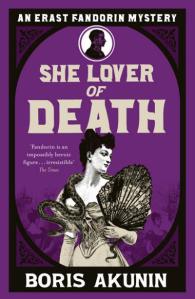
Review: She Lover of Death, Boris Akunin (Andrew Bromfield, trans.)

A huge thank you to my sister Jessica! She introduced me to John Rebus and Guido Brunetti (both detectives and mysteries I adore!), and now she’s introduced me to turn-of-the-century Russian detective Erast Fandorin. Thin and debonair with piercing blue eyes and (quite honestly, the coup de grace) a slight stammer, Fandorin is my latest discovery in the world of gentlemen detectives I love.

She Lover of Death is the eighth book in Boris Akunin’s Erast Fandorin series. There are intriguing hints of Fandorin’s back story (a past romantic tragedy, incredible luck), but since the story is told from the perspective of a young woman who has only met him in this mystery (and in fact only knows him under an alias), I learned just enough to make me want to read the previous mysteries and find out more. Again, since the narrator doesn’t really know Fandorin, I don’t even know if he’s a private detective (he appears to have some problems with the police, so he can’t be a cop), or a Lord Peter Wimsey type character, who solves mysteries as a hobby. All I know of him is that he’s a brilliant detective, a gentleman with a protective streak who gets flustered when he interviews an artist and is faced with a nude female model, and a bit of an adventurer (near the end of the novel, he mentions going off to break a record). A charming man similar to Brunetti and Lynley, but with an air of mystery that makes him even more intriguing.

The mystery in She Lover is fascinating. In Moscow, 1900, a young woman joins the Lovers of Death, a suicide club composed of bohemians. The head of the club is a charismatic man with a romanticized view of Death. Members read poetry at club meetings, and whoever is chosen for suicide has to compose a final poem first. The mystery appeared straightforward at first — we know all about the club fairly early on — and it seemed a well-written, creepy mystery, with the main problem being how to stop the suicide club. However, Akunin introduces plot twists that hint at an actual murderer, and figuring out the identity and motives of this killer is an exciting, convoluted puzzle, and a classic detective story.

I love this book, and am looking forward to checking out the others in the series. Fandorin is a likable character, and I love learning about him from a complete stranger’s perspective. I’m used to reading detective stories from the perspective of the detective or a sidekick figure, so Akunin’s style in this book is an interesting change. The ending is one of those so-obvious-can’t-believe-I-was-fooled type revelations that I love in mysteries. The language is a bit formal, which adds to the atmosphere of the turn of the century Russia setting. The romanticization of Death and naivete of the narrator could so easily have been overdone, but Akunin handles it well. I’m so glad my sister introduced me to this series, and I’m excited to read more about Fandorin.